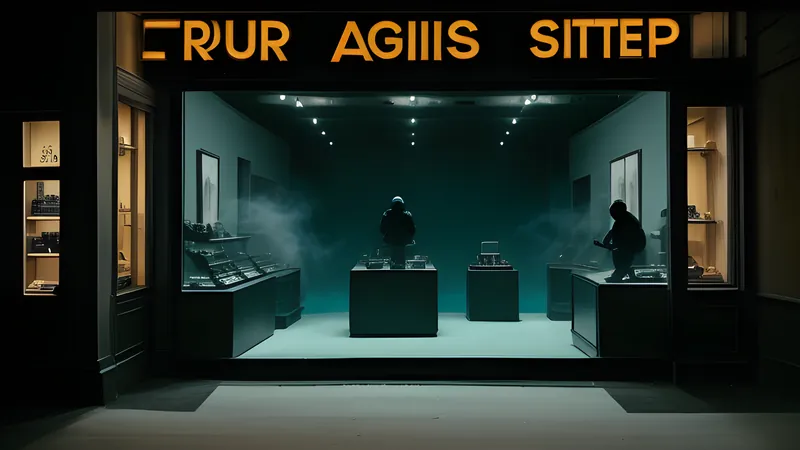
Kansas City Confidential: The Masked-Heist Template
Phil Karlson's 1952 programme picture invented the anonymous crew, then fell out of copyright and into every bargain bin in the world
Contents
Kansas City Confidential has had the strangest afterlife of any American crime film. It was made in 1952 as a piece of second-feature product — Edward Small producing, United Artists distributing, a budget you can see on the screen, a title borrowed from the fashionable “Confidential” cycle of the day. Nobody involved thought they were making anything permanent.
Then two things happened to it. Its copyright was never renewed, so it dropped into the public domain, which meant that for four decades it was reproduced by anyone with a duplicating machine and sold in ten-film bargain sets with muddy contrast and a soundtrack like a phone call from a swimming pool. And somewhere in that fog of terrible prints, a generation of film-mad video-shop kids found it and noticed that it contains, fully formed, an idea that the crime film has been living off ever since.
The idea is the mask.
A florist’s van and four masks
The plan belongs to Tim Foster, played by Preston Foster: an ex-policeman, retired without ceremony, who has spent a long time watching an armoured car collect from a bank and noticing that the flower van parked nearby every morning is never given a second glance. He builds a robbery around the observation, and the crew he assembles is where the film becomes interesting.
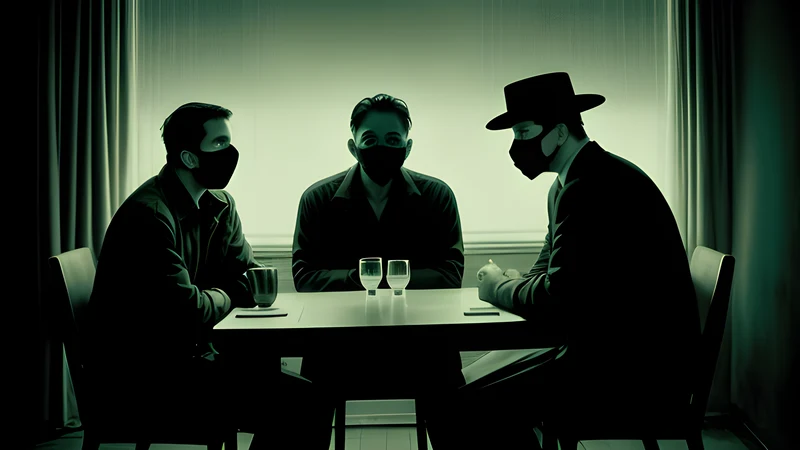
Foster recruits three men — Pete Harris, played by Jack Elam; Boyd Kane, played by Neville Brand; and Tony Romano, played by Lee Van Cleef — and he does it individually, in the dark, wearing a mask, and he insists that they wear masks too — through the recruitment, through the planning, through the job itself, for the entire duration of their association. No member of the crew ever sees the face of any other member, or of the man who hired them. Each is given a torn playing card; the halves will match when it is time to be paid. That is the whole of their bond.
The robbery goes off. The frame goes on. Joe Rolfe, played by John Payne, is the driver of the actual flower van — an ex-convict on parole doing honest work — and he is arrested, worked over by the police in a sequence with a good deal more brutality in it than 1952 usually permitted, and released without apology when the story falls apart. Rolfe has lost his job, his reputation and several teeth’s worth of goodwill towards the law, and he goes looking for the men who did this to him. The trail leads to a resort town in Mexico, where the crew have been told to wait for their split.
Why it works: the mask is a structure
The masks are not a costume choice. They are the film’s architecture, and once you see what Karlson is doing with them, the whole picture reorganises itself.
Consider what anonymity does to a heist story. It removes trust, which is the substance every other crime film in the genre runs on — the crew who came up together, the one who cannot be relied on, the code. It removes the audience’s ability to predict alliances. It means that when the men finally assemble in Mexico, out of their masks and pretending to be tourists, none of them knows which of the sunburnt strangers by the pool is the man who was standing next to him during the robbery. And it means that Rolfe — a complete outsider with a grudge and a face nobody has seen — can walk into the group and be plausibly mistaken for one of them.
That last consequence is the engine of the entire second half. Karlson has engineered a situation in which everyone in the room has a claim to be there and nobody can be verified, and he plays it for a sustained, sweaty paranoia that the film’s poverty-row budget actively assists: a few rooms, a bar, a jetty, and four men watching each other’s hands. The picture cost very little and its best sequences are simply people sitting still, because the tension has been built into the premise rather than the staging.
Karlson’s other structural bet is dramatic irony. We are shown Foster’s plan in the opening reel. We know who the mastermind is; Rolfe spends the film not knowing. Most modern thrillers would withhold this and buy a twist with it. Karlson spends it immediately and buys something better — an audience that watches every scene between Rolfe and Foster with its stomach clenched, because we can see the trap and he cannot.
The look serves the same economy. The film is shot hard: high-contrast, low-key, faces sliced by shadow, the flat pitiless light of interrogation rooms. When men wear masks in this lighting they read as absences rather than as disguises, which is exactly what Karlson wants — a robbery committed by four holes in the frame.
The faces
There is a casting fact about Kansas City Confidential that gives it a peculiar charge for anyone watching it now. The three hired men are played by Jack Elam, Neville Brand and Lee Van Cleef, and in 1952 all three were journeyman heavies with faces the industry had decided were only good for one thing. Within twenty years they would be among the most recognisable character actors in American cinema, mostly through Westerns; Van Cleef would become an icon of the Italian variety.
So the film’s central gag — three men whose faces are hidden — is playing to a modern audience as an inside joke about three of the great faces. Karlson keeps them masked through the most important scenes and then, in Mexico, uncovers them one at a time, and the reveal now lands as a kind of curtain call in reverse. Elam in particular does an enormous amount with almost nothing: a man sweating out a card-table’s worth of nerves in a place with no exits.
John Payne is the film’s other quiet surprise. He had been a musical leading man at Fox — pleasant, well-groomed, entirely unthreatening — and Karlson cast him twice against that history. Payne plays Rolfe as a man whose decency has been beaten out of him quite recently and who has not yet worked out what to be instead. He is stiff in places. He is also, in the interrogation scene, genuinely alarming, because the film has taken a nice man and shown you what the process does to him. Karlson would use him again the following year in 99 River Street, which is the better film and would not exist without this one.
The case against
The Mexican third act loses tension every time it reaches for romance. Helen, played by Coleen Gray, is a law student on holiday who exists to soften Rolfe and to supply the plot with a lever, and every scene she is given is a scene the paranoia is not happening in. The film is 99 minutes and it feels its length in exactly those stretches.
The police brutality that motivates the whole picture is also raised and dropped. Karlson stages Rolfe’s beating with real anger — the film is furious about what happens to a man with a record when the machinery needs a suspect — and then the plot requires him to spend the rest of the runtime doing the police’s job for them, and the fury quietly evaporates. Karlson would go back and get this right in The Phenix City Story three years later.
And the prints. It is genuinely hard to assess a film’s photography when the only version you have seen was struck from a dupe of a dupe. Restorations exist and they are a revelation; if your memory of this film is a grey smear, that memory is of a bootleg rather than of Karlson’s picture.
The ancestors, and the descendant
The heist film’s moral template was set two years earlier by The Asphalt Jungle, which established the shape everything since has used: the plan, the specialists, the flawless job, the human weakness that unpicks it. Karlson has that shape and does something contrary with it — he removes the specialists’ relationships, which was the whole of Huston’s subject. Robert Siodmak’s Criss Cross got to the armoured car in 1949 and used it for doomed romance. Karlson uses it for logistics.
The descendant is the reason anyone still talks about this. Quentin Tarantino has been open for thirty years about what he took from Kansas City Confidential, and the debt is not subtle: a crew of criminals who are deliberately prevented from knowing each other’s identities, assembled by an older man with a police background, meeting in a room to divide a robbery they cannot discuss. Swap the masks for colour-coded aliases and you have Reservoir Dogs. What Tarantino added was to keep the anonymity going after the plan collapses; what he took wholesale was the insight that the most frightening thing in a crime film is a colleague you cannot identify. The Killing sits between them chronologically and took the other lesson — that the interesting part is the timetable.
The verdict
Kansas City Confidential is a cheap film with an expensive idea, and the idea has outlived every star it was made to serve. Phil Karlson looked at the heist picture in 1952, removed trust from it, and discovered that what was left was better: four men in a room, each of whom might be the one who set the others up, and none of whom can check. The romance sags, the anger about policing gets abandoned, and for forty years the only available prints made it look like a film shot through a dirty window. None of that has touched the premise. Find a restoration, watch it before your next viewing of Reservoir Dogs, and notice how much of 1992 was already sitting there in 1952, wearing a mask and holding half a playing card.
Spoilers below
Foster’s real plan is the film’s cold centre, and it is worse than robbery.
He never intends to pay anyone. The masks, the torn cards, the compartmentalised recruitment — all of it exists so that when the crew assemble in Mexico to collect, none of them can identify the man who owes them, and he can arrange for them to be removed one at a time while standing in the same room. Anonymity is not security for the crew. It is a delivery mechanism for their murders. Karlson’s premise, which reads as a professional’s precaution, turns out to have been a trap from the first frame.
Then there is Helen, and the coincidence that the film hangs everything on: she is Foster’s daughter. Rolfe, tracking the men who framed him, falls in with the daughter of the man who did it, and she has no idea what her father is. This is a considerable strain on credibility and Karlson pushes it through by sheer pace, and it does pay for the ending.
Because the ending is about Foster’s confession, and it is stranger than a 1952 second feature had any obligation to be. Foster’s plan had a final move: after the crew were dealt with, he intended to recover the money, return it, and collect the reward — the ex-policeman, publicly disgraced, buying his way back into respectability with the proceeds of his own crime. The robbery was a rehabilitation scheme. What breaks him is his daughter’s presence and Rolfe’s refusal to die on cue, and in the last reel he takes the fall deliberately, clearing Rolfe and shielding Helen from ever knowing.
It is a redemption, and Karlson does not sentimentalise it. Foster gets what he arranged for everyone else. The three masked men are dead, killed by a man they never saw. Rolfe walks out with his name back and the girl, having been beaten by the police, framed by a policeman, and saved by the same policeman’s guilt — which is about as accurate a summary of 1952 noir’s opinion of the law as the decade produced.
Related Content