Just Before Dawn: The Backwoods Slasher With a View
Jeff Lieberman shot the prettiest film in the cycle and made the beauty do the frightening
Contents
The backwoods horror film has a colour scheme, and everybody knows it. Brown. Sweat, dust, filthy interiors, meat, teeth, a sun that punishes. The Texas Chain Saw Massacre set the palette and two decades of imitators kept it, because grime reads as authenticity and authenticity is most of what the subgenre sells.
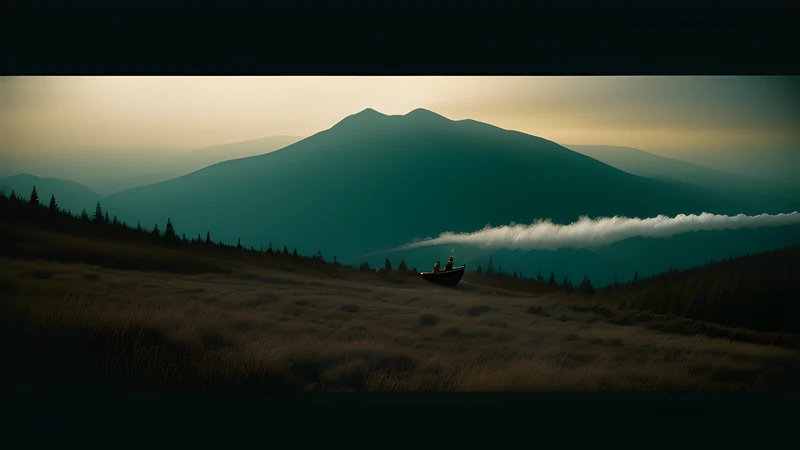
Just Before Dawn (1981) is green. Enormously, gorgeously green — shot in the Oregon Cascades by a director who wanted the audience to understand exactly why five young people would drive up there in the first place. It is the most beautiful film in the entire slasher cycle, and the beauty is the mechanism.
The film
Jeff Lieberman directs, and Lieberman is one of the genuinely interesting minor figures of American horror: Squirm (1976), Blue Sunshine (1978), this, and then a career that never received the run it earned. His pictures share a quality that is hard to name and easy to feel — they are all faintly wrong in ways that have nothing to do with the plot.
Five young people go into the mountains. Warren (Gregg Henry) has inherited land up there and wants to see it. Constance (Deborah Benson) is his girlfriend. Chris Lemmon and the others are along for a weekend. George Kennedy plays Roy McLean, the forest ranger who tells them not to go and is ignored, because in this kind of film the ranger is always ignored.
There is something in the woods. There is a family up there. The film takes an unusually long time to be specific about either.
Why it works: horror in the daylight
The central craft decision is the refusal of darkness, and it is worth being precise about how radical that is.
A slasher hides its killer. The dark is the form’s basic resource — the audience cannot see, the victims cannot see, and the tension is manufactured by the frame withholding information. Take the dark away and you take away the tool.
Lieberman takes it away deliberately. The overwhelming majority of Just Before Dawn’s horror happens in clear daylight, in wide shots, in open country where you can see for miles. He has traded concealment for something better: scale.
You cannot hide a killer in this landscape. You do not need to. The landscape is so vast that a man standing in plain sight three hundred yards away is invisible anyway, because the eye has nowhere to start looking. The film’s most unnerving shots are compositions where nothing is hidden at all — a valley, a ridge, a treeline — and the audience simply cannot process the amount of visual information fast enough to know whether anything is in it. The dread comes from surplus rather than absence.
That is a genuinely sophisticated idea and Lieberman sustains it. It also produces the film’s other great effect: helplessness has a physical cause here. These characters are not trapped in a house. They are in the open, which is worse, because there is no direction that means safety and no door to lock. The wide shot that shows you the beauty is the same wide shot that shows you there is no way out of it.
Brad Fiedel’s score does the complementary work. Three years before he wrote the metal-on-metal pulse of The Terminator, Fiedel is here doing something almost delicate — sparse, woody, occasionally close to folk music, sitting in the film like something the mountains might be producing themselves. The score never warns. It never stings. It hums along with the scenery, which means the scenery keeps feeling like scenery right up until it stops.
Lieberman’s particular wrongness
It is worth staying with the director, because Just Before Dawn makes most sense as the third panel of a very odd triptych.
Squirm is about worms. Blue Sunshine is about a batch of LSD that makes its users lose their hair and their minds a decade after they took it. This is about twins in a forest. On paper the three films have nothing in common, and watching them back to back the authorship is obvious within minutes.
The shared quality is that Lieberman’s horror always arrives through something the characters had already decided was safe. The worms were in the soil the whole time. The drug was taken and enjoyed and forgotten years before it did anything. The mountains are a holiday. Nothing invades in a Lieberman film; the threat was always a component of the environment, and the story is the moment the environment is finally understood.
That is why the daylight photography here is a thesis rather than a stunt. A film about an invading evil needs the dark, because the evil has to arrive from somewhere and the dark is where things arrive from. A film about an evil that was already present has no use for arrival. It needs you to look at the place clearly, at length, in good light, and to fail to see the thing anyway — because the characters have looked at it every day of the trip and failed too.
It also explains the film’s odd emotional temperature. There is no moral scheme here. The teenagers have done nothing to deserve this; the mountain family are not punishing sin the way the cycle’s rural monsters usually are. Lieberman’s woods have no opinion about anybody. The horror is ecological, and the film’s real cruelty is that the view from the overlook was accurate the whole time. It is exactly as beautiful as it looks. It is also occupied.
The collector’s cross-reference
The film everyone reaches for is Deliverance (1972), and the debt is real — the outdoor trip, the mountain family, the canoe, the specific American terror of leaving the road. Boorman’s film is the ancestor of the entire subgenre and this one does not pretend otherwise.
The more useful comparison is with The Texas Chain Saw Massacre, because the two films want opposite things from the same premise. Hooper’s is a documentary lie: the camera pretends to have found this, and the ugliness is the guarantee of authenticity. Lieberman’s is openly composed — every frame is arranged, the light is chosen, the film is showing off. Hooper makes you believe the woods are real. Lieberman makes you believe the woods are beautiful, which is a harder trick to convert into horror and a rarer one when it works.
Sideways, look at Sole Survivor for the same year’s other film about a threat that stands in plain sight and does not need to hide. And for where this sits in the lineage, the twelve films that invented the slasher.
The case against
The characters are thin, and in a film that spends this long with them, thin hurts.
Lieberman is far more interested in the mountains than in the five people crossing them, and it shows in the writing. Constance has a real arc — one of the best in the cycle, and I will come to it below the line — but the others are types filling out a body count, and the film’s first hour asks you to spend a lot of time with them on the strength of scenery alone.
The pacing is the standard objection and it is fair. This is a slow film by the standards of 1981, and the slowness is not always purposeful; there are stretches where the film is simply waiting, and a wide shot of Oregon, however lovely, is still a wide shot of Oregon.
George Kennedy is also somewhat stranded. He is the biggest name in the film and the script gives him the ranger’s traditional job of issuing a warning and then absenting himself for an hour, and Kennedy plays the eccentricity of the role harder than the material can carry.
Watch it anyway. Slashers that attempt an idea are rare enough that one which attempts an idea and lands it deserves considerably more attention than this film has ever had.
Where to find it
Restored and available on disc and the horror streaming services, and this is a film where the transfer genuinely matters — the whole argument depends on the landscape reading clearly. The old tapes murdered it. The Oregon exteriors were shot in and around Silver Falls, and on a decent transfer you can see why Lieberman fought for them.
Spoilers below
Two things make this film.
The first is the killers. The audience spends the runtime assuming one large man in the woods; the film is playing a shell game, and there are two of them, twins, identical, working the same territory. Lieberman withholds this without cheating — go back and the film has been honest throughout, and the double has been doing exactly what a double would do. It reframes half a dozen earlier scenes into something considerably nastier: the impossible geography, the killer’s apparent omnipresence, all of it explicable and all of it worse for being explicable.
The second is Constance, and it is one of the great endings of the cycle.
The final girl convention, as established by 1981, is survival through endurance — she runs, she hides, she is rescued, or she strikes a blow in terror and collapses. She is passive until the last possible instant, and her survival is framed as luck plus virtue.
Deborah Benson’s Constance does something else. Over the runtime she hardens — the film tracks it carefully, in her costume, her posture, the way she stops asking permission — and in the finale she kills, deliberately, with a method so intimate and so unpleasant that the film cannot possibly frame it as self-defence-by-reflex. She forces herself down the killer’s throat. It is a hand-to-hand act of murder committed by a woman who has decided.
The film’s last movement gives her no comfort for it. There is no triumphant music, no rescue that validates her, no return to who she was. She has become something adequate to the mountains, and the film’s closing position is that the mountains required it. Three years before Ripley and thirteen before Sarah Connor’s arms, a small Oregon slasher put a woman through the transformation and then had the nerve to refuse her the applause.
Related Content