Ju-on: The Grudge and the Architecture of Dread
Takashi Shimizu built a haunted house you can never leave, then took the front door off
Contents
Ju-on: The Grudge has a premise you can print on a matchbook: when someone dies in the grip of a terrible rage, the place they died is poisoned, and the curse spreads to everyone who enters, and from them outward, forever. There is no ritual to end it, no rule to survive it, no logic to appease it. You go in the house, you are marked, you die, and the mark passes on. Takashi Shimizu’s 2002 film is the purest expression of that idea, and its structure — shattered, non-linear, indifferent to who lives and who dies — is the reason it still works when so many of its glossy imitators have gone stale.
A curse with no exit and no plot
Most ghost stories are shaped like investigations: a protagonist notices something wrong, learns the history, confronts the spirit, and either lays it to rest or is destroyed. Shimizu throws that engine out. Ju-on is told in named vignettes — “Rika”, “Katsuya”, “Hitomi”, and so on — that hop around in time and hand the point-of-view from character to character with no warning. A social worker enters the cursed house; a chapter later we are with someone else entirely, sometimes before her visit, sometimes after, sometimes watching a person we already know to be doomed walk cheerfully toward the thing that will take them.
The effect is disorientating by design. You cannot latch onto a hero, because the film keeps killing your anchor and rewinding. You cannot map the timeline into safety, because the fragments refuse to line up into a rescue. The curse is not a problem to be solved over ninety minutes; it is a condition the film simply documents, coldly, from several angles. That refusal of narrative comfort is the horror. Nobody is going to work this out, because there is nothing to work out.
The ghosts you already know
Two images escaped the film and entered the culture wholesale. Kayako, the murdered woman, comes down the stairs in a broken-jointed crawl, her long black hair a curtain over a white face, emitting a death-rattle croak that Shimizu built from a distorted human throat-sound. Toshio, her small son, appears as a pale, silent, black-eyed boy who sometimes opens his mouth and produces the cry of a cat. Takako Fuji, who played Kayako across multiple films, turned a few precise physical choices — the angle of the neck, the descent of the stairs — into one of the most recognisable spectres in modern horror.
What makes them frightening on screen, rather than merely iconic, is placement. Shimizu is a master of the wrong-place scare: the ghost is not lunging out of a wardrobe, she is already in the frame, in a corner, under the covers, on the stairs behind a character who hasn’t turned round. The camera holds. Your eye finds her a beat before the character does, and the film makes you sit in that gap, powerless, watching the doom you’ve spotted stroll up on someone who hasn’t. It is a horror of pattern recognition, of the audience’s own scanning eye being weaponised against it.
Why it works: the house as a machine
The genius of Ju-on is that it treats the haunted house as a piece of infrastructure — a mechanism that processes anyone who enters and outputs a corpse and a new carrier. That makes it a curse story rather than a haunting, closer to contagion than to the traditional restless-spirit tale. The idea rhymes directly with the found-footage curse of Noroi: The Curse and the sealed-building logic of REC, where a space becomes a trap that manufactures victims. The specific ancestor, though, is Ringu, whose cursed videotape gave J-horror its central grammar: a curse that spreads like information, that anyone can catch by accident, that treats innocence as no protection at all.
Shimizu had already made two straight-to-video Ju-on features before this theatrical version, and the repetition sharpened him; by 2002 he knew exactly which images and sounds paid off, and he built the film as a greatest-hits reel of dread with the connective tissue deliberately severed. The low budget helped. There is no expensive spectacle to hide behind, so the scares are all staging, timing, and sound — the croak, the cat-cry, the held shot — the cheapest and most durable tools in the box. It sits alongside Dark Water as proof that the Japanese wave’s power came from restraint and suggestion rather than money.
The influence ran in both directions and eventually curdled into cliché. Kayako’s crawl and Toshio’s stare launched a thousand pale, black-haired, jerky-limbed ghosts across a decade of horror, to the point where the imagery became shorthand and then parody. Returning to the 2002 film now means seeing those images before they were worn smooth — the croak genuinely unpleasant, the crawl genuinely wrong, the pallor genuinely sickly rather than a costume choice. Familiarity has dulled the surface, so the trick is to watch for the staging underneath it, which has not aged at all. A ghost in the corner of a held shot is frightening in any decade, whatever her hair is doing, because the fear is geometric: it lives in the distance between where you are looking and where the danger is.
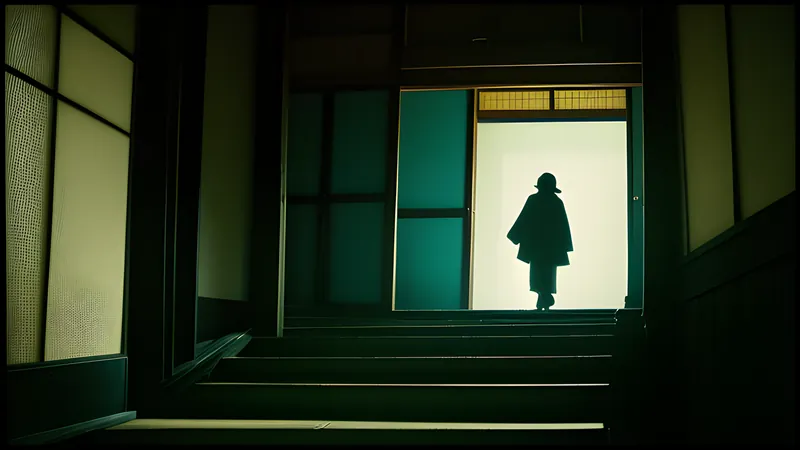
Shimizu also understands the particular dread of the ordinary Japanese home — the sliding doors, the tatami rooms, the futon on the floor, the stairwell — as a set of thresholds that can be violated. The house in Ju-on is unremarkable, a suburban Tokyo property with no gothic pedigree, and that plainness is the point. The curse does not need a castle. It needs a kitchen, a bedroom, a set of stairs, and the everyday spaces where people feel safest become the exact coordinates of their deaths.
The remake, and what travelled
Ju-on crossed to America faster and more strangely than most: Shimizu himself directed the 2004 Hollywood remake, The Grudge, with Sarah Michelle Gellar, transplanting the Tokyo house and its ghosts into a story about American expatriates. It is the rare case of a director remaking his own film in another language, and the result kept the images while smoothing the fractured structure into something more conventional and less unnerving. The reasons the American versions of these films so often lost their menace — the softening, the explaining, the reassurance — are the subject of the J-horror crossover essay, and Ju-on is exhibit A for how much the original’s disorder was doing.
Where to watch: the 2002 theatrical Ju-on: The Grudge has circulated widely on physical media and streaming; seek it out over the remake, watch the Japanese original with subtitles, and pay attention to the corners of the frame. If it lands, the curse films and quiet ghost stories linked above are its natural companions.
Spoilers below
There is little to spoil in the conventional sense, because Ju-on withholds the reassurance of a resolvable plot on purpose — but the film’s structure hides its cruellest move until the pieces settle. The curse’s origin is the domestic murder at the story’s root: Takeo Saeki, convinced his wife Kayako was unfaithful, killed her, their son Toshio, and the family cat in a fit of jealous rage, and died himself. That single eruption of household violence is the seed, and every death the film shows is a branch of it, spreading outward across time to social workers, family members, and strangers who did nothing but walk through the door.
The film’s fragmented chronology conceals the fact that some of the people we follow are already dead within the timeline, or are moving toward deaths we’ve been shown out of order. The chapter structure lets Shimizu spring a character’s fate before their introduction, so that when you meet Rika at what seems like the beginning, the film has arguably already shown you her end. The last movement folds the timeline in on itself — Rika confronting Kayako in a way that suggests the curse has simply looped, or claimed her too, with no daylight of escape.
That’s the final, bleak point. Ju-on denies the exorcism, the burial, the rule that saves the clever survivor. The grudge does not want anything you can give it; it is rage made structural, a stain in a floor plan, and it will keep processing anyone who enters until the film shrugs and ends. The horror the American remake could never quite carry across is exactly this refusal — the sense that you are watching a machine that has always been running and will run after the credits, and that the front door was never a way out, only a way in.
Related Content