Jean Rollin: The Dreamer of Vampire Reverie
Forty years of beaches, clocks and pale girls, made by a man nobody would fund
Contents
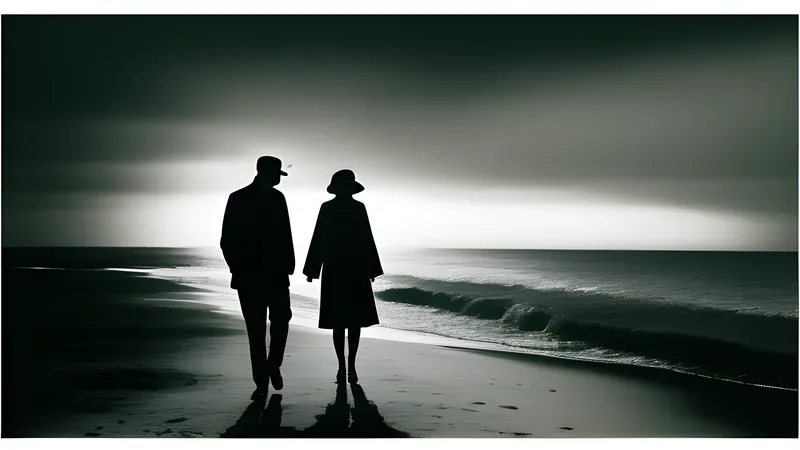
There is a beach in northern France, at Dieppe, where a row of ancient wooden breakwaters marches out into the Channel in black vertical ranks. Jean Rollin filmed it for forty years. It is in his first feature and it is in his last, and it turns up in most of the ones between, sometimes for no reason the script can supply. Two young women walk toward the water between the rotting posts, the sea is grey, and nothing happens. If that image does something to you, Rollin is one of the great directors and you have just discovered him late. If it does not, no argument I can make will help, and I am not going to pretend otherwise.
He is the most divisive figure in European horror, and the division is not about quality in any measurable sense. The films are cheap. The acting is frequently amateur, sometimes catastrophically so. Plots start and are abandoned mid-reel. Continuity errors go uncorrected because there was no money for a second day. Every technical complaint made against Jean Rollin is true, and none of them have ever mattered to the people who love him, because he was working on something the complaint sheet cannot measure.
Where the images came from
Rollin was born in Neuilly-sur-Seine in 1938 into an artistic and bohemian household — his mother moved in a circle that included the writer Georges Bataille, who was briefly his stepfather-figure and whose ideas about eroticism and death sit under everything Rollin later shot. His childhood formative texts were the French pulp serials: Feuillade’s Fantômas and Judex, the Vampires serial, the roman-feuilleton adventures of masked criminals moving through real Paris streets. Add the surrealists, whom he read young and who taught him that an image needs no justification beyond its own conviction, and the whole career is already assembled before he shoots a frame.
That inheritance is why comparing him to Hammer or to the Italians goes nowhere. Rollin’s vampires descend from silent serials and from André Breton, so they arrive with no folklore, no rules, no crucifixes and no Van Helsing. They stand in ruined châteaux in transparent capes and speak in fragments, because Feuillade’s Irma Vep never explained herself either.
The riot, and the first decade
Le Viol du vampire (The Rape of the Vampire, 1968) was assembled from a short he was asked to pad to feature length, shot in black and white with borrowed equipment, and released in Paris in May 1968. The timing is famous. Audiences already primed for insurrection tore the cinema up, the press savaged it, and Rollin acquired a reputation as a provocateur among people who had merely been confused. He later said the money it made from the scandal was what let him keep going, which is one of the better jokes in French film history.
Then the run that defines him: La Vampire nue (1970), Le Frisson des vampires (1971), and Requiem pour un vampire (1971), in which two girls in clown costumes flee something unexplained across a countryside and end up in a castle full of vampires who are dying out. Requiem runs its first quarter-hour with almost no dialogue at all, and it is the purest thing he ever did in the vampire mode — a chase with no pursuer, staged in real ruins in real weather.
La Rose de fer (1973) has no vampires in it whatsoever and is his masterpiece. A young couple wander into a cemetery at dusk and cannot find the gate. That is the entire film. The night comes down, the paths repeat, the girl begins to enjoy it and the boy begins to break, and Rollin — shooting in an actual necropolis at Amiens with a crew of almost nobody — turns a location into a state of mind. It flopped completely. He always said it was the film he was proudest of and the one that nearly ended him.
The economics of a private cinema
Nobody would fund this. That fact governs everything.
Rollin financed his films by shooting pornography under pseudonyms — Michel Gentil most often — and by taking any assignment offered, then diverting whatever he could into the next reverie. When the producers of Les Raisins de la mort wanted gore because gore was selling, he gave them gore: The Grapes of Death (1978) is a genuine horror film about a pesticide turning a wine region’s population into weeping, half-lucid killers, and it is his most conventional and most widely liked picture. When they wanted nudity he gave them nudity, and then held the shot forty seconds too long on an empty corridor while the producer wondered what had happened.
The compromise never went the other way. There is no Rollin film in which the reverie is sacrificed to the assignment. Fascination (1979) — a thief holed up in a château with women who have an appointment at midnight, and a woman with a scythe on a drawbridge in a black cape — is nominally an erotic vampire picture and actually a piece of choreography. Lèvres de sang (1975) hangs an entire film on a man chasing a half-remembered childhood image of a ruined castle, which is a fairly transparent statement of the whole method. La Morte vivante (1982) gave the eighties the viscera it demanded and used it for a story about two women who love each other and cannot survive it.
The comparison people reach for is Jess Franco, and the two men shared distributors, actresses and a working method built on almost nothing. The temperaments are opposite. Franco shot everything, everywhere, at enormous speed, and his best films are accidents thrown up by volume. Rollin shot the same four images for forty years and got closer to them each time.
The company, and the tower block
A private cinema still needs people, and Rollin had a small permanent one. Natalie Perrey worked with him for four decades as editor, script supervisor and occasional actress, and she is the reason films shot with no coverage cut together at all; the famous holds are as much her patience as his. Brigitte Lahaie came from the pornographic industry that was paying his bills, and Rollin did something with her that nobody else bothered to — he cast her for stillness. In Fascination she stands on a drawbridge in a black cape holding a scythe, and the shot is one of the enduring images of European horror because Lahaie does absolutely nothing in it and knows exactly how to do nothing.
She is also the lead of La Nuit des traquées (The Night of the Hunted, 1980), which is the film that answers anyone who thinks Rollin only had one register. There are no vampires, no château and no beach. Instead there is a modern Paris tower block full of people whose memories are dissolving hour by hour, held there by doctors who will not explain, and the horror is watching a woman fight to retain the fact of her own name. It was shot in twelve days in a genuinely empty office building, and it is the bleakest thing he made — a science-fiction film about dementia, decades before that became a genre anyone would touch.
The honest case against him has to be conceded whole. Several of the films are boring in the ordinary sense, and the reverie does not always arrive to redeem them. The eroticism is of its period and its industry, and it is aimed squarely at a male viewer in a way that a modern audience is entitled to find tedious. He was also, by his own cheerful account, an indifferent director of actors who preferred not to give them anything to do. A viewer who finds nothing in the beach will find nothing anywhere in this filmography, and that viewer is not wrong about what is on the screen. They are simply looking at a different film from the one his admirers see.
Why it works
The mechanics are subtraction and repetition, and they are deliberate.
He removes plot because plot forces an image to explain itself. He removes dialogue because his actors, most of them non-professionals and several of them cast for their faces alone, could not carry it — the Castel twins, Marie-Pierre and Catherine, are used as a visual rhyme rather than as performers, and the films are better for asking nothing of them but presence. He shoots real ruins, real cemeteries and real coastline in available light, so the decay in frame is genuine decay that took two centuries to arrive. And he holds. A Rollin shot runs past the point where a trained editor would cut, and that surplus is where the film happens: the eye stops reading the frame for information and starts simply looking at it.
The recurring furniture — the clock, the beach, the cape, the two girls, the château — works the way a refrain works. By the fourth film the images arrive as recognitions. You have stood on that beach before, the film knows it, and the pleasure on offer is the pleasure of return.
He belongs alongside the other French fantasists in the fantastique tradition, and he sits within the long history of the vampire as erotic figure as its most abstract practitioner: his vampires want, and the wanting is never resolved into a story about it.
Where to start, and the late years
He kept going into old age, poor and ill and unfashionable, making Les Deux orphelines vampires (1997), La Fiancée de Dracula (2002) and Le Masque de la Méduse (2009) with digital cameras and the same beach. He died in December 2010, just as the Redemption and Indicator restorations were making his work properly visible for the first time, in transfers that finally showed the colour he had been shooting into and the grain he had been living with.
Start with Fascination, which is the one that converts people: it has a plot, a great villain image, and forty minutes of real strangeness. Then The Iron Rose, if the strangeness took. The Grapes of Death is the safe entry and the least Rollin-like. Requiem for a Vampire is the deep end. Go in expecting a film and you will find a shambles; go in expecting a mood, and a man who spent forty years photographing the same beach because he could not stop, and you will find that European horror has nothing else like him at all.
Related Content