Jacob's Ladder: The Nightmare of the Unravelling Mind
Adrian Lyne's 1990 horror turns a soldier's grief into a reality that will not hold still
Contents
Jacob’s Ladder is a horror film about a man losing his grip on the difference between memory, hallucination, and hell, and its great formal wager is that the audience should lose that grip alongside him. Adrian Lyne, a director better known for glossy erotic thrillers, made in 1990 one of the most disorienting American horror films of its era by refusing to give the viewer solid ground for almost its entire length. It was a commercial disappointment on release and has since become a cornerstone, its imagery lifted wholesale by video games and imitators who mostly missed why it works.
Tim Robbins plays Jacob Singer, a Vietnam veteran working as a New York postal clerk and living with his girlfriend Jezebel, played by Elizabeth Peña. Jacob is haunted. Faceless creatures move at the edges of his vision. Strangers convulse with impossible speed. His dead son appears to him; his war memories bleed into his waking life; his own body seems to be under attack by forces he cannot name. He begins to suspect that something happened in Vietnam that the army has buried, and that the demons pursuing him are connected to it.
Horror built out of glimpses
The screenplay is by Bruce Joel Rubin, who the same year wrote the enormous hit Ghost — a startling double bill from one writer, the same underlying preoccupation with the soul’s passage handled once as reassurance and once as terror. Rubin’s script had circulated in Hollywood for years with a reputation as unfilmable, precisely because its horror is subjective and its structure deliberately unstable. Lyne’s solution was to make the instability the style.
The film’s most famous effect is its demons, and the reason they still disturb is technical. Lyne and his effects team achieved the juddering, blurred head movements by having performers shake their heads at normal speed while being filmed at a low frame rate, then playing the footage back so the motion smears into something the eye cannot resolve. You never get a clean look. The horror lives in the gap between what you glimpse and what your brain tries to complete, and that gap is the whole aesthetic. It is the same principle Val Lewton’s unit understood in the 1940s and that Cat People built an entire studio style around: the thing withheld frightens more than the thing shown.
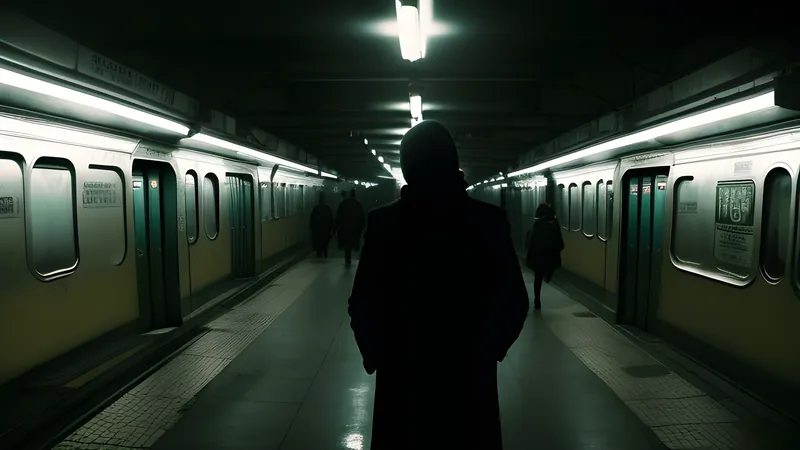
Lyne also degrades the ordinary. A hospital gurney ride becomes a descent into a filthy asylum of the damned; a party tips into a fever of writhing bodies; the New York subway, that most banal of spaces, becomes a threshold into somewhere infernal. The film’s terror is that the everyday world is thin, and that Jacob keeps falling through it.
The unreliable frame as horror engine
Jacob’s Ladder belongs to a specific and precious tradition: horror in which the unreliable protagonist is the whole design, so that the audience cannot trust a single image. Its closest cousins are films where the mind is the haunted house. Repulsion makes an apartment metastasise into the psyche of a woman coming apart; The Tenant completes Polanski’s study of a self dissolving under paranoid pressure. Lyne’s film shares their central bet — that the scariest place a camera can go is inside a perception that has stopped being trustworthy.
It also rhymes forward with In the Mouth of Madness, John Carpenter’s near-contemporary study of a rational man watching reality itself rewrite around him. Where Carpenter frames the collapse as cosmic — the universe is authored by something malign and the hero is a character in its book — Lyne keeps his firmly intimate and bodily. Jacob’s apocalypse is the size of one grieving nervous system, and that scale is exactly what makes it unbearable. Cosmic horror lets you off with awe. This film gives you a man’s specific pain and will not let you look away from it.
Robbins and the discipline of a still centre
The performance that holds all this together has to be, paradoxically, the calmest thing in the film, and Robbins understands that. His Jacob is a gentle, intelligent, decent man, and the horror works because we like him and want the terrors to stop for his sake. A more histrionic actor would have matched the film’s delirium and drowned in it. Robbins plays exhaustion and love — a man clinging to the ordinary tenderness of his life, to Jezebel, to the memory of his son, as the world tries to shake him loose. Danny Aiello, as a chiropractor named Louis who becomes something like Jacob’s guardian, provides the film’s only pool of warmth, and his one recurring idea — a paraphrase of Meister Eckhart about demons and angels being a matter of what you are willing to let go — quietly supplies the film’s whole moral key.
The craft flaw, if it is one, is that the middle stretch can feel like a loop: another hospital, another vision, another descent. But the repetition is the point. Jacob is trapped in a recurrence he cannot break, and the film makes you feel the airless circularity of it before it finally releases you.
Why it endures
Jacob’s Ladder endures because it fused two horrors that rarely sit together: the political horror of what a state does to the soldiers it uses, and the metaphysical horror of dying badly, with unfinished business clutched to the chest. Most films pick one. Lyne runs both through the same faceless demons, so that the pursuit reads simultaneously as institutional cover-up and as the soul’s own refusal to let go. Its DNA is everywhere now — the Silent Hill games owe it an enormous, openly acknowledged debt — but the imitations tend to keep the juddering monsters and lose the grief that gives them weight.
It is worth pausing on how much the film discards. Rubin’s original script contained more elaborate literal demons and a fuller explanation of the chemical conspiracy; Lyne and editor Tom Rolf stripped much of it out in the cutting room, deleting whole sequences and pushing the film toward suggestion. Some of that excised material survives on home-video releases, and comparing it to the finished film is a lesson in the value of subtraction. The deleted demons are more explicit and far less frightening. What Lyne left on the floor is exactly what a lesser horror film would have kept.
The 1990 release was mishandled and the reviews were mixed, several critics finding the film either too obscure or too downbeat. Its reputation grew on video and cable through the decade that followed, the way a certain kind of difficult horror always does, passed between viewers who could not shake it. By now the film’s influence has outrun its box office by an order of magnitude, the usual fate of a picture that arrived a few years early for its audience.
Where to watch and what to pair it with
The film is available on disc and through the usual streaming rentals; look for the cleaner high-definition transfers, since the murk of Lyne’s degraded New York needs contrast to land. Pair it with Repulsion and The Tenant for the unreliable-mind tradition, and with In the Mouth of Madness for its cosmic mirror image.
Spoilers below
The ending recontextualises everything. Jacob Singer died in Vietnam. The film’s present-day life — the postal job, the apartment, Jezebel, the demons, the conspiracy — is the extended final experience of a dying man on an operating table in a field hospital, his consciousness working through terror and attachment in the moments before death. The buried army secret is real within the story’s logic: a passing revelation about a chemical experiment on the soldiers, a drug meant to increase aggression, gives the hallucinations a diegetic seed. But the film’s true subject is the theological reading Louis has been supplying all along. The demons are not devils. They are the parts of himself Jacob will not release, and they tear at him only because he is still holding on.
The final images resolve the whole design into peace. Jacob climbs the stairs of his old apartment to find his dead son Gabe waiting, radiant, and takes his hand, and the two of them ascend into a white light — the ladder of the title, Jacob’s rope up and out. The cut back to the field hospital, where the surgeons note that Singer has died and that he looks strangely at peace, is the film’s quiet masterstroke: the whole nightmare was the work of letting go, and the moment he lets go, the horror simply ends.
That is why the film survives its imitators. The demons were the easy part to copy. The hard part, the part almost nobody reproduces, is that Jacob’s Ladder is finally a film about dying well, and its horror was only ever the resistance to grace. Strip out the grief and the theology and you have a haunted-subway movie. Keep them, and you have a film that uses terror to arrive somewhere unbearably tender.
Related Content