It's Alive: The Monster-Baby Melodrama
Larry Cohen's 1974 mutant infant is a Frankenstein story about a father's shame, scored by Bernard Herrmann and sold twice
Contents
The premise is a punchline that refuses to behave like one. A Los Angeles couple go to the hospital for the birth of their second child. Something goes wrong in the delivery room. The father, waiting outside, hears screaming and then silence, walks in, and finds the entire obstetric team dead on the floor and the skylight broken. The baby has left.
It’s Alive came out in 1974, written and directed by Larry Cohen, and by every reasonable expectation it should be an exploitation footnote — a killer-infant picture with a rubber puppet and a poster. It is instead a mean, sad, unexpectedly moving film about a man who is ashamed of what he has produced, and it has one of the finest scores ever attached to a horror picture, because Cohen somehow persuaded Bernard Herrmann to write it.
Frank Davis and the problem of his son
Frank Davis (John P. Ryan) is a public-relations man. That is the joke Cohen sets up in the first reel and then spends ninety minutes refusing to laugh at: a professional manager of reputations produces the least manageable reputation in California.
His wife Lenore (Sharon Farrell) is heavily pregnant and uneasy; their older boy, Chris, is packed off to a friend’s. Then the delivery room happens, and the film’s real subject arrives with the police. Frank’s employers ask him to take a leave of absence. The neighbours know. The press knows. His older son cannot go to school. And Frank, faced with the fact of the thing that came out of his wife, does what a certain kind of American man of 1974 does: he disowns it publicly, he calls it it, he offers to help hunt it, and he goes out with the search parties carrying a rifle.
Ryan’s performance is the reason this holds together. He plays Frank as a man doing a competent job of hating his own child in order to survive the next news cycle, and letting you see the effort. The horror in the film is not really the infant in the storm drains. It is a father in a good suit explaining to a room full of policemen that he has no son.
That framing turns the whole picture into a melodrama wearing a monster suit. It’s Alive has more in common with a domestic drama about a family destroyed by a scandal than with anything else on the drive-in bill that summer, and Cohen shoots the family scenes accordingly — long, quiet, badly-lit rooms where two exhausted people negotiate a marriage that has been handed something unsurvivable.
The father who made the monster
The ancestor is the obvious one, and it is worth being precise about why. Frankenstein, 1931, gives horror its most durable structure: a creator, a creation he is repelled by, an abandonment, and a violence that follows directly from the abandonment. James Whale’s film is a tragedy about a father who cannot look at his son, and the creature’s rampage is a consequence of a paternal failure rather than an expression of evil.
Cohen took that skeleton, removed the laboratory, and made the creator an ordinary man who did nothing more Promethean than have unprotected sex with his wife. There is no hubris. Frank did not reach beyond his station or steal fire. He conceived a child in the normal way, and the child came out wrong, and the film asks whether a man’s obligation to his own blood survives the discovery that his blood is monstrous. The dread hanging over the whole picture is pharmaceutical — the film gestures repeatedly at the pill Lenore was taking, at a company’s liability, at a suggestion that somebody’s product did this — and Cohen is careful to leave it as a suspicion the corporation is quietly working to bury. The Frankenstein figure in 1974 has become a legal department.
The other parent is Rosemary’s Baby, six years earlier, which had proved a horror film could be built entirely out of pregnancy — the body as the site of the plot, obstetrics as conspiracy, a woman’s reasonable fears dismissed by everyone with a medical degree. Cohen’s contribution is to move the camera to the corridor and film the father.
The children Cohen fathered in turn are easy to trace. David Cronenberg’s The Brood arrives five years later with rage-children produced by a marriage’s collapse and made flesh. David Lynch’s Eraserhead lands in 1977, an entire film about a man alone in a room with an infant he cannot love and cannot leave. The wider bloodline of the terrible child is laid out in the killer kids canon.
Herrmann
Bernard Herrmann scored It’s Alive, and the fact still seems implausible. This is the composer of Citizen Kane, Vertigo, Psycho and North by Northwest, in the final phase of a career that would end with Taxi Driver — he died in December 1975, the night he finished recording it — writing music for a Larry Cohen picture about a mutant baby.
He took it seriously, and the score is the reason the film reaches for something the script alone could not hold. Herrmann does not write a monster theme. He writes lullaby material — cradle-rocking figures, a nursery cadence — and then poisons it with brass and an electronic edge, so the sound of the film is a mother’s song with something crawling through it. When the infant is on screen, the music is tender. That is a deliberate, quite radical choice: the score sides with the baby against the film’s own protagonist, and it means the audience’s sympathies are being pulled towards the thing in the drains for ninety minutes before the plot admits that is where they belong.
It is the clearest demonstration I know of a score arguing with a picture, and I made the general case in how a horror score rewires the audience. Rick Baker built the infant, and Cohen — who had watched Jaws-adjacent economics before Jaws existed — keeps it to glimpses, a claw, a shape, a movement at the bottom of frame. The restraint is partly artistic and mostly financial, and it works for both reasons.
The film that was sold twice
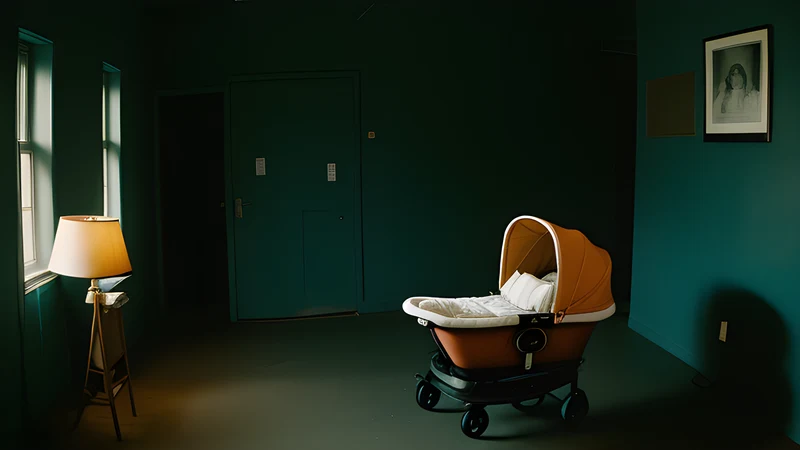
It’s Alive has the strangest commercial history of any Cohen film. Warner Bros. released it in 1974 with a conventional campaign, and it did almost nothing. It sat. Then in 1977, under new marketing leadership, the studio put it out again with a rebuilt campaign — the pram, the claw, the line about there being only one thing wrong with the Davis baby — and the reissue was an enormous hit, returning many times its cost and generating two sequels, It Lives Again in 1978 and It’s Alive III: Island of the Alive in 1987.
The same film, the same prints, three years apart, failure and then fortune. It is the most instructive story in seventies genre distribution, and worth holding onto whenever anyone claims the market has spoken about a picture. The market had not seen it.
Where to watch: the Warner Archive disc is the reliable one, and the film needs a copy that preserves the darkness — the horror lives in underlit corridors and storm drains, and a compressed transfer turns the glimpsed creature into porridge.
The verdict is that this is Cohen’s most emotionally serious film, a creature feature that spends its running time on a marriage and its climax on a father’s surrender. Follow it with God Told Me To, where he asked what it would mean to be the monstrous child rather than to father one, or with Q: The Winged Serpent for the same method turned to comedy.
Spoilers below
The film’s whole design is a slow reversal of the father’s position, and Cohen executes it without a single scene of Frank being persuaded.
Lenore gets there first. She hides the infant in the house at one point, feeds it, protects it — a mother’s recognition working exactly as the film needs it to, and setting up the gap between the two parents that the last act has to close. Frank meanwhile goes out with the hunters, and Cohen keeps him there long past the point of comfort, a man volunteering for his own child’s extermination in order to be seen doing it.
The turn comes in the storm drains under Los Angeles. Frank, with a rifle, goes into the concrete tunnels with the police to finish it — and finds the thing cornered and frightened, and it comes to him. It knows him. Cohen’s staging gives it the most ordinary gesture available: the infant crawls to its father because that is what infants do, and the entire structure of the film collapses onto that one movement. Frank picks his son up, wraps him in his coat, and carries him out, and the man who has spent ninety minutes calling it it is now trying to walk his child past a cordon of armed men.
They shoot it in his arms. Of course they do. There is no version where a father’s late-arriving love is permitted to work, and Cohen is unsentimental enough to make the reconciliation and the killing the same scene — Frank gets to be a father for approximately one minute, which is one minute more than he allowed himself before.
Then the coda, which is the coldest line in the film and the one that turns a family tragedy into a genre engine. As the officials tidy up and the case closes, word comes through: another one has been born, in Seattle. The pharmaceutical suspicion the film has nursed all the way through is confirmed in a single piece of news, the corporation’s problem is revealed as national in scale, and the Davis family’s private catastrophe turns out to have been a data point.
Related Content