It Came from Outer Space: The Sympathetic-Alien 3D Original
Jack Arnold and Ray Bradbury put a broken-down spaceship in the Arizona desert and asked the audience to leave it alone

Contents
1953 gave the genre two answers to the same question and the loud one won. In August, Paramount’s Martians were incinerating Los Angeles in Technicolor. Three months earlier, Universal-International had released a black-and-white 3D picture in which a spaceship crashes in the Arizona desert, the occupants borrow the shapes of some local people while they repair it, and the moral of the film is that we should have let them get on with it.
It Came from Outer Space is the origin point of the sympathetic alien — the strand that runs through Close Encounters, E.T., Starman, The Iron Giant, Arrival and Nope’s better instincts. It is also the first feature Jack Arnold directed in the genre he was about to define, and the title is a lie sold by the marketing department. Nothing came from outer space with any intention towards us at all. Something broke down over Arizona.
Bradbury’s fingerprints, and the credit that isn’t his
Universal bought a story treatment from Ray Bradbury, developed under the working title The Meteor. Harry Essex wrote the shooting script and took sole screenplay credit. Bradbury maintained for decades afterwards that Essex’s screenplay reproduced his treatment closely enough that the credit was a discourtesy, and having read what is on the public record about both documents, the film’s DNA is plainly his. Nobody else in Hollywood in 1952 was writing aliens who wanted nothing.
You can hear him in the dialogue’s rhythm, which is a real problem and a real pleasure at once. John Putnam (Richard Carlson) is an amateur astronomer and writer living outside the town of Sand Rock, and he talks like a Bradbury narrator: elevated, a little lyrical, out loud, to people who did not ask. His girlfriend Ellen Fields (Barbara Rush, fresh from Pal’s ark in When Worlds Collide) teaches at the school. The sheriff, Matt Warren (Charles Drake), is the audience surrogate for common sense, and the film’s engine is that Putnam is right about everything and remains, to the town, a crank with a telescope.
That is the Bradbury idea, and it is sharper than the invasion films will admit. The threat in this picture is a community’s certainty. The aliens do one genuinely frightening thing — they duplicate people and hold the originals — and every human response to it makes the situation worse. A posse forms. Guns come out. The film’s tension is generated entirely by the possibility that Sand Rock will get everyone killed by being reasonable.
Arnold’s desert
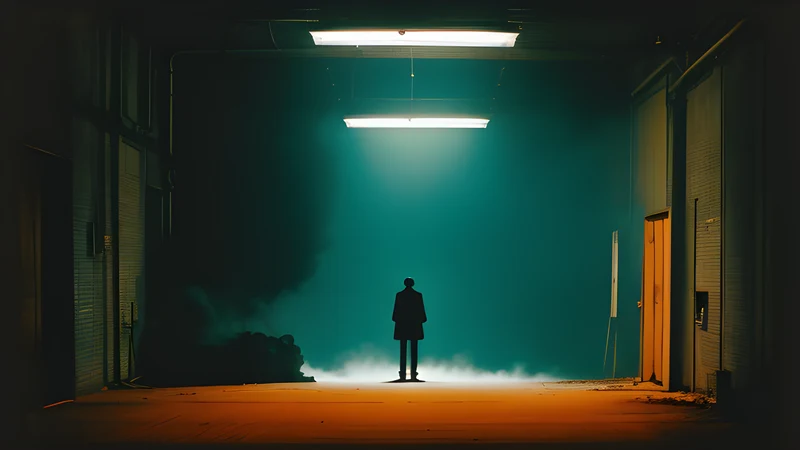
Here is where the film stops being a good script and becomes a good film. Arnold shot the Arizona desert as a character, and he said as much afterwards — that the desert is a place of mystery, that it is beautiful and it will kill you and it does not notice you either way. He puts the camera low and wide, leaves enormous quantities of empty frame, and lets scenes run in silence. Wind. Heat shimmer. A telephone line going out to nothing.
This is the first appearance of the visual grammar Arnold would use for the rest of the decade in Tarantula and Creature from the Black Lagoon, and it is doing specific work. An empty landscape means the aliens can be anywhere, so no monster needs to be shown; the dread is a function of the acreage. Watch how he stages the moment when Putnam knows a duplicate is standing in front of him — the trick is that the duplicate does nothing wrong. It stands in the sun and says ordinary things and does not blink at the right times. Arnold holds the shot slightly past comfort and lets the audience do the identifying.
The 3D is the other half. Universal’s first 3D feature, and it belongs to the small group that understood the format. There is one obligatory gag — a meteor coming at the lens in the opening — and after that Arnold uses stereo depth for recession rather than projection: the desert going back for miles, the mine shafts going down, the crater with the ship in it lying at the bottom of an enormous stereoscopic hole. Depth as scale. The film works flat, which is why we have all seen it flat, and everything Arnold built the composition for is happening in an axis a 2D print cannot render. If you get a chance at a 3D presentation, take it.
The alien point-of-view shots are the most copied thing in the picture: a bulging, bubbled, distorted lens crawling towards a human being, with a wet hiss on the soundtrack. It is a cheap effect — a distorting filter and a fast dolly — and it has been in horror ever since, from the killer’s eyes in a hundred slashers back to Halloween’s front step. Arnold’s version has a peculiar innocence to it, because the thing behind the lens is not hunting. It is looking.
The music does the rest. Universal’s music department, working under Joseph Gershenson with Herman Stein and Irving Gertz among the contributors, put a theremin on it, and this is one of the two or three films that fixed that instrument to the idea of extraterrestrial life for the next half-century. The theremin is a sound with no attack — it slides into existence — and against Arnold’s silences it works less like scoring and more like weather.
The case against
Carlson is a limited leading man and Putnam is written as a lecturer, so the film’s second act has stretches where the argument is being stated rather than dramatised. The romance with Ellen is thin in the way most 1953 romances are thin. And the film’s own creature — glimpsed a handful of times, a large single-eyed thing with a lot of texture and a lot of gauze in front of it — is a compromise. The studio wanted a monster in a monster picture, and every second it is on screen dilutes an idea that works better as an absence. Arnold clearly knows this and shows it as little as the contract allowed; the same discipline is why the creature-restraint principle has a 1953 exhibit.
The deeper criticism is that the film wants credit for tolerance while keeping its exits open. It is gentle about the aliens and it still ends the way a 1953 picture had to end. There is a version of this material — Bradbury’s version, probably — where the town’s suspicion is the only monster, and Universal did not make that film.
What it fathered, and what it argued with
The direct sibling is The Day the Earth Stood Still, which two years earlier had put a reasonable alien on the lawn and let him deliver an ultimatum. Klaatu is an ambassador with a threat in his pocket; Arnold’s visitors are stranded motorists who would like everyone to stop pointing rifles at the tow truck. That is a much stranger and more durable idea, because it removes humanity from the centre of the story altogether.
The film to set against it is The War of the Worlds, same year, opposite conclusion, and the pairing is the best double bill in 1950s science fiction. Three years later, Invasion of the Body Snatchers took Arnold’s duplication premise and removed the sympathy, and the result was the decade’s defining paranoia film — which tells you the duplication idea was always the strongest thing here, and that Arnold had deliberately declined to weaponise it.
Arnold went straight from this to Creature from the Black Lagoon and then to The Incredible Shrinking Man, and the line through all three is a director who kept asking the audience to identify with the wrong party. Downstream, the closest modern relative is The Vast of Night, which reproduces this film’s small-town-at-night texture almost as an act of restoration.
Where to find it: Universal keeps it in print, usually as part of the studio’s science-fiction collections, and the 3D restoration has circulated on disc for those with the kit for it.
Spoilers below
The aliens are the Xenomorphs — the film’s own term, decades before Giger’s, which is a piece of trivia too good to leave out. Their ship comes down and a landslide buries it. They need parts and time, so they copy locals, starting with a pair of telephone linemen, and hold the originals in the mine. The duplicates are imperfect and know it; the film’s best sustained sequence is Putnam trying to have a conversation with a copy of a man he knows, while the copy tries to buy an hour.
The confrontation, when it comes, is a negotiation. Putnam goes down into the mine, meets one of them, and is told plainly what they want: no colony, no conquest, no interest in Earth beyond the repair. They also tell him what will happen if the townspeople find them, which is not a threat so much as a diagnosis. And Putnam’s response is the thing that makes the film unusual. He does not raise a militia or run to Washington. He goes back up and buys the aliens their time by holding off the posse himself, then dynamites the mine entrance to seal the shaft.
The hero of a 1953 science-fiction film sides with the aliens against his own town, and the film treats this as obviously correct. The originals are released unharmed. The ship comes out of the desert and goes, and Putnam says something to Ellen about how it was the wrong time for the two species to meet, and that they will come back when we are ready.
That closing idea has aged into something more melancholy than Bradbury can have intended. It is a promise contingent on us improving, delivered in the year the genre decided that aliens were a problem to be shot at, and every sympathetic-alien film since has been arguing the same case to the same jury. The mine goes up, the ship leaves, and the town never finds out how close it came to killing something that only wanted a lift home. Arnold ends on the empty desert, which is where he started, and the emptiness means something different by then.
Related Content