Island of Lost Souls: The House of Pain Pre-Code Horror
Charles Laughton's Moreau, a whip, and the 1932 film the BBFC kept out of Britain for a quarter of a century
Contents
The British Board of Film Censors rejected Island of Lost Souls outright in 1933, refused it again in 1951, and only passed it in 1958 with cuts and an X certificate. Twenty-five years is an extraordinary sentence for a seventy-minute Paramount programmer, and the Board’s stated objection — that the film dealt in cruelty to animals — was the polite version. What actually alarmed them is still there in every frame: a picture about a man who makes people out of beasts and then rules them by inflicting agony, made with a relish that has no moral alibi anywhere in it.
H.G. Wells hated it too. He had written The Island of Doctor Moreau in 1896 as a savage philosophical argument about evolution, pain and the thinness of the human veneer, and he complained that Paramount had turned it into a horror picture. He was right about the transformation and wrong about it being a loss. The film keeps his thesis and adds a leer, and the leer is what makes the thesis land.
Laughton in white
Charles Laughton was thirty-three, newly imported from the London stage, and had not yet won an Oscar. His Moreau is one of the great screen villains and almost nothing about the performance is what you would expect. He is small, soft, immaculately dressed in tropical white, with a neat pointed beard and a voice like warm cream. He carries a whip and uses it the way a schoolmaster uses a raised eyebrow. Laughton reportedly modelled the look on his dentist, which is either a joke or the most useful piece of character research in the decade: Moreau has the manner of a man about to tell you this will only hurt for a moment.
The performance works because Laughton plays courtesy as the threat. Moreau is delighted to have a guest. He is a superb host. He shows Edward Parker around, explains his work with a schoolboy’s enthusiasm, and radiates the untroubled satisfaction of someone who has never once been contradicted. Richard Arlen’s Parker is a serviceable slab of a leading man and Leila Hyams gets very little to do as Ruth, which is standard for the period; the film belongs entirely to Laughton and to the makeup department, and it knows it.
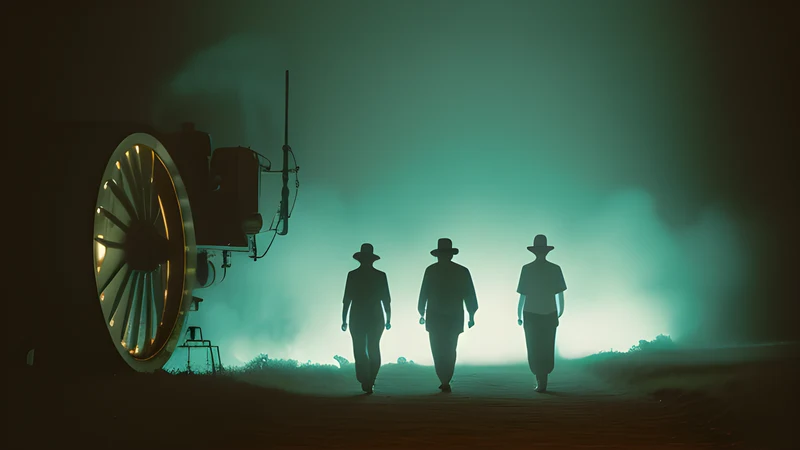
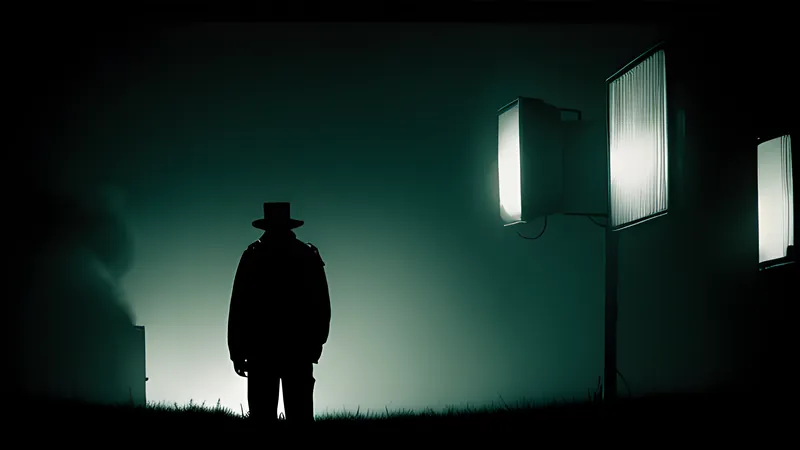
Karl Struss shot it, which is the detail that separates Island of Lost Souls from every other pre-Code creature picture. Struss had already photographed Sunrise and Rouben Mamoulian’s Dr Jekyll and Mr Hyde, and he brings the same expressionist toolkit here: hard shafts of light through jungle foliage, the compound fence rendered as a cage from both sides, faces half-swallowed by dark. Wally Westmore’s makeups on the Beast Men are deliberately imprecise — matted hair, wrong jaws, hands that end badly — and Struss keeps most of them in shadow and motion, so your eye finishes the job. The crowd of them in the final reel is a genuinely frightening image because you can never quite count them or resolve them.
“Are we not men?”
The Law sequence is the film’s centrepiece and its most quoted moment, and it deserves its reputation. Bela Lugosi, buried under hair as the Sayer of the Law, leads the Beast Men through their catechism in a torchlit hollow — the prohibitions against walking on all fours, against eating meat, against spilling blood, each one answered by the chanted question about whether they are men. Lugosi has perhaps four minutes of screen time and does more with his voice here than in most of his leading roles; the whole ritual has the cadence of a church service run by something that has misunderstood church.
It is also the cleanest statement of what the film is actually about. Moreau’s Law exists to hold his creatures inside a shape that pain put them in, and the only sanction behind it is more pain. The House of Pain is never shown at work — the film gives you a door, screams behind it, and Moreau’s mild face on the near side, which is far worse than any surgery could be. Every horror film that keeps its atrocity offscreen and lets the audience build it is working the seam this one opened, an economy the desk has argued for at length in the creature restraint principle.
Devo took their song from the chant, which is how most people under sixty first met the line. That is a peculiar afterlife for a banned film: a 1978 art-punk single carrying a 1932 Paramount picture into general circulation decades before anyone could easily see it.
What the Code would have removed
Island of Lost Souls was released in December 1932, which places it in the eighteen-month window when the Production Code existed on paper and had no enforcement machinery. Watch it with that date in mind and the whole picture reads as a list of things about to become impossible.
Moreau’s plan for Lota, the Panther Woman, is the plainest of them. Kathleen Burke won the part through a nationwide “Panther Woman” talent search — a publicity stunt that landed a nineteen-year-old dental assistant from Chicago in one of the most transgressive roles Hollywood produced that decade. Moreau wants to know whether his creation can mate with a human, and he engineers Parker’s proximity to her with the detached curiosity of a man crossing plants. The film stages this as the horror it is, and Burke plays Lota’s dawning understanding of what she is with real pathos, particularly in the scene where she discovers her own hands reverting. After July 1934 none of it survives: the bestiality subtext, the vivisection, Moreau’s frank comparison of himself to God. Britain simply declined the whole package for twenty-five years — a decision that sits alongside the Board’s later panics in what the BBFC was really afraid of, and confirms the pattern that censorship reliably enlarges a film’s legend.
Criterion’s 2011 restoration finally made the film easy to see in a decent state, and the timing matters. For most of its life this was a title you read about. Encountering it clean, with Struss’s blacks actually black, it is startling how modern the cruelty feels — there is no reassuring frame around it, no scientist redeemed by a last-minute conscience, no suggestion that anybody learned anything.
The lineage
Moreau’s real children are everywhere. The most direct descendant is the strain of body horror that treats flesh as raw material and the surgeon as an artist, which runs through Eyes Without a Face and its beautiful, clinical monstrousness, and then out into the whole body horror lineage. The Beast Men themselves — a made population, held in line by a story about what they are forbidden to do — turn up again in any film where the created thing organises. And the pre-Code freedom the picture exploited was being used the same year by Tod Browning for Freaks, a film that got its director effectively blacklisted for showing real bodies where Paramount showed rubber ones.
The verdict is uncomplicated. Island of Lost Souls is the best Wells adaptation ever filmed, and it earns that against three later versions with more money and better technology, because Laughton understood something the others missed: Moreau is not frightening when he rants. He is frightening when he is pleased. Seventy minutes, no fat, and a villain who never once raises his voice above the level of a man offering you another drink.
Spoilers below
The ending is where the film abandons Wells and improves on him. Moreau’s Law forbids the spilling of blood, and Moreau breaks it himself — ordering the Beast Men to kill Donahue, the captain of the ship that might have carried Ruth away, in front of witnesses who have spent the entire film being tortured into obedience to that exact rule. It is the single stupidest thing he does and the film makes it entirely characteristic. He is so confident of his authority that it does not occur to him that his creatures are listening.
Lugosi’s Sayer of the Law is the one who names it. The realisation moves through the Beast Men in the torchlight — the law is broken, and the man who wrote it broke it, therefore he is meat like them. They take the fence. Struss shoots the assault as a rising tide of half-seen shapes with the compound light behind them, and the film’s cheapest resource, a crowd of extras in hair, becomes its most terrifying.
They carry Moreau into the House of Pain. The camera stays outside, exactly as it has all film, and Laughton is dragged through the door he has been sending others through for years while the Beast Men gather up his own instruments. You hear it. That final withholding is the whole picture’s method turned on its author, and the scream that comes out from behind that door is the reason the BBFC could not find a cut that saved it. There is nothing to trim. The horror is in the architecture.
Related Content