Investigation of a Citizen Above Suspicion: The Police-Power Giallo-Noir
Elio Petri, Gian Maria Volonte and Ennio Morricone build a thriller in which the detective is daring you to arrest him
Contents
Elio Petri’s Indagine su un cittadino al di sopra di ogni sospetto (1970) gives away its murderer in the first five minutes, on purpose, and then makes you sit through two hours of him getting away with it. The head of Rome’s homicide squad — Gian Maria Volonté, never named, referred to only by rank and title — visits his mistress, kills her, and then, with the care of a man arranging flowers, plants evidence pointing at himself. A thread from his tie. A fingerprint left where it cannot be explained. A witness given a good look at him on the stairs.
He is not being reckless. He is running an experiment, and the hypothesis is that his position makes him invisible to the machine he serves. The film is the write-up.
The inversion
The whodunit asks who. The howcatchem — Columbo’s format, and this film predates the series by months — asks how the detective will corner a killer we have already met. Petri invents a third thing. We know who did it, we know exactly how, we watch him hand the answer to his own subordinates repeatedly and increasingly explicitly, and the suspense comes from watching an institution decline to notice. Every clue he plants is absorbed and neutralised by the apparatus. Every hint is reinterpreted as something else by men who cannot conceive of the shape it makes.
That is a genuinely nasty structural joke, and it works because Petri keeps escalating the dare. Early on the provocations are deniable. By the second hour the man is practically confessing across a desk, and his officers are looking at him with the polite blankness of people waiting for a superior to finish a story they do not follow. The film converts institutional deference into a horror device.
Volonté
Gian Maria Volonté was the most physically committed actor in Italian cinema and this is his monument. He plays the Inspector as a man made entirely of appetite and terror, a bureaucrat with the body language of a peacock and the eyes of something cornered. He struts. He performs authority for rooms of men who are required to applaud. He delivers a promotion-day speech about order and repression with the swelling self-love of a man who has never once been contradicted, and Petri lets the camera sit at a slight low angle so we get him exactly as he sees himself.
And then Volonté shows you the vacuum. Alone, or with Florinda Bolkan’s Augusta, the strut collapses into something needy and juvenile. Their relationship is a series of games in which she stages crime scenes for him and he plays the investigator — she has understood, long before the film starts, that his professional identity is the only erotic content he possesses, and she is bored enough to make a hobby of poking it. Bolkan plays her with an amused contempt that is the film’s sharpest weapon. She is the only person in Rome who finds him funny.
The craft: Morricone laughs at him
Ennio Morricone’s score is the reason the film is unforgettable, and it is a hostile act. The main theme is built on a jew’s harp, plucked mandolin and a lurching, off-kilter rhythm — a sound somewhere between a cartoon, a village dance and a wind-up toy. It is comic. It is mocking. And Petri deploys it under scenes of authority, procedure and self-regard, so that the Inspector never gets to be frightening on his own terms. The music is always in the room, giggling at him.
Consider how easily this could have gone the other way. A conventional thriller score would have made the Inspector sinister, and a sinister villain is a flattering villain. Morricone’s theme insists he is ridiculous, and the ridiculousness is the political point: this is a small, vain, frightened man, and the horror is that the state has handed him a building. The score refuses the character his dignity from the opening frame, which frees Petri to give him everything else.
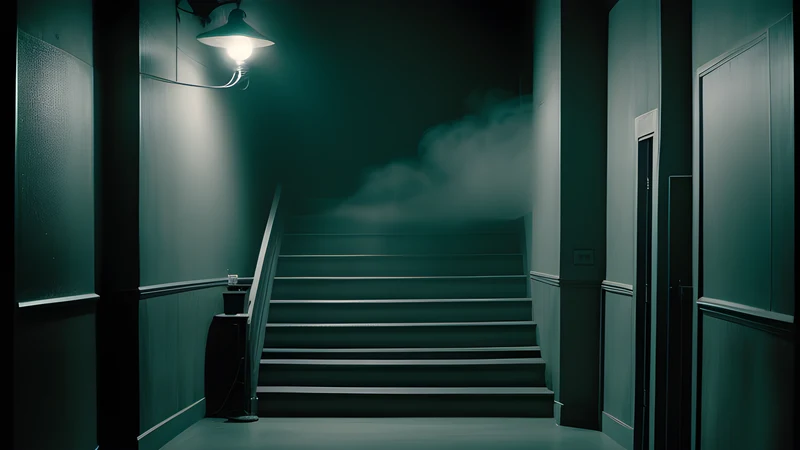
Petri’s other main tool is space. Luigi Kuveiller’s camera keeps finding the police headquarters as architecture — marble, columns, staircases, corridors that run away into perspective — and shooting men as small shapes inside it. The building is the real antagonist. It is also, being fascist-era civic modernism, an unignorable historical joke: the Italian Republic’s police work out of rooms built by the regime it replaced, using the same stairs.
The giallo furniture
This is not a giallo, and it is built out of giallo parts, which is why it belongs in any serious collection of the form’s mutations. The opening is a giallo opening: a stylish murder of a beautiful woman in a beautiful apartment, filmed with fetishistic attention to objects. There is the fixation on physical evidence as texture — the thread, the print, the razor. There is the flashback structure keyed to erotic obsession. Dario Argento’s Deep Red would arrive five years later and use much of the same vocabulary, and The Giallo Canon is full of films that share Petri’s furniture without sharing his target.
Petri’s move is to take that vocabulary and point it at the police rather than at a black-gloved outsider. The giallo’s usual anxiety is that a killer is loose among us and the authorities are useless. Petri’s anxiety is that the authorities are the killer and their uselessness is a policy. Everything the genre normally uses to generate paranoia about strangers, he redirects at the institution. It is the single cleverest thing anyone did with giallo grammar in the 1970s, and it is why the film sits in the same shelf as Dario Argento: Colour, Glass and the Killer’s Glove despite belonging to a different genre entirely.
1970
Context matters here more than usual. Petri and his co-writer Ugo Pirro made this in an Italy that had just entered its long nightmare: the Piazza Fontana bombing of December 1969 had killed sixteen people in Milan, the state’s investigation had immediately gone after anarchists, and a detained railway worker had gone out of a police-station window in Milan under circumstances the country is still arguing about. The anni di piombo — the years of lead — were beginning. Petri’s film is about a policeman who cannot be touched, released into a country that had just watched a man die in police custody and been told it was an accident.
The film won the Academy Award for Best Foreign Language Film, which is a strange fate for a picture this hostile to the concept of official approval. In Italy it was seized and prosecuted, which is a more appropriate reception, and rather proves its case.
The bloodline
The obligatory companion is Bertolucci’s The Conformist, released the same year, which asks how an ordinary man becomes the state’s instrument and answers in gorgeous elegy. Petri asks the same question and answers with a raspberry. Watch them together and the two halves of Italy’s 1970 reckoning fit exactly.
Forward, the line runs to Paolo Sorrentino’s Il Divo, which takes the Petri approach — grotesque, musically insolent, formally show-offy — and applies it to a real man who really did run the country. Volonté himself went on to become Italian political cinema’s designated conscience, and Petri’s own follow-up on the factory floor makes a fine third feature if you want a full evening of the man’s rage.
The case against
It is a thesis with a film attached, and the thesis wins every argument because Petri wrote both sides. Nobody in this movie is permitted to be persuasive except the director. The satire is broad enough that a viewer inclined to disagree has nowhere to stand, which is a real weakness in a work of political art: it converts nobody, it only arms the converted. And Volonté’s performance, magnificent as it is, is playing at a pitch that leaves the rest of the cast doing chamber music next to a brass band. Bolkan survives it. Most of the police station does not.
Where to find it
Restored and well served on disc by the specialist labels, and a regular on the arthouse platforms. Watch it loud. Morricone’s theme deserves a room.
Spoilers below
The Inspector’s provocations escalate until he is effectively delivering a confession as a lecture, and the machine keeps eating it. His subordinates find his planted evidence and construct alternative explanations. A young radical who genuinely saw him is interrogated and disbelieved by his own colleagues, and the film’s bleakest laugh is that the boy tells the exact truth and it is filed as a fantasy about the police, because that is what the police expect boys like him to say.
Then comes the ending, and Petri makes it a fever. The Inspector, having exhausted every method of getting himself arrested, finally writes it all down and hands it over. His colleagues arrive at his home — and they will not have it. They gather in his flat and, one by one, dismantle his confession, explaining to him why he cannot possibly have done it, why the evidence means something else, why he is tired and overworked and mistaken. He is being acquitted against his will by men who need him to be innocent because the alternative would require them to imagine a world in which the building is not sacred.
Petri shoots the last movement so that you cannot securely say whether it is happening. It has the logic of a dream and the staging of a nightmare, and the film declines to resolve it. That refusal is the correct choice and the honest one: a clean arrest would be a lie about Italy in 1970, and a clean escape would be too easy an accusation. What the film leaves you with instead is a man who has proved his hypothesis and gained nothing, because a system that cannot see him also cannot see him confess. He wanted to be caught in order to be significant. Even that was denied.
The final card is Kafka, from The Trial, and Petri has earned it — a quotation about how, whatever the appearance of things, the accused is never freed. Turned around and aimed at a policeman, it becomes something worse than paranoia. It becomes a description of a man who is above suspicion in the most literal sense: outside the reach of the concept, permanently, whether he wants to be or not.
Related Content