Intruder: The Supermarket Slasher After Hours
Scott Spiegel points the Evil Dead camera at a grocery store and finds a whole film in the aisles
Contents
By 1989 the American slasher was a corpse being kicked. The cycle that began in 1978 had produced its masterpieces, its cash-ins, its sequels-to-cash-ins and its direct-to-video ninth instalments, and the ratings board had spent most of the decade removing the only thing several of these films had going for them. Almost nothing arriving that year had an idea. Intruder had one idea and shot the hell out of it.
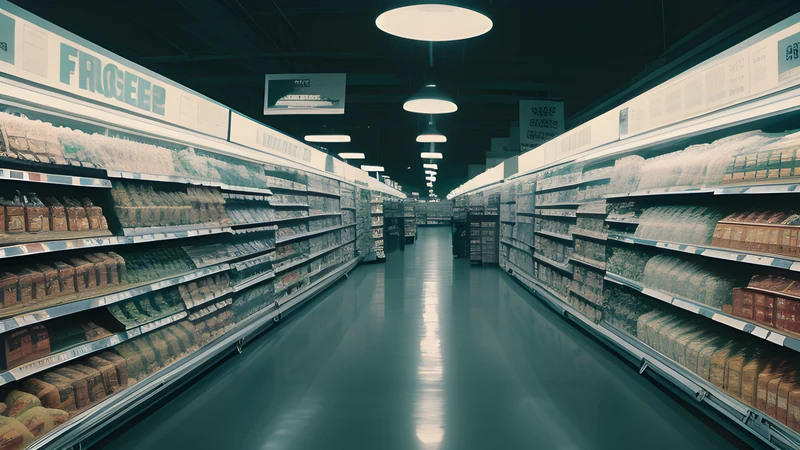
The idea is small and complete: a supermarket, one night, the staff doing a final stock-take because the store has been sold, the doors locked, and someone in the building killing them. That is the entire film. No prologue in 1974, no legend, no institution, no returning brother. A shop, a shift, and a body count.
Who made it
Scott Spiegel came out of the Michigan crowd that produced The Evil Dead — he had grown up making Super 8 films with Sam Raimi and Bruce Campbell, and he had co-written Evil Dead II two years earlier. Lawrence Bender produced, several years before he became the name attached to Tarantino’s filmography. The effects were by KNB, which in 1989 meant Robert Kurtzman, Greg Nicotero and Howard Berger working early and working hard.
The Raimi connection is not trivia. It is the entire aesthetic. Sam Raimi turns up on screen, as does his brother Ted, and Bruce Campbell appears at the end, and the film is essentially the Michigan gang demonstrating that everything they had learned in a cabin in Tennessee transferred to a grocery store in Los Angeles without modification. The Evil Dead method — camera as a physical object with opinions, mounted on things, shoved through spaces, refusing ever to be a neutral witness — is here applied to a genre that had spent a decade using the camera as a locked-off tripod with a knife in front of it.
The camera is the film
This is where Intruder justifies the ninety minutes. Spiegel mounts the camera on everything in the building. A shot from inside a telephone as the dial rotates. A shot from underneath a shopping trolley, tracking along the floor at ankle height. The camera rides a broom. It rides a mop bucket. It comes up out of a sink. Every one of these is a shot that a competent director would have covered with a medium two-shot, and Spiegel instead asks what the store sees.
The technique has a purpose beyond showing off, and the purpose is the reason the film works. A supermarket at night is a space that everyone in the audience knows and nobody in the audience has ever really looked at. It is designed to be invisible — the shelving, the strip lights, the walk-in freezer, the compactor, the loading bay. Spiegel’s stunt camera keeps insisting that the invisible architecture is there, and once you are aware of the geography, the dread has somewhere to live. You know there is a room behind that door because the film showed you the door from inside a telephone. That is a genuinely clever piece of construction, and it is the only slasher of its year doing anything of the sort.
The lighting does the other half. Cinematography plays the aisles as corridors with vanishing points, the strip lights leaving deep gaps between the runs, so that a person can be forty feet away and completely gone. Compare the way Halloween uses the suburban street as a space with too much depth — Carpenter’s shape standing in an area of frame you did not know was occupied. Spiegel is running the same trick in a building where every sightline is engineered to sell you biscuits.
The gore and the board
The KNB work was extensive and most of it was removed. Intruder was gutted for its rating on original release, and the version that reached video for years was missing the sequences the film had been built around — a problem it shares with half the late cycle, and one that has since been repaired by a restored home-video release that puts the effects back.
The set-pieces make use of what a supermarket contains, which is a room full of industrial equipment for processing meat. That is the joke, and Spiegel does not oversell it: the store is not a metaphor, it is simply a place that already has a bandsaw and a compactor in it and did not need a screenwriter’s help. The effects are wet, generous and staged in unhelpful light, and they are the reason the film has a cult.
The removal of gore from these films was rarely a moral act with a moral effect; it mostly produced incoherent movies. There is a longer argument to have about what the body count in a slasher is actually for — the accountancy of who dies and why, laid out in the slasher’s body count as moral accounting — and Intruder is an interesting test case, because its victims are people at work. They are not teenagers punished for sex. They are shop staff on a late shift, being killed among the stock they are counting.
One more craft note, because it is the detail that convinced me the film is smarter than its reputation. Spiegel repeatedly shoots people through the shelving — the camera in one aisle, the actor in the next, the frame sliced into horizontal bands by stacked tins. It is a cheap effect, available to anyone standing in a shop, and it does two jobs at once. It fragments the body before anything has happened to the body, so the film’s later dismemberments are visually pre-figured by a supermarket doing its ordinary work. And it establishes, without a line of dialogue, that in this building you can always be seen by someone you cannot see. That is the whole grammar of a stalking film, discovered in the crisp aisle.
The real ancestor
The obvious reach is Chopping Mall, three years earlier, or Dawn of the Dead for the retail-space-as-arena. Both are wrong, or at least secondary. The real grandparent of Intruder is Evil Dead II — the same year’s Spiegel co-writing credit, the same relationship between camera and space, the same conviction that a low budget is an argument for movement rather than against it.
Behind that sits the giallo, which had been mounting cameras inside things since the sixties, and which gave the American slasher its whodunit skeleton and its fetish for a killer’s point of view. The giallo’s fingerprints on the modern slasher traces the inheritance; Spiegel’s contribution is to notice that the Italians were doing it with money and that you could do it with a broom handle and a mate holding a light.
There is also a strain here of the pure single-location slasher, the sort that survives on geography alone — the same logic that makes Terror Train work by locking its cast in carriages. Constrain the space, and the film has to earn its scares through blocking. Intruder is the supermarket entry in that tradition, and there are not many others.
The case against
The people are cardboard. The film has almost no interest in its cast beyond their availability for set-pieces, and the romantic subplot exists to supply a red herring rather than a character. The dialogue is filler. The mystery, such as it is, holds together only because the film moves too quickly for you to think about it.
More seriously: the technique occasionally eats the tension. A shot from inside a telephone dial is delightful and it is also, for three seconds, a shot that reminds you a crew built a rig. Raimi’s genius was that the wildest camera moves in Evil Dead II served a film that had already convinced you to be frightened. Spiegel has the moves without quite having the film underneath them, and there are passages where Intruder is a demo reel with a plot attached.
The film’s other liability is that it arrived at the end of the argument. In 1989 the audience for a straight-faced slasher had largely gone; the cycle’s survivors were either franchises coasting on a mask or self-aware comedies waiting for Scream to make the mode official. Intruder is neither. It plays the material entirely straight while shooting it like a cartoon, and that mismatch is thrilling for anyone who has seen two hundred of these and baffling for anyone who has seen none. It is, in the least insulting sense, a film for people who already like the form.
I would still hand it to anybody who thinks the 1989 slasher had nothing left. Where to find it: look for the restored version with the effects reinstated. The cut one is a different and much worse film.
Spoilers below
The film runs a whodunit — the store is full of suspects, and the most obvious of them is a violent ex-boyfriend who turns up early, makes a scene, and is thrown out. He is a red herring in the plainest possible sense, and the film uses him exactly as the giallo would: a loud, ugly man positioned to absorb your suspicion so that the quiet one can work.
The killer is inside the operation. That is the structural point and it is why the sale of the store is in the script at all. Everything in the film’s setup — the stock-take, the buyout, the staff being made redundant by a transaction they had no part in — exists so that the violence has an economic engine. A man is losing something he thought was his, and the film’s answer to the question every slasher must answer is: money. It is the least mythological motive in the entire cycle. No Harry Warden, no legend, no burned caretaker. A business deal.
That is quietly the most interesting thing about it. The 1980s slasher almost always locates its evil in the past — a drowning, a prank, an accident at a dance, a wrong done years ago that returns with a mask on. Intruder locates it in the present tense, in the paperwork, and its final act is a man walking through his own workplace destroying the people he has worked beside because the arrangement has changed. The film never says a word about Reagan-era retail or the disposability of shift work. It does not need to. It simply sets the whole thing in a shop that is being sold and lets you count.
Bruce Campbell’s late appearance closes it on a shrug, which is about right. The authorities arrive after the film is over, look at the mess, and understand none of it. Nobody in Intruder is avenged. The store still gets sold.
Related Content