Inside (À l'intérieur): New French Extremity at Its Cruellest
Bustillo and Maury's Christmas-Eve home invasion is the movement's meanest, tightest film
Contents
Some horror films want to disturb you. À l’intérieur — released internationally as Inside — wants to injure you, and it very nearly succeeds. Alexandre Bustillo and Julien Maury’s 2007 debut is the point where the wave of French horror that critics christened the New French Extremity reached its most concentrated, unforgivable form: ninety minutes in a single house, one pregnant woman, one intruder, a pair of scissors, and a level of physical damage that most of the genre only gestures at. Almost twenty years on it remains a hard film to recommend and an impossible one to dismiss.
I have watched it three times, which is more than most people manage, and each time I have come away with the same double reaction — admiration for how ruthlessly it is built, and a genuine need to sit somewhere bright afterwards. This is a revisit, so I will get to the mechanics of the ending below the line. Above it, what matters is understanding what Bustillo and Maury were actually attempting, because the gore is the surface and the design underneath is what makes the film endure.
The setup, stripped to the bone
Sarah is a photographer, heavily pregnant, whose husband was killed in a car crash — she was in the passenger seat and survived. The film opens on the wreck and the loss, and then jumps forward to Christmas Eve. Sarah is due to be induced the next morning; she has chosen to spend the last night alone in her house, cold and withdrawn, a woman going through the motions of a life she no longer wants. Alysson Paradis plays her with a numbed, exhausted flatness that the film will spend the rest of its running time detonating.
After dark, a woman knocks. She asks to use the phone. She knows Sarah’s name, knows her husband is dead, and will not leave. This is La Femme — the Woman — played by Béatrice Dalle, and Dalle is the reason the film works at the level it does. She is a horror antagonist with the gravity of a tragic lead: implacable, grief-stricken, entirely without hesitation. She wants the child inside Sarah, and she intends to take it out herself.
That is the whole plot. The genius of the construction is the compression. Bustillo and Maury lock the story into one location and one night and let the situation escalate with the pitilessness of a maths proof. People come to the door — Sarah’s mother, her editor, a trio of policemen with an arrested youth in the back of the van — and the film uses each interruption to raise the cost, because everyone who enters the house becomes a problem the Woman has to solve.
Where it sits in the movement
The New French Extremity was never a coordinated school so much as a critic’s bracket for a run of savage French films around the turn of the century — Gaspar Noé’s Irréversible, Marina de Van’s In My Skin, Alexandre Aja’s Haute Tension, and above all Pascal Laugier’s Martyrs. What united them was a willingness to film physical violation without the usual generic cushioning, and to aim it at the body as a site of meaning. Inside is the movement’s purest home-invasion entry, and it makes an instructive pair with Martyrs, which arrived a year later with an explicit metaphysical thesis bolted onto its brutality.
The comparison is worth drawing because it clarifies what Inside is and is not doing. Laugier’s film wants its suffering to mean something cosmic; it is arguing about transcendence. Bustillo and Maury are more austere. Their film is about maternity and grief rendered as physical siege, and it declines to console you with a larger idea. The two women are mirror images — both bereaved, both defined by a lost or wanted child — and the horror is that their needs cannot both be satisfied, and neither will yield.
There is a family resemblance, too, to the broader tradition of films that make the violation of the innocent unbearable. Who Can Kill a Child? inverts the terms — there the children are the threat — but it shares Inside’s refusal to let the audience off the hook where the vulnerable are concerned. And in its portrait of a mother undone by a death she cannot process, Inside rhymes strangely with a gentler ghost story like The Others, where grief for a lost family curdles into something monstrous and self-consuming. Bustillo and Maury simply externalise the monster and hand it a blade.
Why it works — the craft under the blood
The reputation of Inside is its violence, and the violence is real: the practical gore effects are extraordinary, wet and weighty and staged with a butcher’s confidence. But the film would not have survived on gore alone. What holds it together is design.
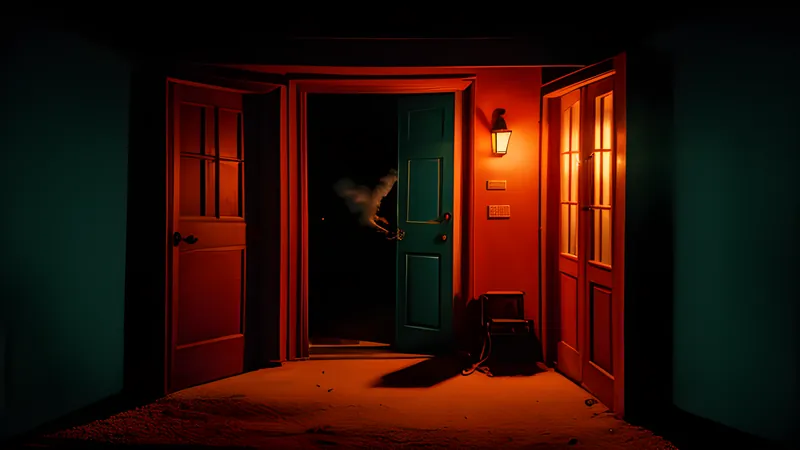
First, the colour. The house is lit in deep reds and blacks, and as the night wears on the compositions grow more painterly and more infernal, until the domestic space reads as an abattoir lit by Caravaggio. Cinematographer Laurent Barès treats blood as a light source. Second, the sound and the pacing — the Woman moves without hurry, and the film’s terror comes from her patience as much as her cruelty. Dalle never runs. She waits. Third, and most important, the film gives Sarah agency; she fights, hides, improvises, and is not merely a body to be opened. The suspense depends on us believing she might survive, which means the film has to keep the outcome genuinely in doubt.
There is a formal echo of the giallo in all this — the black-gloved intruder, the emphasis on the cutting instrument, the aestheticised bloodletting — and anyone who admires the operatic murder set-pieces of Deep Red will recognise the DNA. Bustillo and Maury strip the giallo of its mystery plot and keep only its cruelty and its beauty, then set the whole thing in one house on the worst night of a woman’s life.
Verdict
Inside is the meanest, most tightly engineered film the New French Extremity produced, and its cruelty is earned rather than gratuitous — every escalation follows from the premise, and the premise is grief. It is not a film I would put in front of anyone who does not already know what they are asking for. For the viewer who wants to understand how far the body-horror wave was willing to go, and how much craft can coexist with genuine savagery, it is essential. Watch it once. You will not forget it, and you will not need to be told to stop.
Where to watch: it circulates on cult and horror-focused streaming services and on disc from boutique labels; seek the uncut version, since the film exists in trimmed edits that blunt the point. Pair it with Martyrs if you want the full argument of the movement, and give yourself a day between them.
Spoilers below
The film’s cruellest structural choice is that it refuses to let anyone save Sarah, and it makes each rescue attempt worse than the last. Her mother arrives, is mistaken in the dark, and Sarah accidentally kills her — the first of the film’s terrible ironies, that the victim’s own defence claims an innocent. The photo editor comes to check on her and is dispatched by the Woman. Then the police arrive with a young man in custody, and for a moment the arithmetic of survival seems to shift in Sarah’s favour: three armed officers in the house.
Bustillo and Maury use them to twist the knife. The Woman turns the situation, the officers are killed in sequence, and the surviving policeman, concussed and confused, ends up beating Sarah himself, mistaking her for the threat. Every figure of protection in the film becomes an instrument of harm. By the last act the house is full of corpses and Sarah is barely conscious, and the Woman finally has her alone.
The ending is the reveal that reframes the Woman’s motive. Through flashback the film discloses that she was the driver of the other car in the crash that killed Sarah’s husband — the accident that opened the film — and that she lost her own child in it. She is not a random intruder. She is the other mother from the wreck, come to claim the surviving baby as a replacement for the one the same collision took from her. Both women were in that crash; both lost; only one is still carrying a child.
The final image is unbearable and exact. Sarah has gone into labour, and she cannot deliver — the injuries, the blood loss. The Woman performs a crude Caesarean with her scissors, extracts the living infant, and sits at the top of the stairs in the red light, cradling it, rocking, the surviving policeman and Sarah both destroyed around her. The last shot holds on the Woman with the child, serene at last. The film’s real horror is not the gore. It is that the monster gets exactly, precisely what she came for, and that her grief was real all along.
Related Content