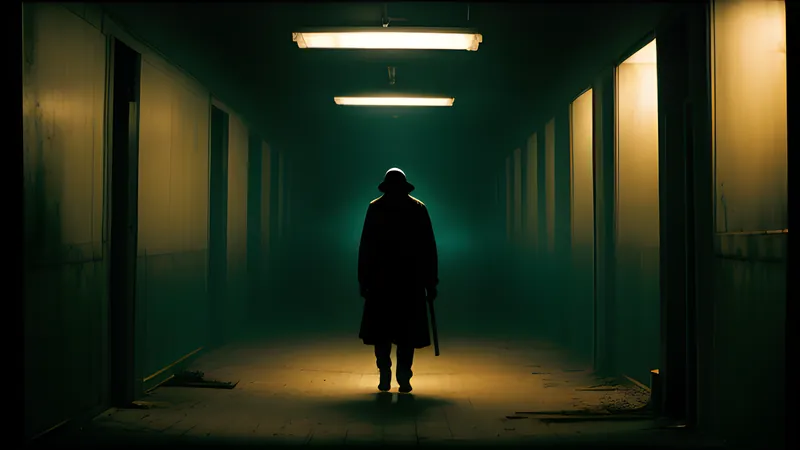
Infernal Affairs: The Original Scorsese Remade
The Hong Kong thriller that The Departed borrowed its bones from
Contents
There is a good chance you have seen Infernal Affairs without knowing it, because Martin Scorsese won his only Best Picture Oscar for the remake. The Departed is a fine, foul-mouthed, blood-soaked Boston opera, and it owes its entire skeleton — two moles, one planted by the police inside the mob, one planted by the mob inside the police, each racing to unmask the other before he is unmasked himself — to a taut 101-minute Hong Kong thriller from 2002 that most Western audiences never bothered to find. Directed by Andrew Lau and Alan Mak, Infernal Affairs is the leaner, sadder, more elegant film, and revisiting it after the remake is a lesson in how much can be gained by cutting rather than adding.
The premise is a perfect machine. Chan Wing-yan (Tony Leung) is a police cadet washed out of the academy so his true assignment can begin: a decade undercover inside a triad, so deep that his own file is known to only one man. Lau Kin-ming (Andy Lau, no relation to the director) is a triad recruit sent in the opposite direction, rising through the police ranks as his gang’s man on the inside. Both have spent ten years being someone else. Both are exhausted by it. And when a drug bust goes wrong because each side has a leak, both are ordered to find the mole — which means each man is hunting himself.
Two men, one mirror
The film’s masterstroke is symmetry, and Lau and Mak shoot it as a series of rhymes. The two moles are photographed the same way, framed in the same reflective surfaces, given parallel scenes with the same therapist and the same longing for an ordinary life they can no longer have. Tony Leung, one of the most soulful actors alive, plays Yan as a man rubbed raw by a decade of pretending, jumpy and tender and sick of it. Andy Lau plays Ming as the smoother article — a criminal who has grown to like being a policeman, who might actually prefer the clean life if he could only erase where he came from. The tragedy is loaded from the first frame: one of these men wants out of the underworld, the other wants out of his own past, and the plot exists to deny them both.
Where The Departed is loud, profane and two and a half hours long, Infernal Affairs is cool, spare and moves like a chess endgame. Scorsese’s version adds psychosexual heat, a shared girlfriend, Jack Nicholson chewing the scenery as a devil. The original trades all of that for restraint. Its bosses — Anthony Wong as the sad-eyed police superintendent who is the only man who knows Yan’s identity, Eric Tsang as the triad chief Sam — are quieter and, in their way, more frightening, because they operate through loyalty and obligation rather than madness. The film respects the intelligence of everyone in it, including the villains, and that respect is a large part of its adult melancholy.
Why the craft works
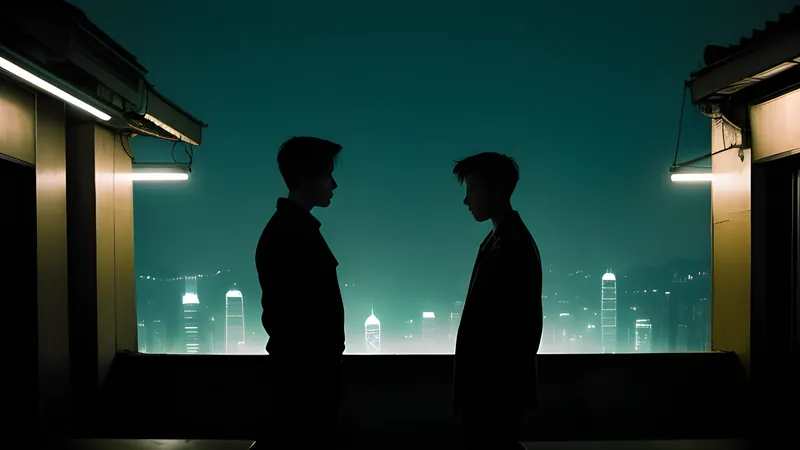
The signature set piece is a masterclass in tension built from almost nothing. Yan taps out Morse code to his handler during a triad meeting while, across the city, Ming intercepts the same signal for the police, each side sending its mole to sniff out the other in the same crowded moment. Two men in two rooms, both listening, both hunted, the geometry tightening with every cut — Lau and Mak sustain it through pure cross-cutting and a ticking sense that any careless glance will end a life. The rooftop meetings, shot against the flat wash of a Hong Kong sky, give the film its recurring image: two men in the open, exposed, negotiating a way to survive each other.
The title matters more than the English one suggests. Mou gaan dou refers to Avīci, the deepest and most unremitting level of Buddhist hell, reserved for continuous suffering without escape. That is the film’s real subject — the two moles are damned to an endless present of pretending, and the horror the film keeps returning to is the impossibility of ever being oneself again, a fate that outlasts any bullet. Scorsese’s title, The Departed, points at the body count. The original points at the soul. It is a more Buddhist, more fatalistic film, and the fatalism gives it a gravity the flashier remake never quite reaches.
The cinematography, by director Andrew Lau himself along with Lai Yiu-fai, favours cool blues and glass and reflection, a city of surfaces in which everyone is watching everyone through a pane of something. The look launched a thousand imitators across Asian crime cinema and beyond. What holds up is the discipline: not a wasted shot, not a scene that outstays its welcome, a thriller that trusts silence and stillness to do the work that lesser films do with a raised voice.
The editing keeps the two timelines legible even as they braid tighter, and the score — sombre strings over the rooftop scenes — leans into elegy rather than adrenaline. There is a running motif of stereo equipment and hi-fi audio, Ming forever chasing a cleaner sound, that quietly doubles the film’s theme: a man obsessed with fidelity who has none himself. Small touches like that are why the film rewards a second viewing. The plot is a clockwork trap, but the melancholy is hand-stitched into every corner of the frame.
The company it keeps
Infernal Affairs is the great modern statement of a very old crime-film idea: that the cop and the criminal are the same man wearing different coats. The purest earlier version of that idea on this site is Heat, Michael Mann’s Los Angeles epic, where De Niro’s thief and Pacino’s detective meet across a diner table and recognise each other as reflections. Lau and Mak take Mann’s mirror and shatter it — instead of two men who resemble each other, they give us two men who have literally swapped places, and let the resemblance become a prison.
It also sits at the head of the modern Asian crime wave that this desk keeps circling back to. For the register of operatic vengeance that Korean cinema would push further the following year, see Oldboy, Park Chan-wook’s revenge nightmare — where Infernal Affairs is all cool restraint, Park goes for the throat, but both films are built on a buried identity and a reckoning that arrives too late. Watched together they map the two poles of the early-2000s Asian thriller: the Hong Kong film’s glassy fatalism and the Korean film’s howling excess.
The verdict, argued rather than stamped: Infernal Affairs is the better film of the pair, and I say that with real affection for the Scorsese. The remake is richer, funnier, more textured. The original is cleaner, sadder and truer to its own idea, and its economy is the point. It says everything The Departed says in an hour less, and it says it with a fatalism the American film sands down for a more satisfying, more violent finish. Start here. Then watch how a genius borrowed it.
Spoilers below
The engine of the ending is a single, unbearable fact: the one man who could prove Yan is a policeman dies before he can. Superintendent Wong, Yan’s sole handler and only link to his real identity, is thrown from a rooftop by the triads, and with him goes the file that would let Yan come home. Anthony Wong plays the death without fuss, and it strands Yan completely — a policeman with no proof he is one, trapped inside the criminal life for good, his exit erased in a single fall.
The genius twist is that Ming, the triad mole, ends up being the officer assigned to hunt the police leak — which is to say, himself. When Yan finally makes contact, believing he has found an ally who can clear him, he is walking straight to the one man who most needs him dead. Their confrontation on the rooftop, gun drawn, is the film’s fulcrum, and the two versions of the story diverge here in ways worth comparing. In the original Hong Kong cut, Yan is shot dead in a lift by another hidden triad mole at the moment his rescue seemed possible, and Ming, exposed to no one, is left alive to face the deepest punishment the title promised: he keeps his stolen life as a decorated policeman, knowing exactly what he is, condemned to the continuous hell of getting away with it. A mainland-market alternate ending was shot in which Ming is arrested, to satisfy censors who required that crime be seen to be punished. The original is crueller and correct. Damnation, the film insists, is not the bullet. It is having to go on living as the wrong man forever.
Related Content