Iceman: The Thawed-Neanderthal Sci-Fi Drama
A man comes out of the ice alive, and the scientists have to decide what he is
Contents
An Arctic research team cuts a block out of the ice and finds a man inside it. He has been there for forty thousand years. He is, against every reasonable expectation, revivable. And Iceman (1984) — this is the whole reason it works — declines to make that the climax. The thaw happens early, the man wakes up, and the film spends the rest of its running time on the only question that actually matters, which is what the people who found him are going to do with him now.
The plainest science fiction of its decade
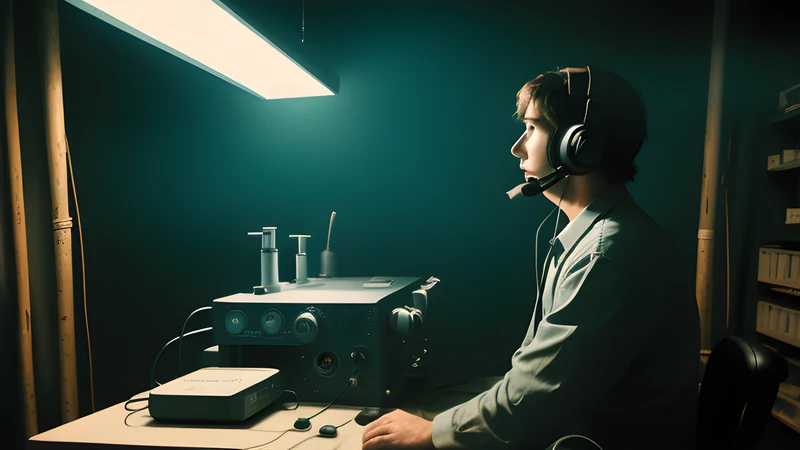
Fred Schepisi came to this from The Chant of Jimmie Blacksmith and Barbarosa, and he brought with him an Australian director’s suspicion of decoration. There is no wonder-cue when Charlie opens his eyes. There is a room, some equipment, a lot of very tired people in parkas, and a body on a table that starts to move. Schepisi and his regular cinematographer Ian Baker shoot the facility as a workplace: cold light, functional geometry, people talking over each other because they have a job on.
That restraint is the film’s whole strategy, and it has aged extremely well. Science fiction of the mid-eighties was in an arms race about spectacle, and Iceman opts out entirely. Its most impressive effect is a man breathing. Every production decision is bent towards making you believe you are watching a real research station handle a real emergency, so that when the ethical argument arrives it arrives as a staffing dispute rather than as a debate.
John Lone is the film
Charlie is played by John Lone, and the performance is one of the strangest and most complete of the decade. Lone was Hong Kong-born, trained in Peking opera, and would go on to Year of the Dragon and The Last Emperor; what he does here, under prosthetics, with almost no intelligible language available to him, is build an entire interior life out of posture, breath and attention.
The critical choice — and it is Lone’s, as much as the script’s — is that Charlie plays throughout as a competent adult from a functioning culture who has woken up somewhere incomprehensible. He has skills. He has manners. He has a religion, and he practises it. He assesses. He tests surfaces. He works out who in the room holds authority, and he is right. When he is frightened, he is frightened the way an adult is frightened, with calculation running underneath it. The film’s most uncomfortable stretches are the ones where you watch him arrive at accurate conclusions about his situation, several scenes before the scientists notice that he has.
Timothy Hutton plays Shephard, the anthropologist, who wants to talk to him. Lindsay Crouse plays Brady, who wants to understand the biochemistry that let a body survive the ice, and who is not a villain for wanting it. Danny Glover is in the crew, doing early-career work with a physical ease that the film uses well. The design of the argument between Hutton and Crouse is careful: both are right, both are decent, and the institution funding them has a third position that neither of them controls.
The face
The makeup is the reason this film could have failed in its first reel, and the design solves the problem by refusing to solve it decoratively. Charlie’s face carries the anatomical markers — the brow, the jaw, the proportion — and stops there. There is no snarl built into it, no fangs, no attempt to make the audience uneasy on sight. The prosthetic leaves the eyes and the mouth almost entirely free, which is a costly choice in materials and an obviously correct one in performance, because everything Lone has to do he has to do with those two features.
Compare it with almost any other prehistoric-man design of the period and the discipline stands out. The default is to build a mask that acts on the performer’s behalf, telegraphing brute or innocent before a scene begins. This one is a piece of anthropology that gets out of the way. You look at Charlie and you see a face that is unfamiliar and entirely legible, and within a minute you have stopped reading it as a special effect and started reading it as a person, which is the only condition under which the rest of the film can function.
The costume follows the same rule. Charlie is dressed by the facility, in the facility’s own clothing, and the sight of a forty-thousand-year-old man in institutional cotton does more to establish the film’s discomfort than any amount of skins and furs would have. He has been processed. He is wearing what the building issues.
Why the vivarium works
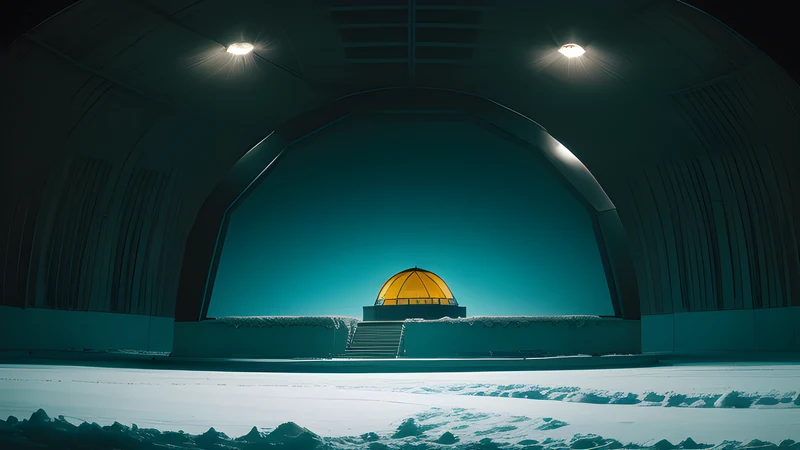
The film’s best craft decision is the habitat. Charlie is housed in an enormous enclosed dome — a manufactured environment, scaled to a landscape, built inside a facility — and observed through glass by people with clipboards. Schepisi shoots it two ways. From outside, it is a beautiful piece of engineering full of scientific promise. From inside, at Charlie’s eye level, it is a cage with a painted sky, and the seams are visible.
The film never says this out loud. It just alternates the two viewpoints until you have understood the entire ethical structure of the story without a word of dialogue about it. The technique here is an editing pattern rather than a shot or a cut, maintained across ninety minutes and never once underlined. It is Island of Lost Souls without the sadism — a laboratory whose real experiment is on the experimenters.
The other superb sequence is the first successful contact, which happens through music. Shephard, exhausted, sings at him through a mask. It is badly sung, it is absurd, and something in it crosses. The scene works because Schepisi refuses to score it, refuses to cut to a reaction shot of the observers cheering, and holds on two men in a plastic tent finding a frequency. Nothing else in eighties science fiction is quite like it.
The case against
The institutional villainy is underweight. The film needs corporate pressure to generate its third act and provides it in the form of decisions made offscreen by people we barely meet, which lets the story escalate without anyone in the cast having to be seriously culpable. A harder film would have made Brady the antagonist and stayed with her.
The middle sags. There is a stretch of perhaps twenty minutes where the picture is essentially a series of observation scenes without escalation, and Schepisi’s patience tips over into passivity. The screenplay by Chip Proser and John Drimmer also cannot resist a certain amount of spiritual reaching — Charlie’s cosmology gets treated with a reverence that sits oddly next to the film’s otherwise unsentimental eye.
And it must be said that the science is a wish. The premise requires you to grant a revival that no biology permits, and the film is so committed to procedural realism everywhere else that the one impossible thing sticks out further than it would in a more fanciful picture.
The real ancestor
The obvious comparison is 1982, two years earlier, and the other film about a research station in the ice that digs up a body: The Thing. The pairing is almost too neat. Same ice, same buried man, same dome full of specialists — and the exactly opposite question. Carpenter asks what the thing in the ice will do to us. Schepisi asks what we will do to the thing in the ice. Watch them as a double bill and the second one plays as a rebuke to the first, which is unfair to Carpenter and useful anyway.
The closer relative is Enemy Mine (1985), which arrived the following year with the same conviction that the science-fiction event worth filming is two beings learning each other’s grammar. And the year’s true sibling is The Philadelphia Experiment, released within months of it: another 1984 film about a man dragged out of his own era into a facility full of people who want to study him, and another one whose best scenes are just incomprehension, well played.
Further back, the ancestor is Bride of Frankenstein — the creature who turns out to have more capacity for tenderness than his makers, and the makers who cannot stop being makers long enough to notice. Iceman is that story with the gothic drained out and the funding paperwork left in.
It is easy enough to find and it deserves better than its reputation, which is thin because nobody knew how to sell it in 1984. Go for Lone.
Spoilers below
The dome sequence turns on a discovery that Charlie makes before anyone else does: that the sky is a ceiling. Lone plays the realisation with an economy that is almost cruel to watch — a man looking up, and looking up again, and adjusting his entire model of where he is. From that moment the film is a captivity story and everyone in a lab coat has become a jailer, whatever their intentions.
Brady’s position hardens into the one the institution wanted all along. The blood chemistry that allowed a body to survive vitrification is worth an unimaginable amount, and it can be extracted more reliably from a subject who is no longer walking around. The film stages the argument that follows in a corridor, at normal volume, between two exhausted colleagues, and it is more frightening than any amount of shouting because you can hear them both being reasonable.
Shephard gets Charlie out onto the ice, and the ending is the reason the film is remembered by the people who remember it. A helicopter comes. Charlie takes hold of it — and Lone’s face, in the seconds before he lets go, is doing the film’s entire thesis at once. He has spent the picture explaining, in a language nobody in the facility bothered to learn properly, that a great bird carries you upward at the end. He is not being rescued. He is being answered.
He lets go, and Schepisi cuts before the fall, which is the only merciful decision anyone in the film makes.
Related Content