Hereditary: Grief Wearing a Haunted House
Ari Aster's debut disguises a family falling apart as a film about a cult
Contents
Ari Aster has said that he thinks of Hereditary as a tragedy that happens to have a horror film wrapped around it, and the description is exact enough that you could use it as a warning label. People walked into cinemas in June 2018 expecting a possession picture and got, for roughly ninety minutes, one of the bleakest domestic dramas of the decade — a mother and a family disassembling under a grief so total it has nowhere to go but the supernatural. The demon arrives eventually. By then you have long since stopped needing it.
This was a feature debut, which is faintly ridiculous. First films are usually where a director learns to control tone; Aster arrives already able to hold two incompatible registers in the same frame, the miniaturist’s cool precision and the raw animal sound of a person who has lost a child. Hereditary is a film about inheritance in every sense — grief passed down, illness passed down, and a curse passed down — and its cruelty is that it treats all three as the same substance.
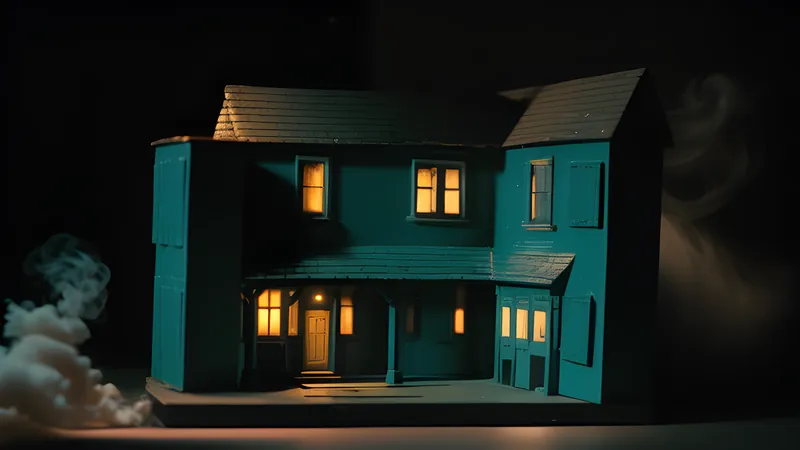
The house that is a model of a house
The first image is a craft thesis. Aster’s camera drifts across a workshop full of Annie Graham’s miniatures — she is an artist who builds obsessively detailed dioramas of her own life — and settles on one of the model bedrooms until, with no cut, an actor walks into it and the doll’s house becomes the real house. We have been told, before a word of dialogue, that these people live inside something made and controlled by a hand they cannot see. The whole film is that shot expanded to two hours.
This is the mechanic that makes Hereditary work, and it is worth naming because so many imitators have missed it. Aster shoots the family home like a diorama throughout — locked-off wide frames, doll’s-house symmetry, the camera positioned where a child playing with figures would hold them. The effect is a slow, creeping loss of agency. You begin to feel that the characters are being arranged. When the horror finally reveals that they are, the film has already trained your eye to accept it, because you have been watching them get moved around the board for an hour. Dread here is a function of framing. The scares are load-bearing, but the geometry is what holds the roof up.
Pawel Pogorzelski’s cinematography keeps the light dim and amber and the house cavernous, full of dark doorways the camera declines to investigate — the great old trick of letting the audience’s eye do the haunting. And Colin Stetson’s score works less like music than like breathing gone wrong, a low saxophone drone that sits under scenes at a frequency you feel in the teeth. None of it announces itself. The film’s surface is calm to the point of clinical, which is exactly why the eruptions land like assaults.
Toni Collette does the impossible
The performance at the centre is the reason the film survives its own machinery. Toni Collette plays Annie as a woman with too much to grieve and no permission to do it cleanly — she carries a family history of severe mental illness, a mother she could not love, and losses she is forbidden by decency from feeling the way she feels. Collette plays grief as something with physical bulk, a thing she has to carry up stairs. There is a dinner-table scene, roughly midway, where an argument with her son detonates into an accusation so unspeakable that the film seems to stop breathing. Collette pitches it at the exact edge of control, a woman saying the truest and worst thing she knows while hating herself for saying it. That she was overlooked at the year’s awards is one of those omissions that ages into embarrassment for the awards, not the actor.
Alex Wolff, as the teenage son Peter, gives the film its other spine — a study in dissociation, a boy who checks out of his own face because what is happening to him cannot be metabolised. Gabriel Byrne plays the father as the film’s only ordinary person, a man of reasonable calm in a house where reason has stopped applying, and his helplessness is its own quiet horror. Milly Shapiro, as the daughter Charlie, does something stranger and harder to describe, which the film will not let me describe yet.
Where it comes from
The obvious grandparent is Roman Polanski’s Rosemary’s Baby, and the debt is real — the slow-boil satanic conspiracy, the coven hiding in plain sight among the well-mannered, the horror of a family that has been chosen and cultivated without its knowledge. But the ancestor Hereditary is really descended from is a grief film rather than a devil film. Aster has been open that he was thinking about domestic drama, and the picture the structure most resembles is the wave of American family tragedies where a child’s death cracks a marriage open and the survivors turn on each other in the ruins. Strip out the occult and Hereditary is that film exactly.
The horror lineage it belongs to is the one where the monster is a metaphor the film refuses to let stay metaphorical. The closest sibling on this desk is The Babadook, where a widow’s grief and rage take the shape of a thing in the house that cannot be evicted, only fed and managed. Both films understand that the scariest haunting is the one you brought with you. And for the specific grammar of grief expressed through editing — associative cuts, premonitions folded into the timeline, a lost child glimpsed where they shouldn’t be — the master text is Nicolas Roeg’s Don’t Look Now, which Hereditary echoes every time it lets an image of the dead bleed into a scene about the living. Aster’s next film would push the grief-as-horror idea into daylight; if this one is the family imploding in the dark, Midsommar is the same wound treated in relentless sun.
The verdict
Hereditary is a great horror film and a slightly cruel one, and the cruelty is the price of its ambition. Some viewers find the final act, where the machinery finally shows itself, a betrayal of the human drama that came before — a switch from grief we recognise to lore we have to be taught. I think that reading mistakes the film’s argument. The whole point is that these people never had a chance, that the grief we spent an hour inside was itself a component of the trap, a designed inheritance. Whether that lands as devastating or as a cheat depends on how much you trusted the film’s opening shot. If you took the diorama seriously, the ending is the only honest place it could go.
What is beyond argument is the craft. This is a film built by someone who understands that horror is a problem of composition before it is a problem of monsters, and who trusts an actor to carry weight that most genre directors would hand to an effect. Watch it for Collette. Stay for the geometry. Then watch what happens when the dolls’ house closes its lid.
Spoilers below
Everything that follows gives away the ending, so stop here if you have not seen it.
The engine of the plot is King Paimon, a demon of the Ars Goetia, and Annie’s late mother — the matriarch whose funeral opens the film — was the head of a cult devoted to giving Paimon a male host. The family were livestock. Charlie, the strange, clicking, allergic daughter, was the demon’s placeholder all along, which is why she never seemed quite like a child; the cult needs to move the spirit into a male body, and Peter is the vessel.
Aster’s most notorious decision is Charlie’s death, and it is a masterclass in how to break a film’s contract on purpose. Peter drives his sister to hospital after a severe allergic reaction; she leans out of the car window for air; he swerves to avoid an animal in the road, and her head strikes a telephone pole. The film does not show the impact. It shows Peter, in close-up, unable to turn around, driving home in silence and lying in his childhood bed while the thing he cannot look at waits on the roadside until morning. Withholding the body is the crueller choice, and it is the correct one — the horror is the boy’s refusal to look, the grief so enormous it cannot even be acknowledged. That single shot of Charlie’s head by the roadside the next morning is delivered flatly, in daylight, and it is worse than any jump scare because the film makes you find it yourself.
From there the possession machinery takes over. Ann Dowd’s Joan is the cult’s recruiter, luring Annie toward a séance under cover of shared bereavement — the Rosemary’s Baby coven, updated. The decapitations of the finale, the naked cultists in the shadows of the family home, the coronation of Peter’s body as Paimon’s host in the treehouse: it is deliberately, almost operatically excessive, a horror climax that abandons the domestic register entirely. I understand why it divides people. But return to the diorama. The family were figures in someone else’s model from the first frame, and a tragedy where the victims never had agency has to end with agency taken completely. Annie’s grief, Peter’s dissociation, Charlie’s wrongness — all of it was the demon’s inheritance being collected. The house was always a doll’s house. The hand that arranges it simply stopped hiding.
Related Content