Hell Night: Linda Blair in the Haunted Frat House
The slasher that wandered into a gothic novel and decided to stay
Contents
Most American slashers of 1981 were shot in places you could rent for very little money: summer camps out of season, suburban streets, high-school gyms, the woods. The economics dictated the iconography, and the iconography hardened into the genre. Then Hell Night turns up with a candelabra.
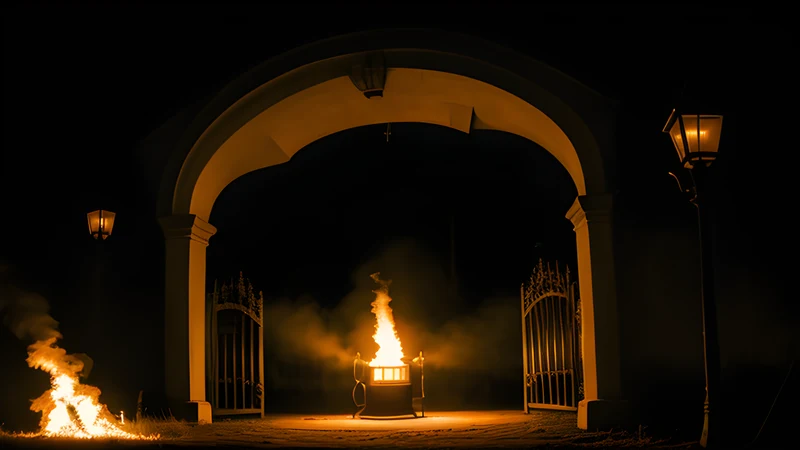
Tom DeSimone’s film puts four fraternity and sorority pledges inside Garth Manor for a hazing dare, and the manor is the whole argument. It has wrought-iron gates, a gatehouse, a wine cellar, a portrait gallery, hidden passages behind the walls and a cellar system that runs under the grounds. It is the set of a 1930s Universal picture that has somehow been invaded by teenagers in period costume, and for eighty-odd minutes that collision is the film’s entire personality.
I came to this one the way I came to most of the 1981 crop — off a video-shop shelf a decade after the fact, working through the slasher rack in the order the covers appealed to me. Hell Night was the one that looked wrong. Everything around it promised a masked man in a field. This one promised a haunted house, and unusually for that shelf, it delivered the thing on the cover.
The producer had done this before
The name to notice on the credits is Irwin Yablans, producing with Bruce Cohn Curtis. Yablans had put together Halloween in 1978 through Compass International, and the success of that film is the reason Hell Night exists in the shape it does. He knew the arithmetic of the form better than almost anyone working: a contained location, a small cast, a night, a threat, a survivor.
What he does here is spend the contained-location budget on something ornate instead of something cheap. Garth Manor was shot largely at Kimberly Crest House in Redlands, California — a real Victorian pile with real staircases and real grounds. That decision costs money at the front end and pays for itself in every frame afterwards, because the production never has to fake atmosphere with fog and a synth cue. The atmosphere is standing there in the wide shot, load-bearing.
The setup is efficient enough to be worth stating plainly. Twelve years earlier, Raymond Garth killed his family in the house. The story the pledges are told is that one of the children survived and is still inside. The fraternity’s president stages the hazing as a night locked in the manor, and salts it with pranks designed to terrify the pledges. The pranks and the actual threat then get tangled, which is the film’s best structural idea: for a long stretch nobody inside the house can tell whether the thing in the corridor is a boy with a bedsheet or the reason the house is empty.
The restraint is the craft
Hell Night arrived in August 1981, in the middle of the period when the Motion Picture Association was cutting American slashers hard and the genre was being publicly scolded for its gore. The film was trimmed to secure its R, and the striking thing on a rewatch is how little that seems to have hurt it — because DeSimone and cinematographer Mac Ahlberg were never building the film around the wounds.
Ahlberg is the reason the film looks like this. He was a Swedish cinematographer with a long European career behind him who would go on to shoot Re-Animator and From Beyond for Stuart Gordon, and he lights Garth Manor as though it were a gothic melodrama. Practical sources — lanterns, candles, torch beams — do most of the work, and the frame keeps its blacks genuinely black. Corridors go dark at the far end and stay dark. Doorways read as holes. When a torch swings, the light finds an inch of a face and loses it again.
That approach produces a specific kind of dread that gore cannot buy. You spend the film scanning the edges of the image, because the film has trained you to believe something is standing in them. Contrast this with the 1980 crop’s tendency to cut hard to a wound as the payload of a sequence — Hell Night is far more interested in the ninety seconds before the wound, and it stages those seconds in depth. Characters cross rooms in wide shots. The camera holds. Something is wrong in the frame and you find it yourself, a beat before the character does.
The hidden-passage architecture is the other piece of craft worth naming. Once the film establishes that the manor’s walls are hollow and connected, every room in the house becomes provisional. A locked door stops meaning anything. That single production-design choice quietly dismantles the audience’s ability to feel safe anywhere in the geography, and it does it without a line of dialogue.
Linda Blair is the load-bearing wall
Blair was twenty-two, and she had been carrying the weight of The Exorcist for eight years. That film had made her one of the most recognisable faces in horror at fourteen and then left her with a career that never quite escaped it — a run of television, a run of exploitation, a public identity fixed to a role she played as a child.
She is very good here, and specifically good in a way the genre rarely asked for. Her Marti Gaines is a mechanic’s daughter at a party full of people with money, and Blair plays her as watchful and slightly outside the group from the first scene. It gives the film a class current that runs under the hazing plot: Marti’s competence with engines and locks and tools is established early as characterisation, and pays off later as survival. The film respects her intelligence, which is more than a lot of 1981 managed.
She also does the practical work of the part properly. Blair sells fatigue, and sells thinking, and she does the long stretches of running and hiding without the performance flattening into shrieking. Set her against what the form usually offered — see the final-girl rule and the films that broke it — and Marti stands out for having a skill set rather than just endurance.
The real ancestor is not a slasher at all
Everyone files this next to Halloween, because of Yablans and the date. The genuine ancestor is the old dark house film: the 1920s and 1930s tradition of a group locked overnight in a mansion with a secret and a survivor in the walls. The Cat and the Canary, James Whale’s The Old Dark House, and most directly William Castle’s House on Haunted Hill, where a group is paid to spend a night in a house and the gimmick is the whole show.
Hell Night is that film with the dates changed. The hazing is Castle’s cash prize. The pledges are Castle’s guests. The manor’s history of family murder is the old dark house’s inheritance plot. What 1981 adds is a body count and a survivor who fights back, and the graft works because the gothic mansion was always a horror machine — the slasher just borrowed it back.
Watch it against Halloween and the difference is architectural. Carpenter’s suburb is horizontal, empty and bright; Haddonfield’s terror is that nothing is hidden and the shape stands in plain view. Garth Manor is vertical and stuffed and dark, and its terror is that everything is hidden. Both films are essentially about geography, and they argue opposite cases.
The closer sibling in its own year is The House on Sorority Row, which also runs a prank-gone-wrong through a big old building and also understands that Greek-system cruelty is free plot. And Prom Night from the year before shares the DNA of a group punished for something they did together — though Prom Night wants disco and Hell Night wants Poe.
The honest case against it
It is slow. The middle of the film is a long sequence of people walking through dark rooms with torches, and DeSimone stretches several of those beyond what the tension can carry. There is a stretch around the halfway mark where the film is essentially marking time until the next reveal, and you feel the length.
The male characters are thin. Blair gets an interior life; the three pledges beside her get a defining trait each and very little else, and one of them is written almost entirely as a joke about a posh accent. The film is not interested in them, and it shows.
The threat, when the film commits to showing it, loses some of its power. This is the standard slasher problem and Hell Night does not solve it — a shape in a dark corridor is more frightening than any make-up appliance, and once you can look at the thing squarely, some of the manor’s charge drains away.
Where to find it
Hell Night has been well served on disc — Scream Factory’s restoration in particular is a genuine upgrade on the murky video-shop presentation most of us first met, and it matters here more than it would elsewhere, because Ahlberg’s blacks are the film. A bad transfer turns his careful darkness into grey soup. Find a good one. It plays best late, with the lights off, on the kind of night where the film’s willingness to hold on an empty doorway becomes unbearable.
The verdict is this: Hell Night is a minor film that made one major decision, and the decision was to take the slasher’s disposable teenagers and put them inside a haunted house that predates the genre by fifty years. Everything durable about the film flows from that. It is the 1981 slasher that remembered horror had furniture.
Spoilers below
The film’s smartest move is that the Garth story is true, and slightly wrong. There is a survivor in the house, and the pledges’ assumption that there is only one is the mistake that kills most of them. The revelation that two of Raymond Garth’s children lived — the smaller, quicker one the film shows you first, and the far larger one below the house — retroactively repairs the middle stretch. The pranks and the deaths could overlap for so long because there was more than one thing moving in the walls.
Marti’s survival is earned rather than granted, which is the film’s real distinction. She uses the gatehouse tools. She uses the car. She uses what the script established about her in the first ten minutes — she is the one character who understands machinery, and the climax turns on exactly that. When she goes through the gates at the end, it is because she made the gates open.
The last shot leaves her alive and lit by dawn, and the film declines the sting the era loved. After a night of the house owning everyone inside it, Hell Night lets the survivor simply leave. It is an oddly gracious ending for a hazing picture, and it is part of why the film has aged better than its reputation.
Related Content