He Walked by Night: The Docu-Noir That Inspired Dragnet
John Alton's storm drains, a killer who builds his own equipment, and the police show born on this set
Contents
The narrator tells you at the start that this is Los Angeles, that the story is true, and that only the names have been changed. It is the standard opening of the semi-documentary crime cycle, delivered in the standard voice — flat, male, civic, faintly bored — and it is the least interesting thing in the film. What follows is one of the most beautifully photographed pictures ever made in America, and the tension between the narration’s dull municipal confidence and the images underneath it is, I would argue, the whole reason He Walked by Night is still worth ninety minutes.
Eagle-Lion released it at the end of 1948. The credited director is Alfred L. Werker; Anthony Mann directed a substantial part of it without credit, and anyone who has seen the Mann-Alton pictures of the same period will recognise which part. The cinematographer is John Alton, and this is the film that ought to be handed to anyone who thinks film noir is a matter of trench coats.
The case, and the man
The story comes from Erwin Walker, an ex-serviceman with technical training and a police connection who ran a burglary campaign across Los Angeles in the mid-forties and shot officers who got close. The film renames him Roy Morgan and gives him to Richard Basehart, who plays him as an intelligent, self-sufficient, almost sexless technician. Morgan has no gang, no girlfriend, no bar he drinks in, no vice the police can lever. He steals electronic equipment, modifies it, sells it through a single unwitting fence, and goes home.
That absence is the film’s real subject. The classic noir criminal is a man with an appetite — for a woman, for money, for status — and appetite is what the police follow. Morgan wants nothing that leaves a trail. Basehart plays him with a still, technical calm, absorbed in his work, and the picture’s most unsettling passages are simply this man at a bench with a soldering iron, doing careful, skilled labour for no visible purpose. He is the first of the genre’s process criminals, and the police in this film are baffled by him precisely because he has no story.
The police, meanwhile, are given the full documentary treatment: the case boards, the ballistics comparisons, the mugshot files, the composite sketch, the laboratory. Scott Brady’s Sergeant Brennan does the legwork and Roy Roberts’s captain does the pressure, and the procedural material is presented with a slightly hectoring pride that dates the film. It also, quietly, dooms it as propaganda — because the honest thing about He Walked by Night is that most of the procedure fails. The composite is wrong. The files do not contain him. The scientific apparatus, filmed with such reverence, spends most of the picture producing nothing.
Why it works: Alton’s darkness
John Alton is the reason to watch this. He published a book the following year called Painting with Light, which is the closest thing the profession has to a manifesto, and this film is the demonstration. Alton’s method was to light almost nothing. Where a studio cameraman would fill a room and then subtract, Alton would place one source, usually low and hard, and let everything else fall to absolute black — not shadow, black, with no detail in it at all. Faces are found by a single edge. Rooms are implied by a stripe of light on a ceiling.
He worked fast and cheap, which is why he ended up at Eagle-Lion, and the poverty is inseparable from the beauty. Alton could not afford to light a set, so he did not, and the result is a film in which the darkness is a physical substance that the characters wade through. The night exteriors are the finest of the era: a wet street with one lamp, a car with one headlamp working, a man crossing a strip of pavement and simply ceasing to exist for four steps.
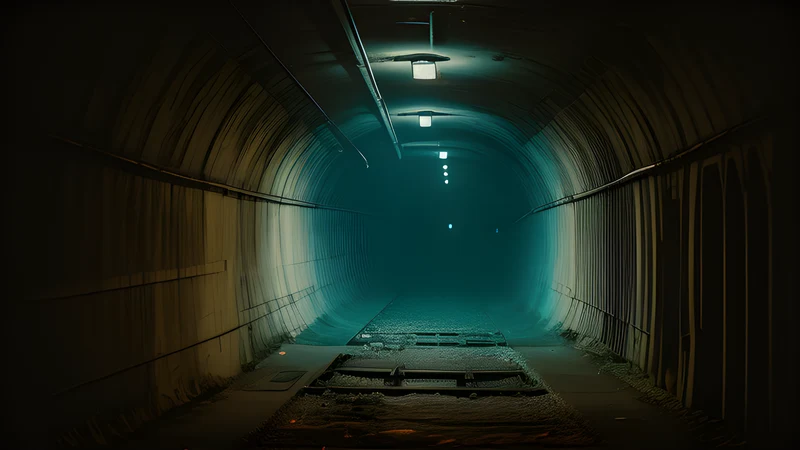
The storm drains are the payoff. Los Angeles has a concrete flood-control system running for miles under the city, and Morgan uses it — a tunnel network with access to a hundred streets, which is a burglar’s dream and a photographer’s. Alton lights the finale with torch beams alone. Actual torches, in an actual concrete tube, with the beams doing all the work: a circle of light on a curved wall, the geometry of the tunnel revealed for a second and then gone, men firing at a sound. It is one of the most technically audacious sequences of the decade, and it was shot a full year before Carol Reed took Orson Welles into the sewers of Vienna. The influence question is unresolved and probably unresolvable. The chronology is not.
Mann’s contribution shows in the violence. The sequences where the procedural machinery gives way to a man cornered have a compressed brutality that Werker’s competent daylight material lacks, and they are constructed exactly like the ones Mann and Alton were building at the same time in Raw Deal — the same use of blackness as an ambush, the same conviction that a small space is more frightening than a large one.
The show that walked out of this film
Jack Webb has a small part as a police forensics man, and it changed television. On this production Webb met Marty Wynn, an LAPD sergeant working as technical adviser, and the conversation that followed — about how badly radio drama misrepresented actual police work, and what a realistic version might sound like — led to Dragnet, which reached radio the following year and then ran on television for a decade and a half.
You can hear it forming in the film. The clipped procedural narration, the fetish for method, the deliberate refusal of glamour, the insistence that the true story is the paperwork — Dragnet is this film’s voiceover, extracted and given its own series. That inheritance is the picture’s largest historical consequence and also, watched today, its dullest half. The parts of He Walked by Night that became American television are the parts that have aged; the parts Alton shot are the parts that have not.
Where it sits in the cabinet
The immediate family is the Mann-Alton run at Eagle-Lion — T-Men, Raw Deal, and this — three films made for almost no money that between them contain more visual invention than the rest of the cycle put together. Alton then took the technique to a bigger budget for The Big Combo, where the fog-and-void climax is the storm drain’s descendant lit for a studio.
The wider cousin is the Fox semi-documentary line, and the comparison is instructive. Panic in the Streets took the same faith in procedure and found a crisis that procedure could barely handle, shooting the whole thing in a real city. Kazan’s film is the better drama; Alton’s is the better photograph, and the two together map the whole ambition of the form in 1948 and 1950.
The descendants are every underground-tunnel finale ever staged, and beyond that, the entire lineage of the criminal-as-technician: the burglar who is a craftsman, the killer with no appetite, the antagonist the police cannot profile because he wants nothing. That figure runs from here to the process thrillers of the seventies and never quite leaves.
The verdict
He Walked by Night is two films fighting, and the loser has the microphone. The civic procedural is stiff, self-congratulatory and largely wrong about its own case; the picture underneath is a study in darkness by the greatest cinematographer the genre produced, attached to a criminal so lacking in the usual motives that the film cannot explain him and has the good sense to stop trying. Basehart is excellent and Alton is extraordinary, and the storm drain finale alone would earn the film its place.
It has been restored, and the restoration matters more here than for almost any other title of the period: Alton’s blacks are the performance, and a bad transfer turns them to grey mud and takes the film with them. Find a good print.
Spoilers below
The film’s most famous scene is a self-surgery. Morgan, shot during an encounter with police, goes home, lays out his instruments, and removes the bullet himself with a mirror and a local anaesthetic he has acquired. Basehart plays it as concentration, and the sequence works because it is the logical conclusion of everything established about him — a man who builds his own radios, alters his own gear and sells through his own channel is not going to a hospital, because a hospital is a person he would have to talk to. It is the film’s clearest statement of what makes him uncatchable: he has no one.
The break in the case is unglamorous, which is the picture’s saving grace. It is not the laboratory or the composite sketch. The police finally get a thread because Morgan’s projector equipment is traced through the fence who has been buying from him without knowing what he is, and the fence is found by the least scientific method available — a detective walking around asking shops. The scientific apparatus is then applied retrospectively to confirm what the shoe leather found. For a film that spends ninety minutes advertising the crime laboratory, the honest admission that the lab was ornamental is remarkable, and I suspect it survives because nobody at Eagle-Lion noticed it was in there.
The end is the drains. Cornered at his house, Morgan goes down through a manhole into the flood system with the whole of the LAPD following, and the last ten minutes are men with torches hunting a man with a torch through concrete tubes. Alton shoots it almost entirely in the beams — light travelling down a curved wall, splashing, finding a shape, losing it. The sound design does the rest: water, echo, and the fact that in a tunnel you cannot tell where a noise came from.
Morgan is shot, and he dies at a grating in a shaft of daylight, which is the only conventional image in the sequence and the only wrong note in it. He is killed climbing towards an exit that was never going to open, in a system he chose because it had a hundred exits. The film’s last irony is that the narrator returns to tell us the case is closed and the city is safe, in exactly the tone he used at the start, over the body of a man the police never once understood.
Related Content