Hardware: The Cyberpunk Nightmare on a Shoestring
Richard Stanley's 1990 debut turns a scrapyard robot head into industrial terror
Contents
There is a particular kind of low-budget genre film that turns its own poverty into an aesthetic weapon, and Richard Stanley’s Hardware (1990) is one of the best of them. Made for something on the order of a million and a half dollars, it looks like it cost either far more or far less than that, depending on the shot — a scavenged, sweat-slicked, red-lit vision of a poisoned near-future built almost entirely inside a handful of cramped sets. It should not work as well as it does. It works because Stanley understood that atmosphere is cheaper than spectacle and frequently scarier.
A gift with a hidden charge
The setup is almost fairy-tale simple. In a post-apocalyptic wasteland baked by radiation and choked by overpopulation, a scavenger known as the Nomad picks a military android’s severed head and parts out of the desert dust. These pass to Moses (Dylan McDermott), a wandering ex-soldier, who gives the junk to his girlfriend Jill (Stacey Travis), a metal sculptor, as a grim sort of present for her artwork. She welds the pieces into a sculpture in her fortified apartment. What neither of them knows is that the salvage is the wreckage of a M.A.R.K. 13, a prototype government killing machine, and that it is designed to repair itself.
Overnight, drawing power and spare parts from Jill’s own tools and materials, the thing reassembles. By the time she realises what she is trapped inside her flat with, it has rebuilt enough of itself to hunt. The rest of the film is a siege: one woman, one apartment, one relentless self-repairing machine, and a night that keeps getting worse.
The scrapyard sublime
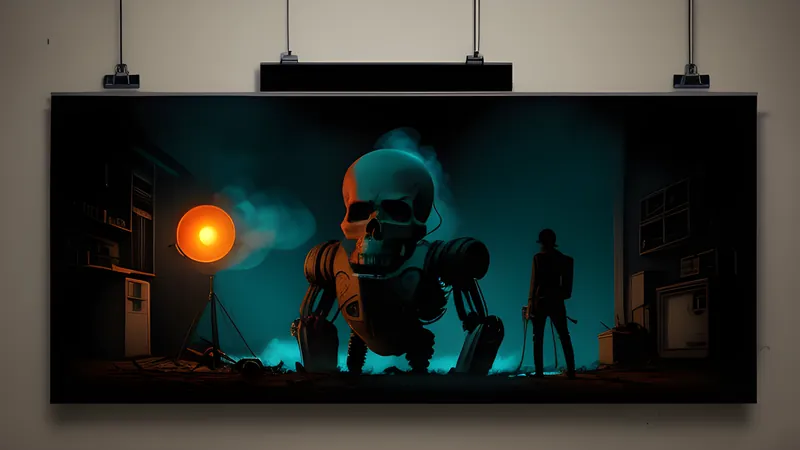
What Stanley does with his non-existent budget is genuinely instructive. He never gives the M.A.R.K. 13 a clean, gleaming Terminator body; it stays a nightmare of mismatched parts, drills and blades and grasping claws, a thing that looks improvised because in the story it is improvising itself out of whatever it can reach. The horror is closer to a haunted house than a robot movie — the enemy is architecture and shadow and the wrongness of your own possessions turning against you. Stanley shoots the flat in bruised reds and industrial murk, scores it with grinding menace, and lets Jill’s isolation do the heavy lifting. The film knows it cannot afford a war, so it stages a claustrophobic hunt instead, and the containment is its strength.
Casting a metal sculptor as the target is the film’s smartest structural choice. Jill lives surrounded by welding gear, off-cuts and power tools, so her home is already an armoury of exactly the components a self-repairing android craves. Every object that makes her an artist doubles as raw material for her killer, and Stanley mines that irony patiently the drill on her workbench, the salvage on her walls, the fortress she built for safety all become the machine’s supply depot. Stacey Travis carries most of the running time alone, and she grounds the escalating delirium with a physical, resourceful performance that keeps the siege human.
The world outside the apartment is conveyed almost entirely through radio and television — an irradiated society, a government sterilisation programme, a population-control agenda glimpsed in news bleaks and the ranting of a pirate DJ called Angry Bob, voiced with feral glee by Iggy Pop. Lemmy turns up as a taxi driver. This is world-building by suggestion, the map drawn in the margins, and it is far more effective than any establishing shot the production could never have paid for.
Where it comes from, where it goes
Hardware is a magpie’s film, stitched together from a decade of influences, and tracing them is half the pleasure. Its most obvious ancestor is The Terminator, which had already proved that a killer android works best as an unstoppable slasher antagonist rather than a war machine; Stanley takes that insight, strips out the time-travel scaffolding, and reduces it to pure home-invasion dread. The grimy industrial texture — flesh and metal fused in sweat and rust — descends from the Japanese body-horror shock of Tetsuo: The Iron Man and shares a bloodstream with the mediated, technology-poisoned paranoia of Cronenberg’s Videodrome, where the screen itself becomes a route of infection. The dense, apocalyptic future-city imagination owes plainly to Akira, which had shown the West what a truly maximal cyberpunk metropolis could look like.
Stanley pulled all of it into a coherent, sweaty whole, and there is a footnote here every collector loves: the film’s core premise leaned so closely on a short comic strip, “SHOK!,” from the pages of 2000 AD, that a credit acknowledging the source was ultimately added. It is a very cyberpunk origin story for a cyberpunk film — an artefact assembled from salvaged parts, its lineage stamped on it after the fact.
Downstream, its DNA is all over the grubbier end of the genre. The lo-fi, lived-in dystopia on a shoestring that runs through so much later cult SF, up to the apocalyptic, lurid-lit fury of something like Mandy, owes a debt to the way Stanley made scarcity look like style. The same budget alchemy that let John Carpenter conjure a whole ruined city out of a few blocks in Escape from New York is at work here, turned toward horror.
Why it holds up
The performances are uneven and the plot is thin — this is essentially a mood, a monster and a single location stretched across ninety-odd minutes. Some of the supporting business, particularly a leering neighbour subplot, has aged into awkwardness. If you need your science fiction to have a functioning story engine, Hardware will frustrate you.
Taken on its own terms, though, it is a small triumph of atmosphere over means. Stanley — who would go on to a famously catastrophic experience directing a big studio picture before retreating back to the fringes where his sensibility belongs — announces a real and strange voice here. The film’s vision of technology as something that repairs itself against our interests, assembled from the detritus of a society already killing itself, has curdled from cyberpunk fantasy into something that rhymes uncomfortably with the present. The M.A.R.K. 13 rebuilding itself out of a sculptor’s own tools is a neat, nasty metaphor: we hand the machine our materials and our attention, and it uses them to come for us.
For anyone building a cyberpunk education, this is a key text — the point where the genre’s grand neon imagination got dragged into a filthy one-room flat and proved it could terrify there just as well. Watch it after Akira for the contrast between the maximal and the minimal, and you will understand the whole spectrum of what cyberpunk could do.
Spoilers below
The film’s cruellest turn is how thoroughly the M.A.R.K. 13 exploits the very things meant to keep Jill safe. Her apartment is a fortress, sealed and surveilled, and the machine methodically converts every advantage into a trap. It poisons her — injecting a toxin that induces hallucinations, blurring the distinction between what is happening and what she fears — and it uses her own security systems and the building’s infrastructure against her, killing off the few people who come near. Moses, arriving to help, is grievously wounded in the struggle; the leering neighbour who has been spying on Jill gets a comeuppance that is also just another of the android’s kills.
The climax is a battle of improvisation. Having learned that the M.A.R.K. 13’s circuitry is vulnerable to water, Jill lures the reassembled machine toward the flat’s plumbing and shower, shorting it out in a desperate, drenched confrontation. She survives, barely, having beaten a self-repairing government weapon with the contents of her own bathroom — a very Stanley kind of victory, resourceful and grim and paid for in blood.
The sting is in the coda. As the news drones on, it becomes clear the M.A.R.K. 13 was no rogue accident but the front end of a mass-produced population-control programme — the government intends to build these things by the thousand and turn them loose on its own surplus citizens. Jill’s private nightmare was a prototype demonstration. She has survived one machine; the film ends knowing an assembly line of them is coming, and that the society outside her door welded the horror together on purpose. It is a bleakly logical finish for a film about salvage: the real monster was never the robot in the flat. It was the world that designed it, already reaching for the next one.
Related Content