Halloween (1978): The Slasher Blueprint, Drawn in Shadow
Carpenter's suburban nightmare built a whole genre out of empty space and patience
Contents
The scariest thing in Halloween is an empty patch of the frame. Watch the film again and notice how often John Carpenter composes a wide shot of a sunlit suburban street, or a tidy living room, or a quiet bit of hedge, and simply lets you look at it, waiting — until a pale shape resolves out of the background where a second ago there was nothing. He does not cut to the killer. He does not sting the music. He lets Michael Myers stand there, half-seen, in the part of the image your eye was not watching, and trusts you to find him and go cold. That single instinct, repeated with total discipline across ninety minutes, is why a low-budget independent picture from 1978 became the most influential horror film of the modern era, and why the hundreds of imitators it spawned almost never understood what they were copying.
Halloween made an obscene amount of money against a budget of roughly three hundred thousand dollars, which for years made it the most profitable independent film ever made. It launched Jamie Lee Curtis, made Carpenter a name, and codified the American slasher so thoroughly that its rules — the babysitter, the holiday, the unstoppable masked man, the surviving girl — hardened into cliché within half a decade. But the film itself is nothing like the crude body-count pictures that carry its DNA. It is elegant, restrained, and frightening in inverse proportion to how much it shows.
The Shape, not the man
Carpenter and his co-writer and producer Debra Hill made one decision that governs everything else: the killer is not a character. In the credits Michael Myers is billed as “The Shape.” He has no motive you can use, no psychology to grip, barely a face — just a boilersuit and a mask (famously a Captain Kirk mask, bought cheap and spray-painted white and stripped of its features) that turns a human head into a blank. Dr. Loomis, the psychiatrist played by Donald Pleasence with mounting biblical dread, exists mainly to insist that there is nothing behind the mask but evil, that Michael is wrong at a level below sickness, an absence in human form.
This is the film’s masterstroke and the thing the imitators lost. A killer with a backstory can be understood, and understanding is the enemy of fear. By keeping Michael blank, Carpenter makes him a screen you project your own dread onto — the boogeyman, exactly as the film keeps calling him. When later franchises, including Halloween’s own sequels, started explaining him (a cult, a curse, a family bloodline), they killed the very thing that worked. Compare what The Texas Chain Saw Massacre had done four years earlier with Leatherface — a man reduced to industrial function, no interiority, pure appetite — and you can see the two founding slashers agreeing on the same principle from opposite aesthetics: the monster works best as a blank.
The camera that will not blink
The craft to study in Halloween is the camerawork, and specifically Carpenter’s use of the widescreen Panavision frame — a luxurious 2.35:1 ratio almost no low-budget horror film would have dared. That wide frame is the whole game. It gives Carpenter acres of dead space on either side of his actors, and he fills that space with threat: Michael lurking at the edge, a doorway yawning behind a character’s shoulder, the deep suburban backyards of Haddonfield stretching into shadow. Cinematographer Dean Cundey lit it so that the darkness has depth, layers you cannot quite read, and Carpenter blocks his actors so that the audience always sees the danger a beat before the victim does. The tension is manufactured almost entirely through composition.
Then there is the celebrated opening: a single unbroken point-of-view shot, gliding through a house, up to a bedroom, and out to the street, the whole murder witnessed through the eyes of the killer, using a body-mounted Panaglide rig (a rival to the then-new Steadicam) to keep it fluid and dreamlike. It is a bravura piece of technique, and its payoff — the reveal of who has been holding the knife — is one of horror’s great gut-punches, which I will save for below the line. What matters here is the principle: Carpenter puts you inside the threat, then spends the rest of the film making you dread it from outside.
And the music. Carpenter, who scored the film himself, sat at a piano and worked out a simple, insistent piano figure in an odd, lurching 5/4 time — a rhythm that never resolves, that keeps tripping over itself, so your body cannot settle into it. It cost nothing and it is one of the most recognisable pieces of music in cinema. Like Suspiria the year before, Halloween proved that a synthesiser in the hands of someone with taste could out-frighten a full orchestra, and that a good horror theme works by refusing to let the pulse relax.
Suburbia as the true subject
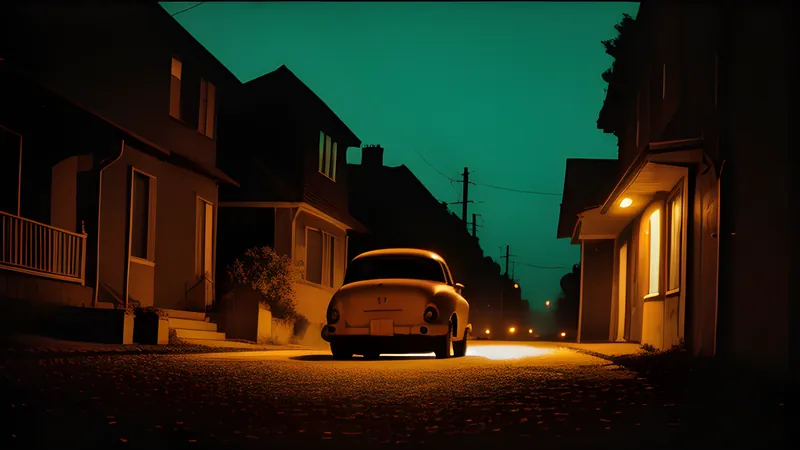
What gives Halloween its uncanny charge, beyond the mechanics, is where it happens. Hooper’s massacre was safely far away, in the rural Texas nowhere. Carpenter brought the horror home, to a manicured Midwestern street of raked leaves and jack-o’-lanterns, the most reassuring image of American safety, and let the boogeyman walk down the middle of it in broad daylight. Michael does not lurk in a haunted house; he stands on the pavement across from the school, in the neighbour’s yard, behind the hedge you pass every day. The violation of that ordinary safety is the film’s deepest note, and it is why it frightened suburban audiences to their bones — it is set in their street.
Curtis, as Laurie Strode, grounds all of this. She is bookish, watchful, a little lonely, and Carpenter shoots her with real tenderness; her ordinariness is what makes the threat land. She is not a warrior, and the film does not pretend she is. She is a sensible girl who notices the pale shape at the edge of the frame slightly too late, and then has to survive on nerve alone.
The verdict, and the bloodline
Halloween is the cleanest, most disciplined horror film of its era, and its restraint has aged into greatness while its imitators curdled. It draws almost no blood; its shocks are architectural; its monster is a hole in the shape of a man. Every slasher that followed took the furniture and left the intelligence, which is why the original still stands alone at the head of a genre it accidentally created.
For the collector, the double bill is obvious and rewarding. Watch it against The Texas Chain Saw Massacre to see the slasher’s two founding fathers — the grimy vérité nightmare and the elegant suburban one — invent the same rules by opposite means. And if you want to see Carpenter’s central idea reborn for a new century, It Follows is the truest descendant: another film built on a slow, patient, unstoppable shape walking toward a young woman across suburban space, using the widescreen frame and a throbbing synth score exactly as Carpenter did. It understood what to steal. Most did not.
Spoilers below
Everything above is safe. Now the film’s turns.
The opening POV murder resolves into the film’s first shock: the killer we have been seeing through, the hand that stabs a teenage girl to death on Halloween night 1963, belongs to a six-year-old boy. The camera pulls back to reveal little Michael Myers, knife in hand, in a clown costume, blinking in the driveway as his parents take the weapon from him. The horror is total and unexplained — a child, no reason, no reaction. It is the last time the film offers any interiority at all; from there, Michael is only ever the Shape.
The ending is the part that built the genre and the part everyone misremembers. Laurie survives the night by hiding, fighting, and improvising — a knitting needle, a coat hanger, Michael’s own knife — and finally, after Loomis arrives, Michael is shot six times and falls from a second-floor balcony into the garden below. Loomis and Laurie look down. The body is gone. Carpenter cuts to a series of the film’s earlier locations — the empty house, the stairs, the street — all now vacant, while Michael’s steady breathing plays on the soundtrack over the black. He is not dead. He is not anywhere. He is everywhere.
That final movement, the vanished body and the breathing in the dark, is the single most copied ending in horror, and it is worth naming why it works when its thousand imitations do not. Carpenter is not setting up a sequel, whatever the studio later did with it. He is completing his thesis: evil is not a man you can shoot, it is a condition of the world, and it has simply stepped back into the shadows it came from. The boogeyman was real, Laurie survived him, and he is still out there in the ordinary dark of an ordinary street. The film gives you a survivor and denies you safety in the same breath, and forty-odd years of slashers have been trying and failing to reproduce that exact, terrible chord ever since.
Related Content