Hagazussa: The Alpine Folk-Horror Descent
Lukas Feigelfeld's graduation film is a drone record with a plague in it
Contents
Hagazussa is a graduation film. Lukas Feigelfeld made it as his thesis project at the German Film and Television Academy in Berlin, shot it in the Austrian Alps, premiered it at Fantasia in 2017, and produced a piece of work more formally confident than most directors manage in a career. It carries the subtitle A Heathen’s Curse, it runs a hundred minutes, and it contains perhaps six minutes of dialogue.
It was released into the wake of The Witch and immediately filed as the German one. That is a disservice to both films. Eggers made a tragedy with a structure and an antagonist. Feigelfeld made something closer to a doom record with images attached.
The shape
Four chapters — Shadow, Horn, Blood, Fire — across two eras of one life in the fifteenth-century Alps.
In the first, a girl called Albrun lives in an isolated hut with her mother Martha. They are alone on the mountain. The village below regards them as something other than neighbours. Martha contracts plague, and the film watches, without hurry, as the disease takes her and as her daughter is left with a body and a winter.
Years pass between chapters. Albrun (Aleksandra Cwen) is now an adult goatherd with an infant of her own and no husband anyone will name. She milks goats. She walks. She is spat at. A woman from the village called Swinda offers something like friendship. A priest hands her a relic of her mother. And the film descends, slowly and without any incident that a synopsis could carry, into something that stops resembling a story at all.
The craft: the score is the screenplay
The most important collaborator on this film is a band. Feigelfeld commissioned MMMD, the Greek drone-doom duo — an offshoot of Mohammad, a group who make music out of bowed contrabass and electronics at frequencies that arrive in the chest before the ear. Their score does not accompany Hagazussa. It is the load-bearing structure.
This is worth being specific about, because “atmospheric score” is a phrase that means nothing. Here is what MMMD actually do: they sustain. A drone establishes a pitch and holds it past the point where a conventional cue would resolve, past the point of comfort, and then holds it further. The physiological effect is that the listener’s body starts anticipating a resolution that never arrives, and the tension migrates from the film into the viewer’s own nervous system. It is the same mechanism a horror sting exploits, run in reverse and stretched across ninety minutes.
Feigelfeld cuts to it. Scenes in Hagazussa end when the drone decides, and the result is a film whose pacing is musical rather than narrative. Once you notice this, the film’s supposed shapelessness reorganises into something rigorous — Feigelfeld is not failing to build a plot; he has built a composition and the images are one voice in it.
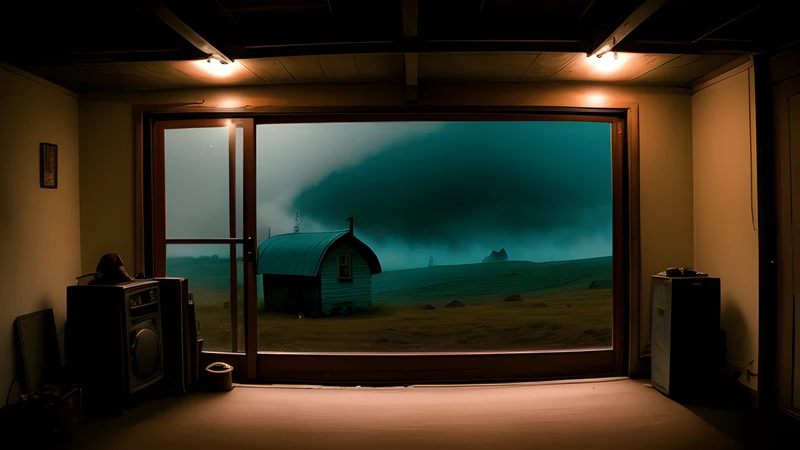
Mariel Baqueiro’s photography does the visual half. The Alps are shot in fog, in low cloud, in a palette that runs from grey-green to black with almost nothing warm in it until fire arrives. The film’s signature move is the long static exterior — a hut, a slope, a treeline — held until you stop reading it as an establishing shot and start reading it as a place that does not care whether anyone is in it. Aleksandra Cwen’s performance is almost entirely physical, and she does something genuinely difficult: she plays a woman being erased without ever playing “sad”. Albrun works. She keeps working. The erosion happens in her shoulders.
The real ancestor
The Eggers comparison is unavoidable and wrong. The true ancestors are older and angrier.
The first is Witchfinder General. Michael Reeves’s 1968 film established the position that Hagazussa holds absolutely: the witch is a product. She is manufactured by a community that requires one, out of whichever woman is most available — isolated, unprotected, poor, strange, or simply owed money. Reeves filmed the manufacturing process as a bureaucracy of torture. Feigelfeld films it as weather. Nobody in this village convenes a trial. They simply behave, day after day, in a way that leaves Albrun no room to be anything else, and the film’s most frightening idea is that this requires no villain at all.
The second is Häxan. Benjamin Christensen’s 1922 film builds to an argument — that the women burned as witches were the ill, the old, the friendless, and that the accusation was a social technology. Feigelfeld’s title makes the same point etymologically. Hagazussa is Old High German, the presumed root of Hexe, and it appears to have meant something like a rider on the fence — a being that sits on the boundary between the settlement and the wild. That is a description of a social position rather than a supernatural power. Albrun’s crime is her address.
There is a third line, outside horror entirely, to Béla Tarr and the slow-cinema tradition: the conviction that duration is meaning, that a shot held long enough stops being about its subject and becomes about time. Feigelfeld’s mountain is Tarr’s Hungarian plain with worse weather.
What the film does with a child
The infant is the detail that separates Hagazussa from every other film in this cycle, and it is the one critics skirt.
Albrun has a daughter. The film never explains where the child came from, and the omission is deliberate — in a village that has already decided what Albrun is, the provenance of her baby is a question nobody would ask honestly and she has no reason to answer. What Feigelfeld films instead is the labour. Albrun feeds the child, carries the child, works with the child on her back, and does all of it in a state of exhaustion that the camera holds on far longer than is comfortable.
The effect is to make the film’s horror domestic. Most witch films are about a woman’s relationship with power, real or alleged. Hagazussa is about a woman’s relationship with an unmanageable workload in a hostile economy, and the supernatural is at best a rumour circulating about her. Cwen plays motherhood with no visible tenderness and no visible resentment, only the flat competence of someone doing a task that will not stop. It is one of the least sentimental depictions of raising a child anywhere in the genre, and it is the reason Albrun’s eventual collapse reads as inevitable rather than as plot.
It also sharpens the Reeves comparison. Matthew Hopkins needed a woman with no man to speak for her. So does this valley. The child is the proof of Albrun’s isolation and the guarantee of it.
The case against
It is a film with almost no incident, and the honest complaint is that the material could carry sixty minutes rather than a hundred. The second half in particular repeats its imagery — the fog, the goats, the walk, the hut — with diminishing returns, and Feigelfeld’s commitment to duration occasionally shades into a young director’s reluctance to cut anything he shot in a hard location.
The hallucinatory final chapter is where opinion divides hardest. Albrun’s collapse is rendered through a sustained sequence of dissociative imagery that a viewer can read as either the film’s culmination or its evasion — the moment where a director without a third act reaches for the psychedelic. I lean towards culmination, because the film has been withholding interiority from Albrun for ninety minutes and the eruption is the only place it can go. But the criticism has teeth.
The other charge is fair too: Hagazussa is not frightening. It is oppressive, which is a different thing. Nobody is going to jump.
Where it sits
Hagazussa is a key text in the European folk-horror wave of the late 2010s, and it forms a natural trilogy with You Won’t Be Alone and November — three regional folk films that take their sources seriously and their audiences’ patience for granted. Feigelfeld has not made another feature that has travelled, which is a loss.
It streams on Shudder and the arthouse services. Watch it loud. This is a genuine instruction rather than a flourish: the score operates below the range that laptop speakers reproduce, and on a phone the film simply is not the film. Headphones or a room with a subwoofer, at night, in one sitting. It rewards submission and punishes multitasking.
If the register appeals, Beyond the Black Rainbow is the closest thing to it in a different genre — another film where a composer is doing the narrative work.
Spoilers below
Everything from here assumes you have seen it.
The plague is the film’s engine and it operates in two registers at once. Martha dies of it in the first chapter, and the film shows the buboes, the fever, the physical facts, without any of the medieval-horror glamour. Then the film waits. Decades later, plague returns to the valley, and the same community that has spent Albrun’s life treating her as an infection has a real one to deal with. Feigelfeld does not connect these with a line of dialogue. He simply places them.
The skull is the film’s cruellest object. The priest returns Martha’s remains to Albrun as an act that is either kindness or disposal — the film genuinely will not tell you which — and Albrun’s relationship with the object becomes the closest thing she has to company. A woman with no living connection to anyone is given her mother’s head and treats it as a household member. The village would call that witchcraft. The film calls it what happens.
Swinda’s betrayal is the pivot. The one hand extended to Albrun in her adult life turns out to be a setup: the friendship exists to deliver her to men. What Feigelfeld understands, and what makes the sequence unbearable rather than merely ugly, is that Swinda is not a schemer. She is a village woman securing her own position by confirming the village’s verdict, and the cost of that transaction is somebody else’s body. This is Reeves’s argument again — cruelty as administration.
The final chapter is Albrun’s only act of will, and its logic is the film’s thesis delivered as a punchline. Having eaten what the woods offer and gone wherever that takes her, she does the one thing available to a person with no power, no protection and no standing: she becomes the contamination. The village spent her entire life insisting she was a source of disease. The film’s last movement lets them be right, and the horror is that they made it true by saying it. There is no curse in Hagazussa, no pact, no devil. There is a woman who was told what she was until the telling was the only role left, and a valley that then has to live in it.
Related Content