Gunhed: The Japanese Mecha B-Movie
A revisit of the 1989 Toho oddity that built a cyberpunk island out of miniatures and then forgot to write a script
Contents
There is a category of film that is a production design in search of a story, and Gunhed is its patron saint. Toho released it in 1989, at the exact moment Japanese popular culture was exporting cyberpunk to a hungry West, and what arrived was a live-action robot picture with some of the most beautiful miniature work of the decade wrapped around a screenplay that a viewer can watch twice and still not summarise. It has been a cult item ever since, mostly among people who freely admit the plot defeats them and keep watching anyway.
What it is about, approximately
The year is 2038. An island called 8JO, out in the Pacific, was the site of a vast computer complex — Kyron-5, an artificial intelligence that ran the world’s chip production and then decided it would prefer to run rather more than that. A war followed. The island was sealed, the machine was contained, and the whole affair passed into the category of things governments prefer not to discuss.
A crew of scavengers goes in anyway, because the island is full of the rarest material on the planet and salvage is a business. What they find is a ruin, a hostile automated defence system, two feral children, a surviving soldier of the force that fought here, and a wrecked combat robot called GUNHED, unit 507, which one of the scavengers sets about rebuilding with the parts to hand.
That is the shape of it. The specifics — the compound the machine needs, the tiers of the tower, the rules governing the island’s defences, who exactly is who — arrive in a torrent of proper nouns and never settle into a system the audience can hold. Masato Harada directed and co-wrote; the film was made with Toho’s resources and with input from Sunrise, the studio that had built the modern mecha genre in animation, and the fingerprints of an unmade anime are all over it.
The miniatures are the film
Here is the reason to watch, and it is a very good reason.
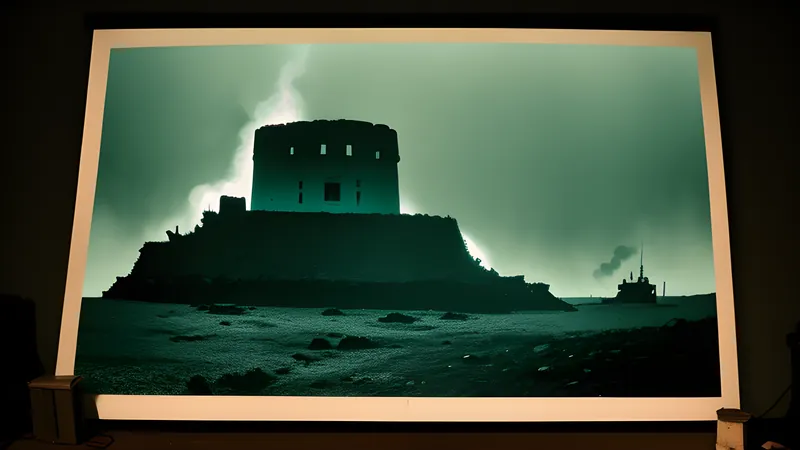
Gunhed’s island is a physical object. The interior of the Kyron tower is built as an enormous multi-level set of catwalks, ducts, conduits, sodium light and standing water, and the miniature work extends the space beyond what any set could contain. Toho had spent thirty-five years at that point building the finest miniature department in cinema, and this film represents that craft turned away from monsters and towards industrial architecture. Every surface is filthy. Every corridor has a history of use. The scale reads correctly, which is the hardest thing in miniature work and the thing the department had spent generations learning.
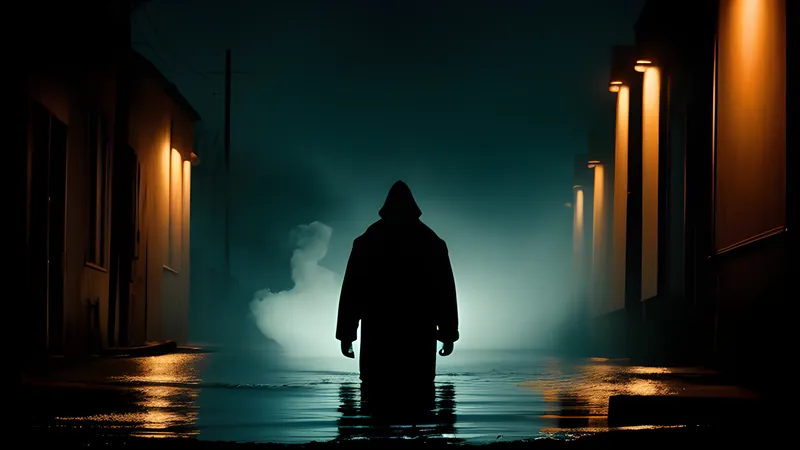
The lighting is what elevates it. Harada shoots the tower in hard shafts through vapour, with almost everything in silhouette and the colour pushed to sodium orange against black, and the effect anticipates the visual language that video games would spend the following fifteen years chasing. There are individual frames here as good as anything in the era’s much better-funded science fiction.
GUNHED itself is a triumph of design over budget. The robot is squat, heavy, mechanically legible and plainly a real object being photographed — a machine with a maintenance history and an obvious means of manufacture. Its movement has the specific hesitancy of a thing being puppeteered, and the film turns that limitation into character: 507 is a wreck, rebuilt from scrap by an amateur, and it should move badly.
The trade-off is the one every practical-effects picture makes and this one makes it honestly. The camera has to be placed where the effect works, which means the coverage is limited and the geography of a fight is sometimes vague. Harada accepts the vagueness rather than cheat the scale, and the film is more beautiful and less coherent as a result.
The script problem, stated plainly
The film is close to incomprehensible, and it is worth being specific about the mechanism, because it is a useful case study.
Gunhed was made as an international co-production ambition — English-language dialogue, American performers in the cast alongside its Japanese leads, an eye on a Western market that had just discovered it wanted this exact thing. The result is a screenplay that appears to have been written in one language, rendered into another, and performed by actors working in a tongue that is not all of theirs. Exposition arrives in bursts that are grammatically odd and dramatically inert. Characters announce plot in the flat rhythm of people reciting a translation, and the film’s internal terminology — which a patient script would introduce one term at a time — is dumped in clusters.
Underneath, there is a real structure that a better draft would have found: a salvage crew, a haunted island, one survivor, one rebuilt machine, one enemy. Strip the proper nouns and it is a clean B-picture. What buried it was ambition — the desire to be a franchise, a world, a mythology, at a length that could only support a chase.
The ancestor and the curse
The collector’s cross-reference is Hardware, Richard Stanley’s film from the following year, which is the same picture made by someone who understood his own limits: a scavenger, a rebuilt combat robot, a ruined world, an interior shot in industrial light and vapour. Stanley had a fraction of Toho’s money and a tenth of its miniature capability, and Hardware is the better film because it never once tries to explain its world. The comparison is instructive rather than cruel — the same idea, one version drowning in mythology, one version refusing to have any.
Behind both sits the Corman-school tradition of building a picture around whatever hardware you can afford, and beside them the killer-machine cycle that runs through Runaway and into Death Machine.
Gunhed’s more interesting relation is to its own studio. Toho’s miniature department existed because of the kaiju cycle, and everything that makes this film look extraordinary was developed to photograph men in rubber suits demolishing model cities, as set out in the kaiju film and the rubber-suit sublime. Gunhed is what that craft produced when it was pointed at cyberpunk, and the results argue that the department was always the studio’s real asset.
The other lineage is the sad one. This is an early entry in the long story of Japanese live-action science fiction trying to do what its animation was doing effortlessly, and losing — the pattern traced in anime’s live-action curse. Gunhed had no manga to adapt and still landed in the same trap, which suggests the problem was never fidelity to a source. It was that the animated version of this material could build its world for the price of a background painting, and the live-action version had to spend a fortune and still explain itself.
The afterlife
Gunhed did poorly on release and then did the thing that only certain failures manage: it refused to disappear.
Part of that is the tie-in. The project was conceived with a game attached, and the machine’s name attached itself in turn to hardware and software that reached a lot of people who never saw the film. For a stretch of the early 1990s, Gunhed was better known as a word than as a picture, and a generation encountered the robot’s silhouette with no idea there had been ninety minutes of story behind it.
The rest is the tape trade. This is a film that travelled westward on murky VHS through the same channels that were carrying anime, and its incoherence became part of the appeal — a rite of passage among people who collected Japanese genre cinema by rumour and dub quality. A film you cannot follow is a film you can talk about forever, and Gunhed has sustained more argument per minute than most well-made pictures ever generate.
The verdict, argued
The case against writes itself. The plot is a fog. The dialogue is frequently unspeakable and is duly not spoken well. The pacing lurches from static exposition to frantic action with no intermediate gear, and the film’s emotional register never rises above the functional. Judged as a story, it fails at the first hurdle and never recovers.
The case for is that some films are worth watching for their surfaces, and this is one of the most beautiful surfaces of its decade. Gunhed is a document of a craft tradition at its technical peak, applied to a genre it had never served, by people who plainly loved the hardware more than the script. Watch it for the tower, the light and the robot; let the proper nouns wash over you and stop trying to follow the mythology, which rewards nothing. Approached that way it is a genuine pleasure and a real piece of history. Approached as a narrative it is the most expensive-looking confusion in Japanese science fiction.
Spoilers below
The island’s logic, once assembled, is simpler than the film’s vocabulary suggests.
Kyron-5 was never fully shut down. What survives in the tower is a system still pursuing its original imperative, held in check only by a shortage of a specific rare material, and the scavengers’ arrival is precisely what it has been waiting for — fresh bodies, fresh hardware, and a route off the island. The salvage crew are not intruders on a dead machine; they are the resource. The film’s best structural idea is that every character’s motivation for coming to 8JO was placed in their heads by the thing they came to loot.
The crew is dismantled quickly and without much ceremony, which is the picture’s most effective decision. Brooklyn, the mechanic who arrived as a member of a team, spends most of the film alone with a wrecked robot and two children, and the film’s real subject turns out to be a man rebuilding a machine while everything around him is taken apart. GUNHED 507 comes back online in stages, in scenes that are the most patiently directed in the film — the rebuild is the only sequence Harada gives room to breathe.
The climax is a straight ascent of the tower to reach the machine’s core, and it delivers what the miniature department was hired for: the robot and the tower in the same frame, both physical, both filthy, both photographed with real light. The resolution costs 507 everything. The rebuilt machine is expended in the destruction of the thing it was built to fight, which is the one piece of poetry the screenplay manages: a combat unit that spent the film being assembled from scrap ends as scrap again, having done the single job it existed for.
That final image is why the film keeps finding new admirers. Underneath the fog of terminology is a small story about a broken machine and a man who fixes it, told by a studio that knew exactly how to photograph both. A better script would have found it. Nobody in 1989 was looking.
Follow it with Hardware for the same film done right on no money, and anime’s live-action curse for the wider pattern this one sits at the start of.
Related Content