Grindhouse Double Bills and the Death of 42nd Street
How a way of watching, not a genre, made the movies we now call grindhouse
Contents
Ask a young cinephile what “grindhouse” means and you will usually get a description of a look: scratched prints, missing reels, jump-splices, over-saturated colour, a fake “our feature presentation” bumper. That look is an invention of the 2000s, a nostalgic costume assembled by Quentin Tarantino and Robert Rodriguez for their 2007 double feature and copied a thousand times since. The real thing was never a genre or an aesthetic. It was a way of watching, tied to a specific few blocks of Manhattan, and when those blocks were redeveloped the way of watching died. What survives is a memory of a room, and a shelf of films that room built.
The grind policy
The word describes a business model. A “grind” house ran a continuous programme, opening early and closing late, with no fixed showtimes — you walked in whenever, watched until the story came round again, and left when you had seen the whole loop. The term borrowed from the burlesque circuit, where “grind” venues ground out non-stop entertainment for a low, flat admission. Applied to cinema, the grind policy meant volume: cheap tickets, long hours, a captive clientele of shift-workers, drifters, insomniacs and the merely curious, and a constant appetite for product to keep the projectors turning.
That appetite is the engine of everything we now romanticise. A grind house could not afford to wait for prestige pictures, and its audience did not want them. It wanted incident, and lots of it, which is why the programming ran to horror, kung fu, biker films, women-in-prison pictures, nudie-cuties, Italian imports and whatever a small distributor could licence for a flat fee. The films were disposable by design, made to be consumed once, fast, by a half-attentive room, and then swapped out for the next thing. The disposability is exactly why so few survive in good prints, and exactly why the ones that do survive feel so alive.
What the double bill did to the films
Here is the part worth studying as craft, because the exhibition context shaped the movies themselves. The standard grind-house unit was the double bill, and often a triple, which imposed a brutal discipline on any film hoping to hold a room that could see its second and third features for the same admission. A picture had to hook within its opening minutes, before the audience wandered to the lobby or fell asleep, and it had to keep delivering, because its real competition was the exit and the concession stand. Slow builds were a luxury the format could not afford, and you can feel that pressure in the tempo of the surviving films: they open on incident, they escalate on a clock, they distrust the quiet scene. A grind-house film that respects your patience is a grind-house film nobody booked.
The economics ran the other way too. A distributor would pair a known quantity — a title with a recognisable star or a proven exploitation angle — with a cheaper second feature that rode in on its coat-tails. The second slot was where the genuinely strange things happened, because a film guaranteed a booking as the bottom half of a bill did not need to be commercial on its own terms. It only needed to fill ninety minutes and not embarrass the top feature. That margin funded a great deal of accidental art: first films by directors nobody would otherwise have financed, regional oddities, experiments too weird for a solo release. American International Pictures built an empire on exactly this arithmetic, and Roger Corman’s whole training academy for future A-list talent ran on the certainty that a Corman quickie would always find the bottom of a bill somewhere.
You can still read the grind-house DNA in the films that were made for the Deuce and set on it. Frank Henenlotter’s Basket Case (1982) is the purest example — a scuzzy, tender monster picture shot on and around 42nd Street itself, financed on scraps, paced like something that knows it must grab a distracted audience by the collar and never let go. I have written about it as a body-horror fable that turns Times Square into its own dream, and half of what makes it work is that it was made by the culture it depicts. The same street ran uncut horror imports that would spend years fighting British certification; Tobe Hooper’s The Texas Chain Saw Massacre played the grind circuit as a documentary-textured shocker, and I have argued that its power is the lie that it might be real, a lie that landed harder in a room full of strangers than it ever could at home.
The Deuce
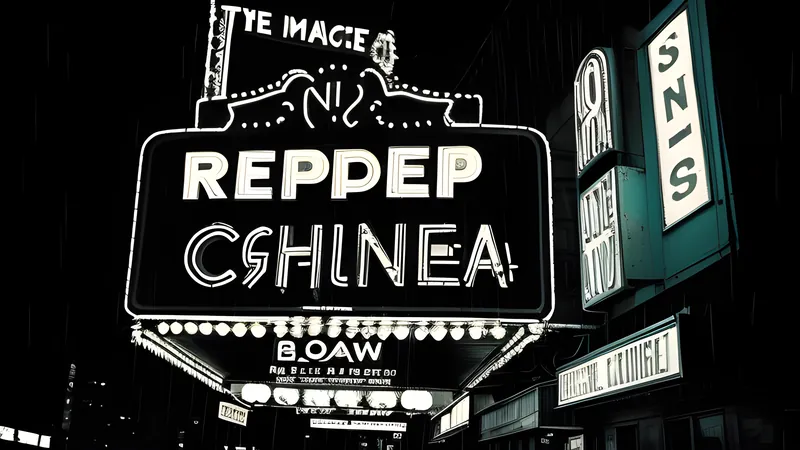
The physical heart of it was 42nd Street between Seventh and Eighth Avenues — “the Deuce” — a strip of grand old legitimate theatres that had slid, across the middle of the century, from vaudeville and Broadway tryouts into a dense row of grind houses and adult cinemas. The Lyric, the Victory, the Selwyn, the Empire, the New Amsterdam: names that had once meant Ziegfeld now meant kung-fu triple bills and the smell of decades of cigarette smoke. By the 1970s the block was one of the densest concentrations of disreputable exhibition anywhere in the world, and it kept its own chroniclers. Bill Landis’s fanzine Sleazoid Express documented the Deuce from the inside with a rigour that mainstream criticism would not match for decades, treating these films and these theatres as a subject worth serious attention.
The audience is the part the nostalgia flattens. The Deuce was not a curated repertory paradise. It was often frightening, frequently a front for other trades, and genuinely dangerous after dark. The romance of the grind house has to sit alongside the reality that it was a symptom of a broken, hollowed-out stretch of a struggling city, and that many of the people who filled those seats were there because they had nowhere warmer to be. The films were cheap because the whole context was cheap, in every sense. Honesty about that is part of taking the culture seriously.
Redevelopment and the machine that replaced it
The Deuce died from two directions at once. From above, the 42nd Street Development Project — the long municipal campaign to reclaim and “clean up” the block, accelerating under Mayor Giuliani through the 1990s — condemned, bought and gutted the old theatres. Disney’s restoration of the New Amsterdam, reopened in 1997 for a stage musical, became the symbol of the transformation: the grandest of the old grind houses returned to family entertainment, the loop of continuous exploitation replaced by timed tickets to a licensed spectacle. The AIDS crisis had already devastated the surrounding economy of adult businesses. What had been a zone of continuous, indiscriminate, communal watching became a pedestrianised destination of billboards and chain restaurants.
From below, home video had already pulled the floor out. The whole point of the grind house was access — it was where you went to see the films the respectable circuit would not book. Once a corner-shop rental club could put Zombie Flesh Eaters on a shelf, the reason to sit through a triple bill in a dangerous room evaporated. The exploitation audience atomised into a million living rooms, each with its own pause button, and the communal machine that had shaped the films fell silent. This is the same technological shift that triggered Britain’s video nasties panic at exactly the same moment, seen from the other side: video killed the grind house in New York while the tape it enabled terrified the establishment in London.
The costume and the corpse
Which brings us back to the scratches. The Tarantino-Rodriguez Grindhouse and its many imitators love the print damage because it is the one part of the experience you can reproduce. You cannot recreate the continuous programme, the flat admission, the dangerous street, the half-sleeping room, the flat-fee distributor scraping a booking for a film nobody else would touch. So the revival fetishises the surface — the wear a projected print acquired from being ground through machines for years — and mistakes the symptom for the thing. A digitally added scratch is a tombstone, not a resurrection.
The films themselves are better served by being watched straight, without the costume. Basket Case is a real film with real feeling under the grime. The Corman quickies are genuinely inventive. The imports that scandalised two continents are, at their best, serious works of horror. What we lost when 42nd Street died was never the movies, which mostly survive in cleaner shape than they ever played in. What we lost was a way of encountering them: cheap, communal, indiscriminate, and gone. The grind house was a room, and the room is a car park now.
Related Content