Gozu: Miike's Yakuza Trip Into Nightmare Logic
A 2003 gangster errand that dissolves into pure dream
Contents
Takashi Miike made so many films in the early 2000s that critics learned to sort them into piles: the violent ones, the family ones, the ones made for television, the ones nobody can quite classify. Gozu (2003) — full title Gokudō kyōfu dai-gekijō: Gozu, roughly “Yakuza Horror Theatre: Gozu” — sits alone in a pile of its own. It begins as a gangster picture, tight and generic, and then, without ever announcing the turn, walks out of that genre and into a dream from which it never wakes. It is the closest Japanese cinema has come to filming the actual texture of a nightmare, and it remains, twenty years on, Miike’s most quietly radical work.
I’ve watched it perhaps four times, and each viewing has confirmed the same thing: the film is not being weird at you. It is being logical, according to the rules of sleep. That distinction is the whole review.
The errand that will not stay simple
The premise is almost insultingly plain. Minami is a mid-ranking yakuza whose “brother” in the organisation, Ozaki, has begun to lose his grip — seeing yakuza attack dogs where there are only lapdogs, growing paranoid and dangerous. The boss orders Minami to drive Ozaki to Nagoya and have him disposed of. Minami loves Ozaki and hates the assignment, and the film’s opening stretch is genuinely a crime story: the reluctant soldier, the doomed friend, the long car journey toward an act the driver can’t stomach.
Then Ozaki’s body vanishes from the car. And the film’s floor gives way.
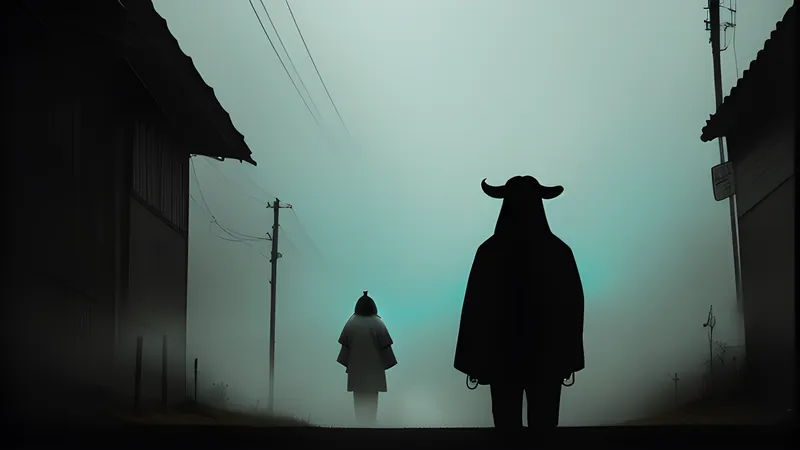
Minami’s search for the missing corpse leads him through a town in the Nagoya outskirts that observes none of the ordinary rules. An innkeeper who lactates and bottles her own milk. A man with a hideous facial condition who runs a cafe. A yakuza boss with a private compulsion so grotesque it’s played, correctly, as deadpan farce. And, in the film’s signature apparition, a man with the head of a cow — Gozu, the ox-headed guardian of the Buddhist hell — who materialises in a room, licks the hero’s face, and hands him a slip of paper. None of it is explained. None of it needs to be. Miike simply lets the search continue as though a cow-headed messenger were a normal thing to meet on a bad night, and the calm is what makes it unbearable.
Why the nightmare logic actually works
Plenty of films throw random strangeness at the wall and call it surrealism. Gozu works because Miike understands the specific grammar of dreams, and shoots to it with discipline.
The first rule he obeys is affect. In a real nightmare, the terror isn’t in the monster; it’s in your own inability to react correctly to it. You meet something impossible and feel only a low, administrative dread — where is the body, how do I complete the task, why won’t anyone help me. Miike keeps Minami in exactly that register. His hero never screams at the cow-man. He worries about his errand. That flatness of response, held against escalating impossibility, is precisely how sleep feels, and it’s the effect the whole film is engineered to produce.
The second rule is banality of setting. Miike shoots this in unglamorous daylight, in ordinary rooms, in a nowhere town of car parks and cafes and municipal blandness. The horror doesn’t arrive in a gothic castle; it arrives in a rest stop. That commitment to the mundane is what gives the apparitions their charge — a cow’s head is far worse in a beige inn than it would be in a temple. The screenwriter, Sakichi Sato, who also wrote Miike’s Ichi the Killer, structures the whole thing as a quest that keeps almost resolving and then sliding sideways, the way dream tasks recede the moment you approach them.
There is also a fourth quality, quieter than the others: the way objects in Gozu refuse to stay inert. A ladle, a car boot, a slip of paper, a bottle of milk — each ordinary thing is handled with a weight that implies significance, and the film never confirms whether the significance is real or projected. That is exactly the paranoid attention of a dream, in which every detail seems to be a clue and none of them resolve. Miike lets you do the interpreting, then quietly withholds the answer, so the anxiety of decoding never lifts. It is a remarkably sophisticated effect to sustain across two hours, and he sustains it without a single line of explanation.
The third is a refusal to wink. There is comedy in Gozu — a great deal of it, some of it startlingly filthy — but Miike never plays a scene as a joke he’s in on. Everything is delivered with the same grave face. That straightness is the discipline that separates genuine surrealism from mere quirk, and it’s why the film unsettles long after a “wacky” version would have been forgotten.
Where it belongs in the collection
Gozu is usually filed as an outlier, but it has clear ancestors and cousins worth chasing. The most cited touchstone is David Lynch, and the debt is real — the ox-headed man is a direct descendant of the impossible figures that stalk Lynch’s Eraserhead, and Miike shares Lynch’s conviction that the uncanny belongs in kitchens and corridors rather than crypts. If Lynch is the grandfather, the immediate family is Miike’s own.
It helps to know where Gozu came from. Miike shot it in the thick of his most prolific stretch, the same window that produced a dozen other pictures, and yet it premiered at the Cannes Directors’ Fortnight in 2003 — an art-house imprimatur that surprised everyone who knew Miike only as the shock merchant of Ichi the Killer. The Cannes berth mattered, because it forced the festival-critic world to reckon with the idea that the most notorious gore director of his generation had made something closer to Bunuel than to a splatter reel. Both readings are correct. That doubleness is the career in miniature.
For anyone coming to Miike through Gozu, the essential companion piece is Audition, which pulls the identical trick from the opposite direction — a placid drama that curdles into horror so gradually you can’t find the seam. And the two films that rhyme most closely with Gozu’s tone are its batch siblings in this desk’s Miike run: Visitor Q, the DV-shot domestic provocation that shares Gozu’s deadpan approach to the unthinkable, and Wild Zero, which channels the same anything-goes energy into pure garage-rock joy. Watch the three together and you get a complete map of what early-2000s Miike could do with a small budget and no fear.
The verdict
Gozu asks for a particular kind of surrender. If you need a film to add up, it will feel like being trapped in someone else’s sleep, and you’ll resent it. If you can let a story proceed by association rather than cause, it’s one of the most rewarding things Miike ever made — funny, frightening, tender about its central friendship, and genuinely unpredictable in a way almost nothing in modern cinema manages. It never once tells you what it means. It doesn’t have to. It knows exactly what a nightmare is, and it reproduces one with a craftsman’s precision. That precision is easy to miss because the film wears the costume of exploitation — the lurid title, the yakuza trappings, the gross-out set pieces — but everything underneath is controlled to the frame. Miike is doing avant-garde work in a genre disguise, and the disguise is so convincing that the achievement often goes uncredited.
Where to watch: it circulates on cult-label discs from its original distributors and turns up on horror-focused streaming services; any decent transfer serves it, since the film’s power is in performance and pacing rather than spectacle.
Spoilers below
The ending is where Gozu either loses you completely or reveals its whole game, so it’s worth walking through. Minami’s quest, it turns out, has been leading him back to Ozaki all along — but Ozaki returns transformed, reborn as a woman who insists she is still Ozaki, and who carries proof of that identity on her body in a mark only Minami would recognise. The film’s final movement stages a reunion between the two men that is now a reunion between a man and a woman, consummated in a scene that Miike shoots as the literal, grotesque, impossibly touching climax of the whole dream.
The last image pushes the birth metaphor past all decorum: an adult Ozaki is delivered, whole and full-grown, back into the world, with Minami as reluctant midwife. It’s the most extreme thing in the film and, read correctly, the most sincere. The entire nightmare has been about Minami’s refusal to lose the person he loves, and the dream grants him the only resolution a dream can — it returns Ozaki to him in a form that cannot be taken away by the organisation that ordered the killing. Love survives, monstrously and completely. Miike plays the finale for shock, and it delivers the shock, but underneath the outrage is a genuinely moving idea: the dream will do anything, break any rule of body or logic, to keep the beloved alive. That’s why Gozu lingers. The strangest film in Miike’s catalogue is also, secretly, his most romantic.
Related Content