Ghost Stories: The British Portmanteau Revival
Nyman and Dyson drag the Amicus anthology into the twenty-first century
Contents
The portmanteau horror film is a British invention that Britain then abandoned. Ealing built the template in 1945 with Dead of Night, Amicus industrialised it across the sixties and seventies, and then the form died of its own formula — too many wraparounds where a sinister proprietor deals tarot cards to five doomed strangers in a lift. By the mid-eighties the anthology was a punchline. It stayed a punchline for thirty years.
Ghost Stories, released in 2017, is the film that took it seriously again, and the reason it works is that Andy Nyman and Jeremy Dyson clearly love the dead form enough to know precisely which bones to keep. They wrote and directed it themselves, adapting their own stage play, which had run in the West End from 2010 and had spent the better part of a decade terrifying theatre audiences with an effect that nobody thought could survive the transfer to film.
The play’s route to the screen is part of the point. It opened in 2010, moved into the West End, toured, and kept selling on word of mouth and a house rule about not revealing the ending — a piece of showmanship that also happened to be an accurate description of how the thing worked. By the time the film premiered on the festival circuit in 2017 and reached British cinemas the following spring, Nyman and Dyson had spent seven years watching live audiences tell them, nightly, exactly which beats landed and which ones died. Very few horror films arrive that thoroughly tested.
Three cases and a debunker
Nyman plays Professor Phillip Goodman, an academic and television sceptic whose speciality is humiliating psychics on camera — cold reading exposed, mediums caught with earpieces, grieving relatives told gently that they have been robbed. He is good at it. He is also, in a way the film establishes early and quietly, a man who needs to be right about this rather than a man who happens to be right.
Goodman is contacted by Charles Cameron, a legendary debunker of an earlier generation who inspired his career and then vanished. Cameron hands him three case files that resist explanation and invites him to try.
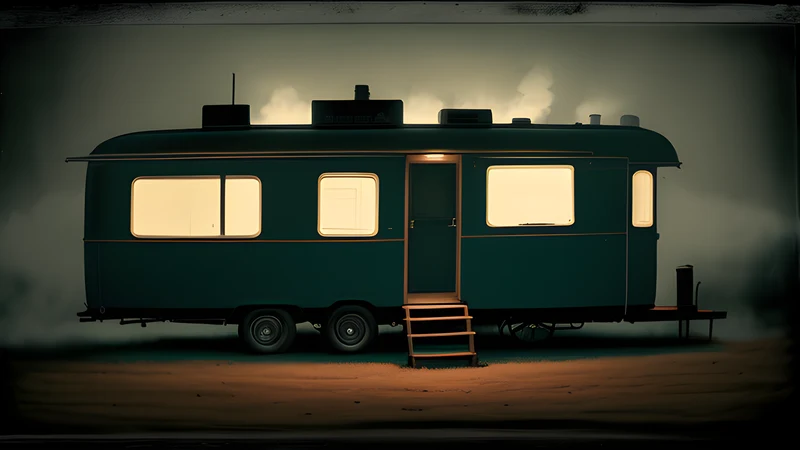
The handover happens in a caravan on a dead stretch of coast, and the choice of location tells you what kind of film this intends to be. The great sceptic of his generation has ended up parked on scrubland in the fog, surrounded by his own paperwork, and Nyman and Dyson shoot the scene with the flat grey misery of a place nobody chose. Amicus would have given the mentor a panelled study and a decanter. This film gives him a caravan, because it has decided that English dread lives in the places you drive past.
The cases are the anthology, and the casting is the first sign of intelligence. Paul Whitehouse plays Tony Matthews, a night watchman doing rounds in a disused institution — a comic actor deployed for the specific bleakness a comic actor can produce when the jokes stop. Alex Lawther plays Simon Rifkind, a teenager who drove his father’s car into the woods and met something on the road, and Lawther gives one of the great British horror performances of the decade in perhaps fifteen minutes, all shredded nerves and a voice that keeps climbing. Martin Freeman plays Mike Priddle, a moneyed man waiting on the birth of a child, and Freeman plays him with an affability so relaxed it starts to feel like a threat.
Why the scares actually land
Here is the craft, because Ghost Stories is a film that understands the mechanics of fright at a technical level and is willing to show its working.
Nyman’s day job is relevant. He is a magician and mentalist by training and spent years co-creating Derren Brown’s stage shows, which means he has stood in front of live audiences thousands of times measuring exactly how long you can hold a room before you have to pay it off. That timing is all over the film. The scares in Ghost Stories are constructed rather than sprung: the film shows you an empty frame, lets you find the wrong thing in it yourself, and then refuses to cut for three seconds longer than is comfortable.
The night-watchman sequence is the clinic. Ole Bratt Birkeland shoots the institution in long, patient takes with a lot of dead space at the edges of the frame, and the horror arrives in the periphery, unremarked, while the camera goes on being interested in something else. There’s no musical sting to tell you where to look. The audience does the work, and an audience that has done its own work is far more frightened than an audience that has been shoved.
The Rifkind sequence runs the opposite tactic — claustrophobic, hand-held, a boy in a stationary car with the interior light on and the woods pressing in — and it demonstrates the pair’s other principle, which is that a scare is only as good as the performance underneath it. Lawther is doing something almost unwatchable with his breathing. The horror is his face.
The adaptation problem was the whole risk. On stage, Ghost Stories worked partly through the sheer physics of a shared dark room: hundreds of people flinching in unison, blackouts you cannot look away from because there is nothing to look at. Film has none of that. Nyman and Dyson’s solution was to abandon the theatrical apparatus entirely and rebuild the effects in cinematic grammar — frame composition, held takes, sound design that puts noises fractionally off-screen. What survives is the philosophy rather than the staging.
The real ancestor
The film’s parentage is worn openly. Dead of Night is the grandfather: Ealing’s 1945 anthology invented the circular frame in which the wraparound turns out to be the true horror, and Ghost Stories is in direct conversation with it. The middle generation is Amicus — Milton Subotsky’s house style, the portmanteau as an industrial product, five tales and a twist for the price of one feature. I’ve written about that whole apparatus in Amicus and the art of the portmanteau horror, and the shortlist of what actually still plays is in the Amicus portmanteau canon. Ghost Stories takes Amicus’s structure and Ealing’s frame and marries them.
There’s a third strand, and it’s the one people miss. Dyson is a founding member of The League of Gentlemen — the non-performing writer of the four — and the film has that troupe’s precise cruelty about English provincial texture: the wrong carpet, the exact wrong pub, the specific desolation of a business park at night. The dread in Ghost Stories is national. It smells of damp.
For the sceptic-versus-the-inexplicable machinery, the closest cousin is The Entity, which builds a whole film out of the friction between a woman’s experience and the professionals explaining it to her. Both films are interested in the same question: what is the debunker actually defending?
The case against
The anthology’s oldest structural flaw is intact. Three tales of unequal strength means one of them is third-best, and the Priddle segment is the one carrying the most plot freight and the fewest genuine frights. Freeman is superb and the sequence is doing necessary work for the frame, and it still plays as the section where the film is thinking about its ending rather than about your pulse.
The bigger objection is that the film is a machine with a solution, and once you know the solution it becomes a different and lesser object. This is the anthology’s ancient bargain and Ghost Stories pays the price along with everyone since 1945. On a second pass the tales flatten into evidence. What survives rewatching is the technique — the held frames, Lawther’s breathing, the appalling patience of the watchman sequence.
There’s also a fairness question about the frame that reasonable people argue over: whether the film plays straight with its audience or whether it wins by withholding. My view is that it plays straight and plants everything, and I’d concede that the planting is subtle to the point of deniability.
What is beyond dispute is that two men who love a discredited form went and proved it wasn’t discredited, just badly used. The anthology’s problem was never the shape. It was thirty years of people filling the shape with nothing.
It streams widely and the disc carries a commentary that is unusually useful — Nyman and Dyson talk technique rather than anecdote. Watch it in the dark, phone in another room, and follow it with Dead of Night. Then compare the two frames and see which one moves you more, because the answer is less obvious than the seventy-two years between them suggests.
Spoilers below
The frame eats the tales, exactly as Ealing taught it to.
The film’s real subject is Goodman’s guilt, seeded from the opening in fragments: a strict religious father, an estrangement, and a memory of a boy at school called Sparks who was tormented by other boys. Goodman was there. Goodman watched. The tormentors chased Sparks into a tunnel, and Sparks did not come out, and the child Goodman — frightened, complicit, silent — went home and said nothing. The entire adult career, the debunking, the public dismantling of anybody claiming the dead persist, reads afterwards as forty years of a man shouting at the tunnel that nothing is in there.
The mechanism of the reveal is that the three cases are furniture. Goodman is discovered to be immobilised and non-responsive, and the men whose stories he has been investigating turn out to be figures around him in that condition — the voices in the room, repurposed by a mind constructing an elaborate investigation rather than face the tunnel. Mike Priddle is the hinge: the bully from the schoolyard, promoted inside the fiction to a man with a Range Rover and a smile, delivering the case Goodman most needs to disbelieve.
Cameron, the mentor who set the whole thing in motion, resolves into part of the same architecture — a construction that let Goodman keep being the sceptic for one more hour.
The last movement strips it all away and leaves Goodman inside his own head with the thing he did, and the film’s final image gives you an eye, aware, trapped, watching. The joke Nyman and Dyson have been building for ninety minutes is that a debunker’s job is to prove there’s nothing there. Their punchline is that he was right about the ghosts and wrong about himself, and that the haunting he could not explain was the one he was carrying the whole time.
Related Content