Gerald's Game: The Handcuffs and the Moonlight Man
The unfilmable King novel, filmed — one bed, one woman, and the worst afternoon in Maine
Contents
For twenty-five years, Gerald’s Game was the Stephen King novel everyone agreed couldn’t be filmed. The reason is simple arithmetic. A woman is handcuffed to a bed. Her husband dies. She stays there. That’s the book — three hundred pages of a single consciousness in a single position, almost all of it interior monologue, with a body on the floor and a dog in the doorway.
Cinema has no access to interior monologue that doesn’t sound like a bad audiobook. Every attempted adaptation foundered on the same rock: how do you shoot a novel whose entire action is thinking?
Mike Flanagan’s answer, arrived at in 2017 for Netflix, is so obvious that it’s slightly embarrassing nobody got there first. If a woman alone in a room needs to talk, give her people to talk to. Let the voices in her head walk around the bedroom.
The premise, and the trap
Jessie (Carla Gugino) and Gerald (Bruce Greenwood) drive to a remote lake house to repair a marriage that’s been quietly dying. Gerald has a plan involving Viagra and a pair of police-issue handcuffs. Jessie goes along with it and then, mid-scene, decides she doesn’t want to — and the argument that follows is one of the more uncomfortably well-observed scenes about consent in mainstream horror, because it’s about a decent-ish man who has decided that his wife’s reluctance is part of the game.
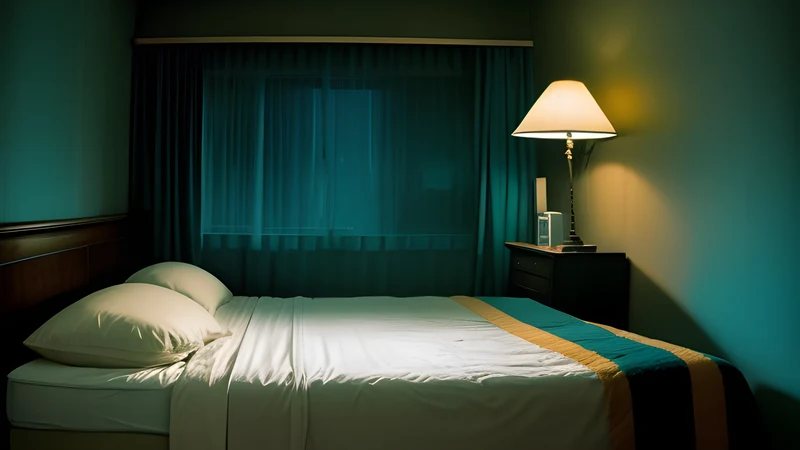
Gerald has a heart attack. He falls. Jessie is cuffed to a solid bed frame in a house with no neighbours, a door propped open, and a starving stray dog outside.
That’s the first fifteen minutes. The remaining ninety are a woman working the problem, and the reason the film sustains is that Flanagan never lets it become a survival procedural. The handcuffs are a device for making a woman sit still long enough to finally look at her own life.
The mechanics: how to shoot a fixed subject
The formal problem is that your protagonist cannot move, and a camera that can’t get a new angle on a static subject dies in about ten minutes.
Flanagan and his cinematographer Michael Fimognari solve it by making the room the variable. The bed stays; everything else changes. Light does most of the work — the film runs from bright afternoon through a long amber dusk into hard blue moonlight and back to dawn, and the shifts are the clock. You always know how long she’s been there because you can read the wall.
Then the hallucination conceit gives them their coverage. Jessie’s mind produces a version of Gerald, unmanacled, wandering the room, cruel and articulate — Greenwood is superb, playing her self-loathing as a smug man in a golf shirt. It also produces a version of Jessie, free and competent, standing at the foot of the bed telling her what to do. Suddenly Flanagan has a three-hander with blocking, eyelines and shot-reverse-shot in a room containing one conscious person.
That’s the adaptation solved. King’s interior monologue was already dialogic — the novel’s Jessie hears voices she names — so Flanagan is being faithful rather than clever. The choice is to stage the book’s psychology as theatre rather than translate it into voiceover.
The third element is the sound, and it’s brutal. The film is close-miked. You hear the cuffs on wood, the dry click of a throat, a woman’s breathing at a level that never lets you sit back. Where Hush generated tension by removing sound, this one generates it by putting your ear four inches from a face for ninety minutes.
Gugino is the whole thing. It’s a performance with almost no gesture available — she has one arm, a range of about eighteen inches, and a face — and she plays exhaustion, panic, humiliation, dark comedy and finally a kind of terrible clarity, without ever appearing to reach for it. That she got no serious awards attention is a straightforward function of the film having a Netflix logo on it in 2017.
The real ancestor
The obvious one is Misery, Rob Reiner’s 1990 film, another King property about immobility and another where the horror is being unable to leave a bed. It’s a fair comparison and it’s the wrong ancestor.
The real ancestor is The Diving Bell and the Butterfly, Julian Schnabel’s 2007 film about Jean-Dominique Bauby, locked in his own body, and cinema’s most rigorous attempt to film a mind with no exterior. Both films are solving the same problem — how to shoot consciousness — and both conclude that the answer is to let the interior become the set.
There’s a Buñuel inheritance too, in the way the dead husband gets up and starts talking. And the film’s other true kin is Kubrick’s The Shining, which I’ve written about as a hotel that rearranges itself — both are King adaptations where a space becomes the shape of a psychology, and both are about a marriage in which one party has been quietly making the other smaller for years.
It sits, of course, with the tradition in ten one-location thrillers, and it’s arguably the most extreme entry available: the location is a bed.
Worth knowing: King wrote Gerald’s Game and Dolores Claiborne as companions, linked by a solar eclipse in 1963 that both women experience. Flanagan keeps the eclipse and the childhood that goes with it, which is where the film’s real horror lives.
The case against
The film has one structural problem and everybody knows what it is: the last ten minutes.
King’s novel has an epilogue — a long, discursive, first-person coda, delivered as a letter, that ties the book’s real-world thread together. Flanagan films it. He films it as voiceover with montage, and after ninety-five minutes of the most disciplined single-room cinema you’ll see, the film suddenly becomes an audiobook with pictures. It’s faithful. It’s also a cliff.
I’ve gone back and forth on this for years. The coda contains the film’s actual argument, and there’s no obvious way to dramatise a legal aftermath spanning years without breaking the form entirely. Flanagan chose fidelity over shape. I’d have cut it and lost something.
Elsewhere: the flashback material with young Jessie (Chiara Aurelia) and her father (Henry Thomas) is essential and slightly over-explained. And the dog, whose function in the novel is grim and mechanical, is handled with a squeamishness the rest of the film doesn’t share.
Why it earns the shelf
Because it takes a premise that reads as exploitation — a woman cuffed to a bed in her underwear for the length of a film — and makes it the least exploitative thing imaginable. The camera is never once complicit. Flanagan’s coverage of Gugino is at eye level, in close, focused on a face doing arithmetic.
And because the escape sequence is the best five minutes he has ever directed. You’ll know it when you get there. It is one of the most physically upsetting things Netflix has ever put on its front page, and it works because it’s practical — a real problem, a real solution, and a real cost.
It’s still on Netflix, it’s a hundred and three minutes, and it should be watched alone.
Spoilers below
The escape, first, because it’s the film’s centrepiece and its reputation.
Jessie works out that the cuffs won’t come off her hand while her hand is the shape it is. She uses the water glass she’s spent an hour getting to, breaks it, and degloves her own wrist — cutting a bracelet through the skin and peeling the hand free, using her own blood as the lubricant. Flanagan shoots it long, close, and in continuous time, with practical effects and no cutaway. It’s the only moment where the film’s discipline serves pure sensation, and it earns it, because every element — the glass, the geometry, the blood — has been established as an object in the room for an hour.
Then the Moonlight Man. Through the night, Jessie has been visited by a figure in the corner: enormously tall, misshapen, carrying a box of bones and trinkets, showing them to her. Gerald’s voice insists it’s a hallucination — deoxygenated brain, terror, the mind manufacturing a devil. Jessie calls it Death and decides it has come for her.
She escapes, crawls to the car, drives half-blind into the dawn, and hits him on the road. And in the epilogue we learn the truth: the figure is Raymond Andrew Joubert (Carel Struycken), a real man with acromegaly, a necrophile and grave robber who had been breaking into houses across the region. He was in the room. Every night, he stood in her bedroom, showing a handcuffed woman his box of stolen bones, and left.
That reveal does two things. It ratifies her sanity, which the entire film has been in the business of questioning. And it makes the horror worse, because the consoling explanation was that she imagined him.
The coda is Jessie writing a letter to the eclipse. In 1963, aged twelve, her father sat her on his lap during the darkness and used her, and then asked her not to tell — and she agreed, because he cried. The film’s whole architecture snaps into place: the handcuffs are the marriage, the marriage is the father, and Jessie’s real imprisonment was a promise she made at twelve to keep a man comfortable.
She goes to Joubert’s trial. She looks at him, in court, in a room full of people, and says the line the film has been building towards — that he’s much smaller than she remembers. And he is, because she is looking at him rather than at the version of him her fear built.
That’s the ending, and it’s why the coda survives its own clumsiness. The monster was real. The prison was in the promise. Every man in this film asked her to be quiet, and the film ends with her speaking in the one room where speech is recorded.
Related Content