Forbidden Planet: Shakespeare in Deep Space
MGM smuggled The Tempest and Sigmund Freud aboard a 1950s space adventure
Contents
Most 1950s science fiction was shot fast and cheap in black and white, a monster and a scream and a matinee crowd. Then in 1956 MGM, the most opulent studio in Hollywood, poured roughly two million dollars into a CinemaScope space epic in lush Eastmancolor, hired a Disney animator to draw the monster and a pair of avant-garde composers to invent the soundtrack, and built it all on the skeleton of a Shakespeare play. Forbidden Planet is the film that dragged the genre uptown, and its ambitions were so far ahead of its moment that the movies spent the next decade catching up.
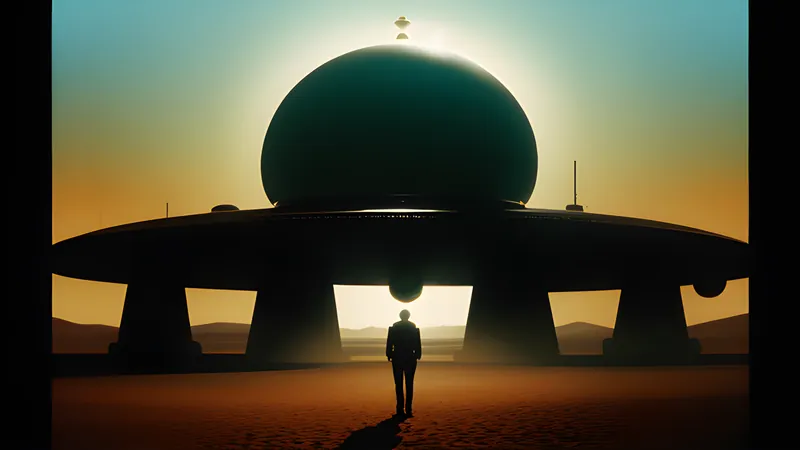
The template it set is enormous. A crew of uniformed professionals aboard a saucer-shaped faster-than-light cruiser, cracking wise on the bridge, answering to a captain, exploring a strange new world — sound familiar? Gene Roddenberry took the shape of it wholesale a decade later, and Star Trek is unthinkable without the United Planets cruiser C-57D getting there first. But the borrowing runs the other way too, back four centuries, because the story underneath the ray guns is The Tempest.
Prospero on Altair IV
The C-57D arrives at Altair IV to check on an expedition that went silent twenty years earlier. It finds two survivors: Dr Edward Morbius, a philologist played by Walter Pidgeon with sonorous, faintly sinister grandeur, and his daughter Altaira — Anne Francis, raised alone in this alien Eden and innocent of the whole business of men. Morbius wants the rescuers gone. He has made a life on this world with his machines and his books, and he warns Commander Adams — Leslie Nielsen, two decades before his comic reinvention, playing it as a stiff-jawed leading man — that an invisible force killed the rest of his party and will kill them too if they linger.
Read the cast against the play and the design snaps into focus. Morbius is Prospero, the exiled scholar-magician marooned on his island with his daughter and his secret knowledge. Altaira is Miranda, who has never seen a young man and falls for the first one to land. The crew are the shipwrecked nobles washed onto his shore. Robby the Robot — the film’s breakout star, a barrel-chested servant who cooks, sews, and manufactures on command — is Ariel, the bound spirit doing his master’s bidding. And the invisible thing prowling the perimeter, the monster from the id, is Caliban: the brute the magician keeps insisting he has mastered.
Cyril Hume’s screenplay never announces the source, and it does not need to. The pleasure is in watching a genre picture carry the weight of a great play without straining, using science-fiction hardware to literalise what Shakespeare left as poetry. Prospero’s magic becomes Krell technology. The invisible spirits of the island become force fields and disintegrator beams. It is the most sophisticated adaptation nobody credits, and it works because the underlying story — an old man, his power, his daughter, and the thing he refuses to see in himself — is durable enough to survive the trip to Altair IV.
The monster from the id
The film’s central invention is the Krell, a civilisation of unimaginable advancement that vanished overnight two hundred thousand years ago, leaving behind a subterranean machine the size of a planet. Morbius has spent two decades studying their ruins, and a Krell device has boosted his intellect, which is how he built Robby and his comfortable exile. The mystery of what killed the Krell in a single night, at the very summit of their achievement, is the engine of the plot, and its answer is the most quietly devastating idea in 1950s science fiction.
The Krell built a machine that could turn thought directly into matter — anything they imagined, made real, without lifting a hand. And they forgot one thing: the sleeping animal in the basement of every mind. On the night they perfected their machine, the collective subconscious of an entire species was granted the power to act, and all the buried rage and appetite and cruelty that reason had civilised away came roaring up out of the dark and slaughtered them by morning. “Monsters from the id,” the ship’s doctor calls it, and the phrase names the whole Freudian scheme the film is built on. The id is the primal drive; the machine gave it hands. The most advanced beings in the galaxy were destroyed by their own unconscious.
That is a genuinely radical thing for a Cadillac-budget MGM adventure to be about. It borrows its psychology straight from Freud’s model of the mind — the ego riding the id like a rider on a horse it cannot fully control — and turns it into a monster movie where the monster is the protagonist’s own repressed self. The film that would later work this same seam most powerfully is Solaris, Tarkovsky’s meditation on a planet that dredges up the buried contents of the astronauts’ minds and gives them flesh. Altair IV and Solaris are the same haunted world: a place where the interior becomes exterior, and a man is destroyed by meeting what he had hidden from himself.
Electronic tonalities
You cannot discuss Forbidden Planet without its soundtrack, because there has never been another quite like it and it came first. Bebe and Louis Barron, a husband-and-wife team of experimental composers working out of a Greenwich Village studio, built the entire score by hand out of custom electronic circuits. They would design a circuit, overload it until it shrieked and warbled and decayed, record the sound as it died, and edit the results on tape into cues. The Barrons called the result “electronic tonalities” — a phrase forced on them by the musicians’ union, which would not let two people who played no instruments be credited with a “score.”
The effect is total. There is no orchestra anywhere in the film, no strings under the love scene, no brass for the heroics. Every sound of Altair IV — the hum of the Krell corridors, the burble of Robby’s circuits, the wail of the id monster at the force fields — comes from the same alien electronic soup, so that the score and the sound design and the world are indistinguishable. The Barrons had done for the whole film what Bernard Herrmann’s theremin had done for one instrument in The Day the Earth Stood Still: they gave the future a sound. The difference is one of degree so extreme it becomes a difference in kind. Every synthesised film score, every ambient electronic drone under a spaceship, descends from those overloaded circuits dying on tape in a Village apartment.
The verdict
Forbidden Planet is the film in which American science fiction grew up in public — a genre picture with the production values of a prestige drama, the structure of a Shakespeare play, and the psychology of a Freud lecture, all delivered with enough ray-gun spectacle to keep the matinee crowd happy. Some of it has dated: the leering comic subplot with the ship’s cook and Robby’s whisky, the stiffness of Nielsen’s romance, the frank ogling of Anne Francis’s costumes. None of it touches the central engine, which is as bleak and modern as anything the genre has managed since. A species dies of its own mind. That is not a 1956 idea. That is a permanent one.
Watch it as the bridge between the sermons of the early decade and the cosmic awe to come. Pair it with The Day the Earth Stood Still for the other side of intelligent 1950s sci-fi, 2001: A Space Odyssey for where the ambition led, and Metropolis for the earlier spectacle that also hid a moral machine inside its marvels.
Spoilers below
The tragedy resolves the whole Freudian design. As Adams and his doctor piece it together, the invisible killer stalking the crew is not a Krell survivor or a native beast. It is Morbius. The Krell machine amplified his mind exactly as it amplified their whole civilisation, and every time his buried self is threatened — by the crew’s presence, by young Adams courting his daughter, by the prospect of losing his island and his power — his sleeping id draws on the planet-sized machine and manifests as a rampaging invisible force. The monster is his own jealousy and possessiveness given the power to kill, and it comes for the men who would take Altaira away from him.
The confirmation is a masterstroke of staging. The id monster, briefly outlined in a force field, is glimpsed as a snarling horned brute — animated by Joshua Meador, on loan from Walt Disney, so that the id of a repressed philologist looks like a fairy-tale devil. When it finally breaks through the fortified door of Morbius’s study, the doctor forces the old man to confront the truth: the thing outside answers to him. Morbius denies it, then in the act of finally rejecting his own monster — commanding it to stop as it kills him — proves the connection by dying as it dies. He wins the last battle against his own subconscious at the cost of his life.
Dying, Morbius tells Adams to trigger the Krell machine’s self-destruct, and the C-57D pulls away as Altair IV detonates, erasing the last trace of the dead super-civilisation and the man who could not survive his own mind. Altaira leaves with Adams; Robby, saved from the wreck, ends up piloting the ship home. The doctor’s closing line lands the moral: humanity is roughly a million years from Krell wisdom, and when we get there, we might remember Morbius as proof that no intellect is safe from the animal it carries. The most advanced technology imaginable did not save them. It just gave the oldest thing in them a way out.
Related Content