Faust: Švankmajer's Puppet Damnation
An ordinary Prague commuter is handed a map, and the map leads to hell
Contents
A man leaves a Prague metro station in the rain. Two strangers hand him a leaflet. It is a map, hand-drawn, with a building marked on it. He takes it home the way you take any leaflet home — because refusing was more effort than accepting — and puts it down, and that evening he cracks open his bread roll and finds an embryo inside it.
That is the first five minutes of Lekce Faust (1994), Jan Švankmajer’s second feature, and it is the most efficient piece of storytelling in his filmography. The man has been cast. He has not agreed to anything, signed anything, or wanted anything. The universe has simply decided that he is playing Faust now, and the only remaining question is how long it takes him to notice.
Petr Čepek plays him, in what turned out to be the last role of his life; Čepek died in 1994, and the film carries the weight of that without ever intending to. There is no character name. The credits and the world both treat him as a man who happened to be standing there.
Several Fausts, at once
Švankmajer’s script is a collage, and he is entirely open about it. The film draws on Goethe, on Christopher Marlowe’s Doctor Faustus, on Christian Dietrich Grabbe’s Don Juan and Faust, and — crucially — on the Czech folk-puppet Faust plays that survived for centuries in travelling marionette theatres while the literary versions were busy being respectable.
That last strand is the one nobody expects and the one that makes the film. The Czech puppet Faust is a knockabout — a fairground damnation with slapstick, a comic servant, and devils who bicker. Švankmajer splices this into Goethe’s cosmology, and the seams show on purpose. One moment a life-size marionette delivers Marlowe’s despair; the next, a wooden devil is doing a pratfall. The film’s argument is that these are the same story, and that the fairground version is closer to the truth, because damnation as a comic turn is more insulting than damnation as tragedy.
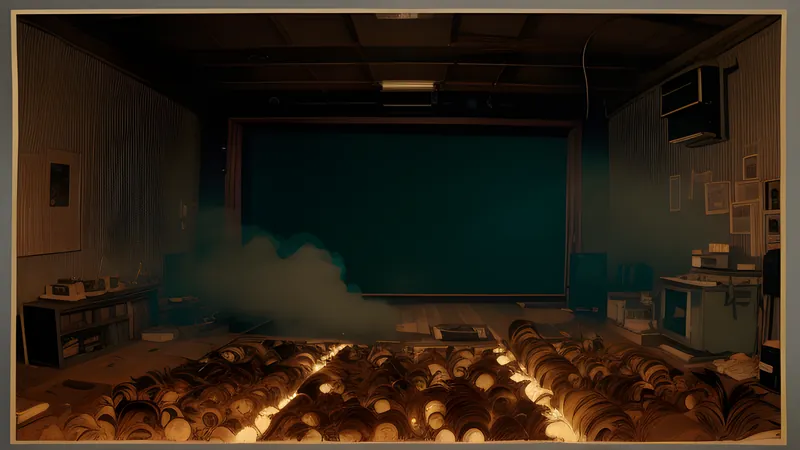
The man walks his map into a courtyard, through a door, into a derelict theatre with a dressing room. There is a Faust costume waiting. He puts it on, walks out onto a stage, and there is an audience. From that point he is inside the play, and the film never quite lets him back out — every time he escapes into Prague, the streets deliver him back to the theatre with the patience of a stage manager.
The mechanics: strings you can see
The technical decision that carries Faust is that Švankmajer refuses to hide the apparatus.
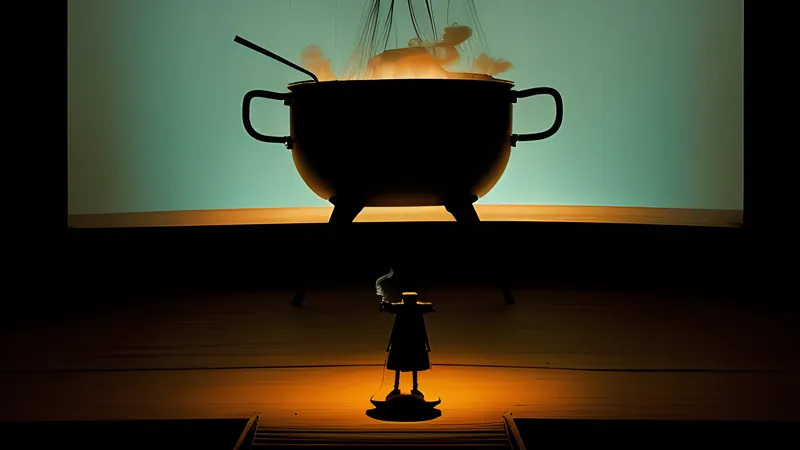
The marionettes are life-size, they are on visible strings, and in several sequences the camera simply tilts up to show the hands working them. In others, Čepek — a real, unstrung man — stands in the same frame as a strung puppet playing his scene partner, and Švankmajer lets you see that he is the only thing in shot without a mechanism. Then, later, the strings come for him too.
This is a formal joke that lands as metaphysics. A film about predestination has one job: to make the audience feel the wire. Most Faust adaptations do this with dialogue — the devil explains that the deal was always rigged — and the explanation lands as theology rather than dread. Švankmajer does it by pointing a camera at the wire. There is no argument to have with a string.
The Mephistopheles design is where the craft gets genuinely cruel. He is a clay head, animated in stop motion, and the clay is worked in front of you until it settles into Faust’s own face. Švankmajer’s clay behaves like clay; it slumps, it takes thumbprints, it remembers being handled. So the devil arrives wearing the protagonist’s features on a substance that visibly has no interior. It is the same material logic that runs Alice, where the shrunken girl becomes a porcelain doll — Švankmajer’s cosmology holds that a person is a made object with someone else’s fingerprints on it, and he keeps proving it with props.
And the sound, as ever, does half the work. Wood knocks. Clay squelches. The theatre’s silences have a room tone that presses. Švankmajer scores nothing and foleys everything, so the film’s emotional register is entirely a question of what you can hear being touched. Compare the amplified chewing that drives Little Otik and you find the same instrument tuned to a different appetite.
The running gags are the horror
Faust is very funny, and its comedy is where its cruelty lives.
Two men in bowler hats recur, appearing at the edge of frame with the map, handing it to strangers, waiting. They are recruiters. They are the reason the film’s dread is structural — this has happened before, it will happen again, and the theatre has an audience because it always has an audience.
Then there is the leg. A man with a wooden leg drifts through the film, and the leg keeps changing hands, keeps being carried, keeps turning up as an object that somebody has to deal with. It reads as pure Švankmajer absurdity for eighty minutes. It is a setup.
The old man in the alley, the trapdoors, the devils squabbling over a clay infant, the alchemical business that goes nowhere — all of it operates the same way. The film presents its own furniture as nonsense, and the nonsense is doing bookkeeping.
This is a rarer skill than it sounds. Comic absurdity and dread are usually rivals, because a laugh releases the pressure a scare has built, which is why most horror comedy alternates instead of combining. Švankmajer gets both out of one gesture by making his jokes procedural. Things are funny because they are being done wrong by someone who has clearly done them a thousand times, with the sullen competence of a council employee. The devils bicker like colleagues. The theatre runs like a theatre. That flat institutional texture is simultaneously the joke and the horror, and it never has to choose, because the punchline and the threat are the same observation: this is somebody’s job.
The real ancestor
The literary genealogy is announced in the text, so ignore it for a moment and look at the film’s actual parent, which is the Czech marionette theatre.
Puppetry in Bohemia was a serious business — a vehicle for the Czech language when German was the official one, a folk institution with a repertoire, and the tradition that produced Jiří Trnka. Švankmajer trained in it. When he stages Faust with life-size marionettes in a derelict Prague theatre, he is repatriating the story: reclaiming it from Goethe’s study for the touring puppeteers who were performing it in market squares while Goethe was still at school. The film is an act of restoration disguised as an act of vandalism.
Its cinematic siblings are the Czech films that treat evil as an administrative matter — The Cremator, above all, where damnation is a career path with a uniform. For a wildly different register on the same bargain, Brian De Palma’s Phantom of the Paradise sells the soul to a record label and gets the eternal-contract joke exactly right. And the Quay Brothers’ Institute Benjamenta is what happens when Švankmajer’s students put a live human into the doll’s house and let him stay there.
The honest case against
Faust is the most punishing thing Švankmajer made. Roughly ninety-seven minutes of collaged text, delivered in a mixture of registers, by a mixture of media, in a mixture of tones, with no score and no emotional handholds. Viewers who need to know why a scene is happening while it is happening will be locked out from the theatre door onwards.
The film’s coldness is also a real limitation rather than a pose to be defended. Čepek gives a wonderfully baffled, ordinary performance — a man being processed — and Švankmajer declines to let us close. That distance is thematically correct and dramatically expensive, and there are stretches in the middle third where the alchemical business circles a drain that has already been established as a drain.
The verdict, though. This is the best Faust film there is, and it is the best one because it removes the two things every other version thinks it needs. There is no ambition — the man never wanted knowledge or power or Helen. And there is no bargain — nobody offers him anything. He picks up a leaflet. Everything else follows from a moment of ordinary passivity in the rain, which is a far more accurate account of how people end up damned than any midnight signature in blood.
Where to find it: Lekce Faust has circulated on decent transfers via the Švankmajer box sets and turns up in the arthouse streaming tier. If you are starting the director from scratch, take Alice first, then this, then the appetites of Conspirators of Pleasure.
Spoilers below
The last five minutes are the reason the film exists.
The man finally breaks the loop. He gets out of the costume, out of the theatre, out of the courtyard, into the street — and Švankmajer, who has spent an hour and a half proving that escape is a scene the theatre also owns, lets him run. He is free, in daylight, in Prague, moving. And a car hits him.
That would be a nihilist’s punchline on its own. Švankmajer goes one step further and cashes his gag. A passer-by picks up the severed leg and walks away with it, carrying it exactly as the wooden-legged man carried his all film, and the loop closes with a sound like a door in a puppet theatre. The leg was always going to change hands. Someone is always carrying the leg.
What that ending argues is genuinely bleak and genuinely rigorous. The damnation in this Faust has no theological content at all. There is no hell, no reckoning, no soul weighed. There is a role, and a costume, and a rota, and when you have finished playing your part, the props are collected and reissued. The two men in bowler hats are still at the metro station. They have leaflets.
Related Content