Fata Morgana: Herzog's Desert Science-Fiction
The film Herzog shot as an alien's report on Earth, and then quietly stopped calling one
Contents
The best way into Fata Morgana is through the film Werner Herzog set out to make and did not. He went to the Sahara at the end of the 1960s with an idea that sounds like a Roger Corman pitch: creatures from the Andromeda galaxy arrive at a dying planet and film what they find. The footage would be their survey. The planet, obviously, is ours.
He came home with something that could not carry that scaffolding, released it in 1971 with the science-fiction frame mostly dismantled, and spent decades afterwards being asked what it is. The honest answer is that Fata Morgana is a short feature about the surface of the Earth photographed as though nobody who made it had ever seen the Earth before. That is closer to science fiction than most things marketed as such.
The mirage in the title
A fata morgana is a specific optical phenomenon: a superior mirage in which layered air of differing temperatures bends light so that distant objects appear stacked, stretched, floating, or inverted above the horizon. Sailors reported castles in the sky. The name comes from Morgan le Fay, who was supposed to conjure them.
Herzog’s film opens by handing you the concept directly. A plane lands through heat haze. Then another. Then another — the same shot, or near enough, repeated with a patience that dares you to look away, the aircraft swimming and buckling in air that has stopped being transparent. The runway liquefies. Nothing in the frame is being manipulated. The distortion is what the atmosphere does to light over hot ground, and Herzog simply pointed a camera at it and held.
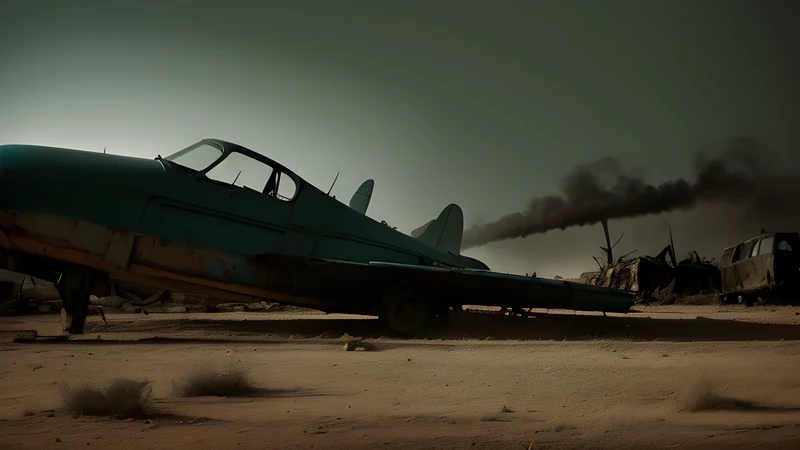
This is the film’s whole method in its first minutes. Find things that are already unreal and photograph them plainly. The Sahara and the Sahel provide a great deal to work with: dead animals mummified by dry air, wrecked aircraft half-swallowed by sand, oil drums, abandoned settlements, tracks going nowhere. Herzog and Jörg Schmidt-Reitwein shot most of it from a moving vehicle in long lateral tracks, so the landscape slides past the frame with the affectless rhythm of a survey. No commentary. No context. Just a planet, being looked at.
Three movements
The film is organised into three named parts, and the titles do the heaviest lifting of any words in it.
The first is Creation. Over the desert imagery, Lotte Eisner reads from the Popol Vuh, the Quiché Maya book of origins — the account of gods making the world, failing, and making it again. Eisner was the great historian of German silent cinema, the woman Herzog regarded as the moral link between his generation and the era of Murnau and Lang, and her voice in this film is doing something more than narration. She is reading a creation myth from one destroyed civilisation over footage of another civilisation’s leavings, in the language of a third. Nobody explains this. It simply happens, and the effect is that the images acquire scripture without acquiring meaning.
The second is Paradise, and this is where the irony sharpens. The paradise on offer is a landscape of industrial wreckage and marginal human settlement, filmed with the same unhurried respect. People appear — some working, some posing for the camera, some talking about things the film declines to subtitle into any coherent argument. A man holds a lizard. A boy stands very still. The sequence accumulates without building.
The third is The Golden Age, the shortest and by some distance the strangest. The survey method breaks down here, and Herzog swaps the desert for something small, interior and extremely hard to describe without ruining it. I will leave it below the line. It is the closest the film comes to a joke, and it is not a joke.
The score is doing steady work underneath all of this. Herzog reaches for Leonard Cohen, for Mozart, for Blind Faith, and the anachronism is the point — Western music laid over the Sahel like a foreign weather system, beautiful and irrelevant.
Why the science-fiction framing still matters
Herzog has been dismissive of the Andromeda premise in later interviews, and critics have generally been happy to drop it. That is a mistake, because the premise is what makes the film’s most striking quality legible.
The defining move of Fata Morgana is the withheld reaction shot. In a documentary, the camera’s attitude toward what it finds is communicated constantly — by framing, by cutting, by voice-over, by the implicit presence of a person who has judged this worth showing. Herzog removes all of it. The wrecked plane and the dead camel and the working man are given the same duration and the same distance. That flatness is not neutrality. It is the specific quality you would get if the observer had no prior category for any of it, which is exactly what an intelligence from Andromeda would lack.
Read as a documentary, this is a film with a coldness problem — Europeans pointing a camera at Africa and refusing to say anything, which is a posture with a long and unflattering history. Read as the survey footage Herzog originally intended, the coldness is diegetic: it belongs to the fictional observer rather than to the filmmakers. The framing does not dissolve the objection, and I would not pretend it does. But it changes what the film is claiming, and the claim is stranger and more defensible than the abandoned-documentary reading allows.
The craft that carries it
What makes Fata Morgana watchable rather than merely conceptual is the shooting. Schmidt-Reitwein’s lateral tracks are long — long enough that your eye finishes reading the frame and has to start over, at which point you stop looking for information and start looking at light. The film is training you out of narrative attention and into optical attention, and it does that with duration alone, no tricks.
The other decision is the refusal to establish. There is almost no wide shot that tells you where you are in relation to anything else. Each image is a fragment of a place that never assembles into a geography. That is precisely how the mirage of the title works: it presents you with something that is genuinely there and simultaneously nowhere you can walk to.
The third decision is the cutting, which almost nobody talks about because it is designed to be invisible. Herzog assembles the tracking material without any of the rhythmic escalation that documentary editing normally supplies — no shortening of shot lengths to build, no cutaway to a face to tell you how to feel, no accelerando into a sequence’s end. Shots simply succeed one another at roughly the pace of the vehicle. The result is that the film has no dramatic contour at all, and the burden of finding shape falls entirely on the music and the three part-titles. That is a genuinely radical structural choice, and it is why the part-titles hit as hard as they do: they are the only architecture in the building.
Herzog would refine this into the landscape overtures that open Heart of Glass five years later — the cloud sea, the manipulated waterfalls, the sense of a natural world conducting business far above the human plot. Fata Morgana is where he found that grammar, with no plot underneath it at all.
The collector’s cross-reference runs sideways into the avant-garde. Documentary is the wrong shelf entirely. The nearest ancestor is the dream cinema that trusts an image to be sufficient on its own — the loop-logic of Meshes of the Afternoon, the flat juxtapositions of Un Chien Andalou. Where Deren and Buñuel constructed their irrationality in a studio, Herzog drove to a place where the irrational was already lying on the ground and filmed it.
The descendant is easier to name: every slow-cinema landscape survey of the last three decades, and a fair chunk of the ambient documentary form. The tracking shot across ruined ground with music that does not belong to it is now a whole dialect. It was invented, or at least perfected, here.
Where it sits, and how to meet it
Fata Morgana circulates through the Herzog disc collections and screens in retrospectives, usually paired with the early shorts. It is short, and short is a mercy — this is a film that would collapse at feature-and-a-half length.
Do not treat it as an endurance test and do not treat it as a documentary about anywhere in particular. Put it on with the lights off and the sound loud and let the heat haze do what heat haze does. If you find yourself waiting for it to start, it has already been running for twenty minutes, and that discovery is the film’s actual event.
Spoilers below
There is no plot to spoil, so what follows is about the ending and about the film’s most uncomfortable passage, both of which land harder unprepared.
The Golden Age closes the film on two performers in a room — a woman at a piano, a man on drums, playing and singing in a manner that has been variously described as amateur, deranged, and unbearable. Herzog holds on them well past the point of comfort. After an hour of desert emptiness photographed with something close to reverence, the film’s final statement on the golden age of humanity is this: a small, badly lit, endless lounge act performed with total commitment to nobody.
That is the joke, and it is savage. The gods of the Popol Vuh made the world several times over and destroyed each draft that failed to praise them. Creation and Paradise pass across the screen as sand, bone, wreckage and mirage. And the golden age — the culmination, the thing all of it was for — turns out to be two people making a noise in a room because they cannot help it. Herzog gives that image the last word deliberately. The survey from Andromeda ends with the observers finding the dominant species doing the one thing that makes least sense and refusing to stop.
The other thing worth naming is what the ending does retroactively to everything above it. Once you have seen the lounge act, the desert material stops reading as elegy. On a first pass, the wrecked planes and dry bones play as ruins — evidence of something that was and is gone. After The Golden Age, they play as the normal condition, and the humans scratching about among them are the anomaly. The film reverses its own polarity in its last five minutes, and the earlier hour is a different object on rewatch.
That reversal is also where the film’s ethical problem sits at its sharpest, and I will not pretend the science-fiction frame dissolves it. A European crew drove through the Sahel photographing people and their poverty at a fixed, wordless distance, and declined to say what it thought. Calling the observer an alien explains the technique without excusing it. Herzog has been asked about this for fifty years and has never given an answer that fully lands. The film is extraordinary, and the objection travels home with you. Both of those are true, and a viewer who feels the second one is reading the film correctly rather than missing the point.
Related Content