Fascination: Rollin's Château of Blood
Brigitte Lahaie, a scythe, a drawbridge, and the most beautiful film Jean Rollin ever made
Contents
There is a single shot in Fascination that has outlived the film, the director, and most of the arguments about both. A woman in a black cape stands on the drawbridge of a château at dusk, holding a scythe, waiting for men who have not yet understood what is happening to them. It is on the posters, the Blu-ray sleeves, the T-shirts, the tattoo flash. It has been reproduced so often that people who could not name Jean Rollin can picture it. What gets lost in that reproduction is that the shot is earned — the eighty minutes around it are the most controlled, most confident work of a career that spent thirty years being called careless.
Jean Rollin made Fascination in 1979, roughly a decade into a run of French vampire pictures that nobody was asking for. The films had been savaged in France, ignored abroad, and financed by whatever he could scrape together between the pornographic features he shot under other names to keep working. By 1979 he had the measure of his own instrument. He knew what he was good at — landscape, silence, women in white against grey stone — and he stopped apologising for what he was bad at.
The fad that turned out to be real
The film opens in 1905 with a detail that sounds like invention and is documented history. In a slaughterhouse, two well-dressed young women drink a glass of fresh ox blood while a physician looks on. This was a genuine Belle Époque treatment: anaemic patients were prescribed warm blood straight from the abattoir, and the practice was common enough in France to leave a paper trail. Rollin found it, understood immediately what it was worth, and built a film on top of it.
The value is structural. Every vampire film has to solve the problem of the supernatural — the moment where the audience is asked to accept fangs, soil, an aversion to crucifixes. Rollin sidesteps the problem entirely by starting from the record. Blood-drinking here begins as medicine, prescribed by a doctor, taken by respectable women in good coats. What happens over the following decades of the story’s interior logic is that the medicine becomes a taste, the taste becomes a rite, and the rite acquires members. The horror arrives by drift. By the time the film reaches its real subject you have already agreed to the premise, because a medical footnote from 1905 signed off on it.
That opening also sets the class argument that carries the whole picture. The women drinking are wealthy. The blood is a by-product of an industry worked by people who will never appear on screen. The men who arrive later at the château arrive with guns and a bag of stolen gold, convinced that force and money settle everything. Rollin lets that conviction stand for about an hour before he removes it.
Marc, the gold, and the trap that looks like a refuge
The plot is a thief’s mistake. Marc has double-crossed his own gang over a haul of gold coins and runs for a château he believes to be empty. It is not. Two women are there — Eva and Elisabeth — apparently alone, apparently harmless, apparently amenable. Marc, who has a pistol and an opinion of himself, decides he is in charge of the situation. His gang is closing in outside. Midnight is coming, and the women keep mentioning midnight.
Brigitte Lahaie plays Eva, and this is the performance that makes the case for her as a serious actress rather than a curiosity of French film history. Lahaie had come to Rollin from the adult industry, where she was a genuine star, and the received wisdom about such crossings is that they produce stiffness. She is amused. She plays Eva as someone who has already read the ending and is being polite about it, and that amusement is more frightening than any amount of hissing would be. Franca Maï’s Elisabeth carries the film’s other register — she is the one who might still be reachable, which is exactly what makes her useful to the house.
Marc’s problem is that he is in a genre he has not identified. He thinks he is in a crime picture: gold, a gang, a hostage situation, a siege to be survived until dawn. Everyone else in the building knows the genre is something older. Rollin plays this gap for a full hour and never once winks at it. The thief keeps making crime-film moves, and each one lands in a room where they mean nothing.
Why it works: the empty frame and the patient cut
Rollin’s craft is easy to miss because it looks like a lack of craft. The camera holds. The compositions are frontal and symmetrical, often centring a figure in a doorway or an archway with dead space all around. Scenes run past the point where a conventional edit would release you. Watched impatiently, this reads as amateurism — a man who could not afford coverage, so he let the take run.
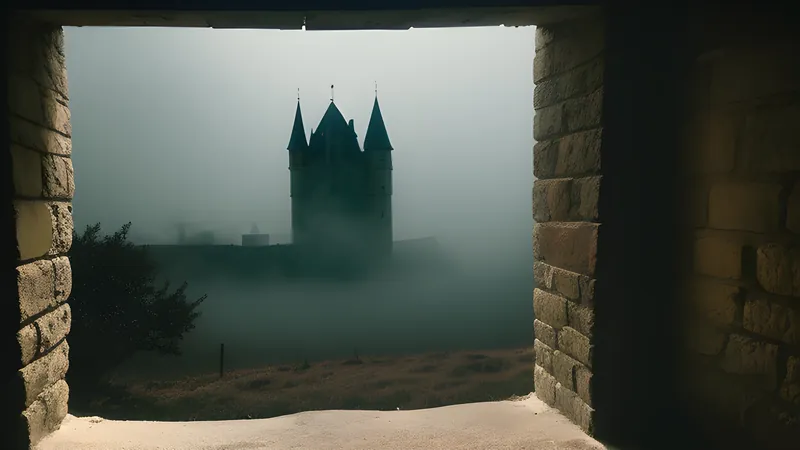
Watch the cutting rhythm instead. Rollin holds because holding is what generates the dread; the horror of a Rollin shot is almost always the horror of something that has not happened yet in a frame with too much room in it. The drawbridge shot works because he arrives at it late and stays with it long. The château is filmed as architecture rather than as a set — real stone, real water, real distance between the front gate and the front door — so that when the men come across the bridge, the walk itself is the tension.
There is also the sound. Fascination is quiet in a way almost no horror film from 1979 permits itself. Composer Philippe d’Aram supplies a small, thin, circling score, and Rollin uses it sparingly, letting wind and gravel and water do most of the work. The result is that a scythe swung in near-silence lands as an event rather than as a sting cue.
And the violence, when it finally arrives, is brief. That is the discipline the film is least credited for. A director with Rollin’s reputation might have been expected to wallow. The set pieces in Fascination are shockingly quick — a blow, a stagger, a cut away to a face that is already thinking about something else. He knew that duration is what makes gore boring and that surprise is what makes it stick. This is the same instinct that governs the best European gore of the period, and it is worth setting against the argument in why practical gore ages better than CGI blood: what ages best of all is gore a director was willing to cut away from.
The ancestor nobody names
The obvious lineage runs to Hammer’s Karnstein pictures and their aristocratic lesbian vampires — the same castles, the same white nightgowns, some of the same commercial calculation. Hammer’s Carmilla adaptation is the film most people reach for. It is the wrong ancestor.
The real ancestor of Fascination is Harry Kümel’s Daughters of Darkness, made nine years earlier, and the family resemblance is total: an out-of-season location filmed as a vacuum, a small closed cast, a predator who wins by conversation, a violence that arrives quickly and elegantly and then stops. Daughters of Darkness proved that the European vampire film could be furniture-quiet and still lethal, and Rollin took the lesson further than Kümel did, because Rollin had less money and therefore more silence.
Trace it back further and you land on the serials — Feuillade’s Les Vampires from 1915, whose criminal gang in black hoods gave French genre cinema its permanent taste for masked women moving through real locations at night. Rollin said as much repeatedly. The scythe on the drawbridge is Feuillade’s Irma Vep with an agricultural implement.
The verdict
Fascination is the film to hand to anyone who thinks Jean Rollin was a hack with a castle. It is coherent from first frame to last, its premise is drawn from the historical record rather than from vampire boilerplate, its central performance is genuinely witty, and it contains at least one image that has entered the permanent iconography of European horror. The pacing will still lose some viewers — the middle hour is a slow tightening, and if you need incident every four minutes you will be checking the runtime. That is a fair complaint and I would not argue anyone out of it. What I would argue is that the slowness is the mechanism rather than a flaw in it, and that the drawbridge does not work in a film that hurries to reach it.
Rollin made better-known films and gorier ones. He never made a more complete one. If Fascination sends you on, the natural next stop is The Living Dead Girl, where he takes the same instincts somewhere much bloodier and much sadder, or Lips of Blood, which is the purest distillation of what he actually wanted to be doing. For the wider map, the eurohorror canon is the place to start.
It circulates widely on restored disc and turns up regularly on the horror-focused streaming services, usually in a transfer that finally lets you see the dusk properly. That matters more here than it does for most films of the period.
Spoilers below
The trap is that Marc was never a hostage-taker. The women are members of a society of wealthy blood-drinkers who meet at the château at midnight, and Marc is the refreshment. Everything he interprets as seduction is catering. Eva’s amusement across the whole middle section reads completely differently on a second viewing: she is keeping the meat calm.
Eva’s death is the film’s cruellest structural joke. She goes out to face the gang alone with the scythe, kills them with a competence Marc never manages, and is shot for her trouble. The most capable person in the film dies executing a plan that works, and the film simply moves on. Rollin gives her no last words worth the name and no lingering. It is over.
Elisabeth is the one Rollin is actually interested in, and the ending belongs to her. She kills Marc — the thing she has been arranged for from the start — and then finds that she wanted him, which arrives too late to be of any use to anyone. The final image of her in white on the château grounds is Rollin’s recurring closing gesture, the same one he reaches for at the end of The Iron Rose: a woman alone in a landscape that has swallowed the plot. Nothing is explained. The society will meet again next month. The gold is still in the bag.
Related Content