Fantastic Voyage: The Body as Inner Space
Richard Fleischer's 1966 spectacle miniaturised a submarine, a crew and the whole idea of the frontier
Contents
In 1966 the space race owned the future. Every science-fiction spectacle pointed the same way, up and out, toward the moon and the planets and whatever waited past them. Richard Fleischer’s Fantastic Voyage did the contrary thing. It pointed the camera inward, shrank a submarine and five people to the size of a microbe, injected them into a dying man’s bloodstream, and discovered that the last unmapped frontier was the one everybody was walking around inside. It is a film about inner space, made at the exact moment the culture could think of nothing but outer space, and that inversion is still the smartest idea in it.
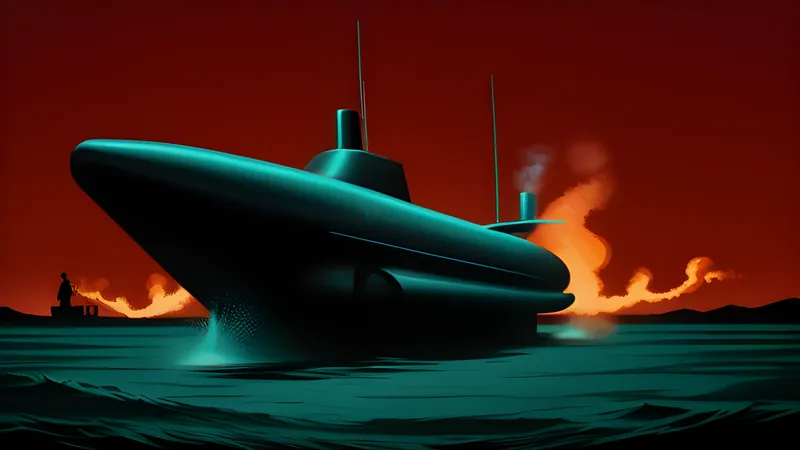
The premise is pure Cold War pulp, delivered with a straight face. A scientist named Benes has cracked the secret of miniaturisation without the fatal limit that has held it back, and enemy agents put him in a coma with a blood clot lodged too deep in his brain for a surgeon’s knife to reach. So the CMDF, a hush-hush government outfit, shrinks a nuclear submarine, the Proteus, and its crew to microscopic scale and injects them into Benes’s carotid artery. They have sixty minutes before they revert to full size. The clock, the closed environment and the sabotage plot are all recognisable furniture, and the film assembles them with a craftsman’s confidence.
The landscape inside
What lifts Fantastic Voyage above its own daft plot is production design. The film won Academy Awards for its art direction and its visual effects, and both were earned. The interior of the body is rendered as a genuine environment, cathedral-vast and strange: the artery as a rushing red canyon, the heart chambers as thundering caverns, the lungs as glowing translucent forests, the inner ear as a silent hall where a single dropped instrument could kill the patient with a shockwave. Dale Hennesy’s sets and L. B. Abbott’s effects work turn anatomy into terrain, and the film understands that this is its whole reason to exist. It stops for the view, repeatedly, and it is right to.
The craft lesson here is patience with spectacle. Fleischer, an old hand who could shoot anything from film noir to biblical epic, keeps the pace deliberate and lets the audience gawp. When the Proteus is caught in an arteriovenous fistula and swept off course, or when the crew must swim through the heart during a deliberately induced cardiac arrest, the tension comes from geography, from the body as a place with weather and currents and lethal architecture. This is design as storytelling. The film sells the peril by making the space believable, and a modern effects house drowning a sequence in weightless digital gloss could stand to study how much weight practical sets and matte work carried here.
The cast is doing sturdy, unshowy work in service of the sets. Stephen Boyd is the security man Grant, our audience surrogate, a plain-spoken sceptic dropped among specialists. Arthur Kennedy is the surgeon Duval, Donald Pleasence the fretful, sweating Dr. Michaels, William Redfield the sub’s captain. And Raquel Welch is Cora Peterson, the surgical assistant, in the role that turned her into a star before One Million Years B.C. the same year sealed it. The characters are functions more than people, which is the film’s real weakness, and it is worth naming plainly. They exist to explain the next marvel and to be winnowed by the next hazard. The body is the protagonist.
The score earns a mention because it does something unusual. Leonard Rosenman scored the entire voyage with a spare, avant-garde palette and, for long stretches, no music at all, letting the hum and gurgle of the body carry the tension. Silence in the inner ear, the wet acoustic of the lungs, the pulse pressing against the hull of the sub: the sound design treats the interior of a man as a real acoustic space, and that commitment to the aural texture is a large part of why the environment convinces. It is the same discipline a good horror director brings to an empty house, applied to an empty artery.
Where the science shrugs
A revisit has to be honest about the seams, and Fantastic Voyage has a famous one. Isaac Asimov, who wrote the novelisation and cleaned up as much of the science as the story would allow, could never fully reconcile the central conceit, and neither can the film. The unresolved problem of what happens to the miniaturised submarine when the hour runs out, and to everything the crew leaves behind inside the patient, is the sort of thing that keeps physicists awake and screenwriters reaching for the next set piece. The film mostly wins the argument by moving fast and looking gorgeous, which is a time-honoured strategy and, on its own terms, a legitimate one.
There is period baggage too. Cora exists partly to be imperilled and partly to be looked at, and the film’s idea of a woman on a scientific team is very much of 1966. The dialogue creaks. The Cold War framing is a museum piece. None of this sinks the picture, because none of it was ever the point. The point was to take you somewhere no camera could go, and on that promise the film delivers with a generosity that has aged better than its politics.
The real ancestor and the descendants
Trace the lineage and Fantastic Voyage turns out to be a hinge. Its direct descendant is easy to name: Joe Dante’s Innerspace in 1987 ran the identical premise as a screwball comedy, with Dennis Quaid piloting the miniaturised pod and Martin Short as the hapless body he ends up inside. Twenty-one years apart, the two films bracket a whole shift in tone, from earnest awe to knowing farce, over the same anatomical map.
The more interesting inheritance is thematic. By imagining the human body as a landscape you could enter, be threatened by and be changed by, Fantastic Voyage opened a door that body horror would walk through with far darker intentions. The whole idea that flesh is a territory, uncanny and hostile and ours, runs from here to the work catalogued in David Cronenberg, the flesh and the machine, where the inner landscape stops being a wonder and becomes a betrayal. Fleischer showed the body as cathedral; Cronenberg showed it as trap; the fascination is the same organ.
It also belongs to a specific moment in big-idea, big-canvas science fiction, and the useful comparison is the film that arrived two years later and swallowed the genre whole. 2001: A Space Odyssey pointed outward where Fantastic Voyage pointed inward, but both films made spectacle the argument, both trusted the audience to sit and stare, and both descend from the visual grammar first laid down in Metropolis, the blueprint every effects-driven science-fiction picture keeps quietly robbing. One more thread worth pulling: the same director, Richard Fleischer, would return to science fiction seven years later with a film pointed at a much bleaker future, and the two make a revealing pair about a craftsman working the genre’s opposite poles.
Spoilers below
The sabotage plot pays off exactly where the film has been pointing all along. The traitor aboard the Proteus is Dr. Michaels, and Pleasence, sweating and twitching from his first scene, telegraphs it so heavily that the reveal is less a shock than a confirmation. Michaels has been stalling, steering the sub into hazards, hoping the clock runs out before the surgery succeeds. His attempts culminate in a struggle for control of the vessel and a crash that leaves it wrecked deep in the brain.
The famous set piece is the antibody attack. When the crew is forced to pass through areas the body reads as an intruder, white blood cells and fibrous antibodies swarm, and in the film’s most iconic image the strands wrap around Cora as the others tear them away by hand. It is grotesque and beautiful, the immune system rendered as a living net, and it remains the sequence people remember decades later.
The escape is the film’s cleverest stroke and the moment it most fully commits to its own metaphor. With the Proteus destroyed and time nearly gone, the surviving crew swim to the corner of Benes’s eye and are drawn out of the body on a single tear, restored to full size on a glass slide the instant they clear him. It is a resolution of real elegance, the body weeping out the tiny travellers who saved it, and it neatly sidesteps the awkward question of the lost submarine by simply not mentioning it. Michaels, left behind and consumed, provides the film’s grim answer to what the body does with what it will not tolerate.
The verdict on a revisit is that Fantastic Voyage survives as a design achievement and a conceptual one, a film whose characters are cardboard and whose science is a shrug, redeemed entirely by the audacity of its central idea and the beauty of its execution. It took the frontier everyone was staring at and turned it inside out. Watch it for the sets, stay for the tear, and then follow the body inward to David Cronenberg, the flesh and the machine for where this fascination goes once it stops being safe, or outward to 2001 for the era’s other great argument that spectacle can be a thought.
Related Content