Fando y Lis: Jodorowsky's Riotous Debut
Before El Topo, Jodorowsky filmed a paralysed woman, a wheelbarrow and a quest for a city that doesn't exist, and started a riot doing it.
Contents
Every myth needs an origin, and the myth of Alejandro Jodorowsky — the tarot-reading, boundary-storming guru of the midnight movie — begins with a riot. When Fando y Lis premiered at the Acapulco Film Festival in 1968, the audience reportedly turned on it so violently that Jodorowsky had to be smuggled out, and the film was subsequently banned in Mexico. He has told the story many times, with the embellishment of a natural showman, so the precise temperature of the outrage is hard to fix. What is not in doubt is that his first feature announced, in black and white and on almost no money, an artist who intended to assault the audience and call it liberation.
Seen today, past the legend, Fando y Lis is rawer and stranger than the polished provocations that made his name. It is the debut of a man learning his own language in public, and its roughness is part of what it has to teach. This is where the whole Jodorowsky project starts — the pilgrimage narrative, the grotesque tableaux, the mingling of the sacred and the obscene — before he had the craft to make any of it go down smoothly.
The wheelbarrow to Tar
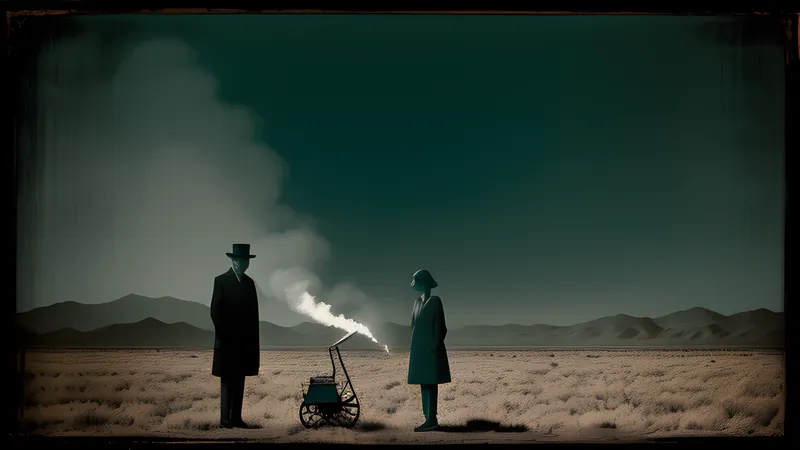
The story, such as it is, comes from a play by Fernando Arrabal, Jodorowsky’s collaborator in the Panic Movement, the surrealist-provocateur collective they formed with Roland Topor. Jodorowsky has said he directed the film from his memory of the play rather than a script, which accounts for its dreamlike discontinuity. Fando (Sergio Kleiner) is a young man; Lis (Diana Mariscal) is his lover, paralysed and unable to walk. Together they journey across a blasted, post-apocalyptic-seeming landscape toward Tar, a mythical city said to grant every wish, with Fando pushing Lis in a small cart piled with their possessions — a gramophone, a drum, the debris of a life.
They never seem to arrive. Instead the pair pass through a series of grotesque and surreal encounters — decadents playing cards, a mud-daubed procession, figures who torment and tempt them — that function less as plot than as stations of a pilgrimage. The relationship between Fando and Lis darkens as they travel; his tenderness curdles periodically into cruelty, and the film circles obsessively around love, dependence, memory and the violence buried inside devotion. It is a quest film in which the quest is really an excavation of two damaged people.
The imagery is where the future Jodorowsky is unmistakable. Burning pianos, bodies in mud, ritualistic cruelty staged with a painter’s eye for composition, a constant traffic between the holy and the defiled. Shot over many weekends across a long stretch of time with a shifting non-professional cast, the film has the handmade texture of an obsession pursued outside the industry entirely. There is no studio gloss anywhere in it, and that is the point.
The birth of a sensibility
Fando y Lis matters most as the seed of everything that followed, and the cross-references write themselves. The pilgrimage toward a promised place that may not exist, the episodic structure of grotesque encounters, the fusion of religious iconography with shock and blasphemy — all of it would return, refined and amplified, in the film that actually built Jodorowsky’s legend. That film is El Topo, the 1970 acid Western that invented the modern midnight movie as a commercial phenomenon, and you cannot fully understand its confidence without seeing the wilder, less controlled experiment that came first.
From there the line runs straight to The Holy Mountain, where the quest-for-enlightenment structure and the alchemical, tarot-soaked symbolism reach their most elaborate pitch, and eventually to the wounded, autobiographical Santa Sangre, where the same preoccupations — the damaged body, the devouring parent, guilt made flesh — find their most emotionally coherent form decades on. Watched in sequence, Fando y Lis is the overture in which every theme is stated before the composer has quite worked out how to orchestrate them.
There is a wider lineage too. The Panic Movement’s aim was to shock the bourgeoisie out of its complacency through spectacle, and Fando y Lis belongs to that broad postwar surrealist current — the descendants of Buñuel and Artaud — for whom the image existed to disturb rather than to please. Its dream-logic bad-trip atmosphere, the sense of a nightmare unfolding with its own remorseless internal reason, connects it to the industrial unease of Eraserhead, another debut in black and white by an artist building a private cosmology from the ground up. The two films would make a punishing, revelatory double bill.
The collaboration with Arrabal deserves its own note, because it clarifies what Jodorowsky was and was not doing. Arrabal was a playwright of genuine standing whose “theatre of panic” mixed ceremony, blasphemy and childlike cruelty, and he would go on to direct his own confrontational films. Jodorowsky took the raw provocations of the stage work and reached for something more mystical with them, folding in the tarot, the eastern philosophy and the psychomagical ideas that would define his later persona. You can feel the two temperaments pulling against each other across Fando y Lis — the anarchic prankster and the would-be shaman — and the friction gives the film an instability that its more assured successors lack. It is the only Jodorowsky feature where you sense he has not yet decided which kind of provocateur he is going to be.
Why it works, and why it enrages
The honest thing to say is that Fando y Lis does not always work, and that its failures are inseparable from its value. It is uneven, wilfully obscure, sometimes tedious in the way genuine experiment can be, and the cruelty in it — particularly around Lis’s body and helplessness — is confrontational in ways that were designed to provoke and still do. This is not a film that seeks your comfort or your understanding. It was made by someone who believed that art should be dangerous, and it commits to that belief past the point of good taste, which is exactly why it caused a riot.
What works, and works powerfully, is the conviction. There is no hedging in Fando y Lis, no gesture toward respectability, no attempt to make the strangeness palatable. Jodorowsky films his images as though they are sacred even when they are grotesque, and that total seriousness — the refusal to wink — is what separates real surrealism from mere weirdness. The film demands that you take its dream on its own terms or leave, and the audience at Acapulco, according to legend, chose to leave loudly.
It also works as a document of a particular faith in cinema, the belief that a film could function as an initiation, a ritual, a genuine derangement of the viewer’s settled sense of things. That faith would soon find its audience in the midnight houses, where films were consumed by crowds primed to receive them as experiences rather than entertainments, a phenomenon explored in our piece on why the midnight movie needs a crowd. Fando y Lis was too early and too raw to find that crowd on release. It had to wait, like its maker, for the culture to build the room in which it made sense.
Where to find it: it circulates on Blu-ray and through streaming and repertory programmes devoted to Jodorowsky, often paired with his other early work. Approach it as an origin document rather than a masterpiece, and it becomes fascinating — the sound of a sensibility being born in real time, with all the noise that entails.
Spoilers below
To speak of “spoilers” for a film this associative is almost a category error, but the film does resolve, and its resolution is the key to everything Jodorowsky would later do. As Fando and Lis’s journey to Tar continues, the balance between them tips further and further toward Fando’s cruelty. His love for Lis is real, and so is his resentment of her dependence, and the film refuses to let either cancel the other out. The tenderness and the violence are the same feeling seen from two sides, which is the uncomfortable truth the whole pilgrimage has been circling.
The climax makes that truth literal. In a fit of rage and torment, Fando turns on the helpless Lis and, in the film’s most notorious sequence, brutalises her — the cruelty that had been simmering finally boiling over into an act that destroys the thing he loves. Lis does not survive it. The city of Tar, the promised place where every wish is granted, is never reached; the wish that mattered has already been ruined by the man carrying it there.
The final movement follows Fando in the aftermath, grieving and undone, the quest collapsed into mourning. Jodorowsky closes on images of burial and reunion that reach for transcendence out of the wreckage, a first stab at the redemption-through-suffering arc he would spend his whole career perfecting. It does not fully earn the grace it grasps for — the craft was not there yet. But the ambition is the whole story. In this raw, riotous debut, a young filmmaker was already trying to build a ladder out of guilt and cruelty toward something like the sacred, and getting his audience to riot rather than climb it with him. Everything he made afterward was a refinement of the attempt.
Related Content