Explorers: Dante's Kids Build a Spaceship
Joe Dante's unfinished 1985 film has the best first hour and the most argued-about last twenty minutes of the decade
Contents
Three boys in a small American town build a spacecraft in a back garden out of a fairground ride, a washing machine motor, and a circuit design that arrives in one of their dreams. That is the premise of Explorers, and for roughly seventy minutes it is one of the most purely likeable films anybody made in the 1980s. Then it hits a wall that has nothing to do with its own ambitions and everything to do with a release date.
Paramount put Explorers into cinemas in July 1985 in a state Joe Dante has spent forty years describing as unfinished. The studio had a slot, the slot was immovable, and the film went out without a completed third act — no final effects, no reshoots, no chance to solve the problem the ending had. Dante has been consistently blunt about this: the version that exists is a rough cut with a release print made from it.
The first hour
Ben Crandall (Ethan Hawke, fifteen, in his first film) is a science fiction obsessive who falls asleep with the television on and dreams of a circuit board. Wolfgang Müller (River Phoenix, fourteen, also his first) is the friend who can actually build things — a boy with a basement lab, a long-suffering family, and the specific manner of a child who has read ahead. Darren Woods (Jason Presson) is the kid from the wrong side of it all, who does not care about the science and comes anyway.
They build the circuit. It generates a sphere of force that can be moved and shaped and made to travel, and the film’s best long sequence is the three of them working out what it does — first as a floating bubble in a basement, then as a thing they can sit inside, then as a way of flying a stolen Tilt-A-Whirl car over their own town at night.
Nothing in that stretch is condescending. Dante shoots the boys as competent people doing real work: they test, they fail, they nearly kill themselves, they iterate. Wolfgang’s lab is full of half-finished projects and a hand-lettered periodic table. Ben’s obsession is specific — he has the posters, he knows the films, he is the kind of boy who has opinions about which alien invasion picture is best. The film respects the labour, and because it respects the labour, the flight when it comes is earned rather than granted.
The craft: the night flying
The sequence that justifies the film is the first proper flight, and it is a masterclass in what a director does with a budget he cannot afford.
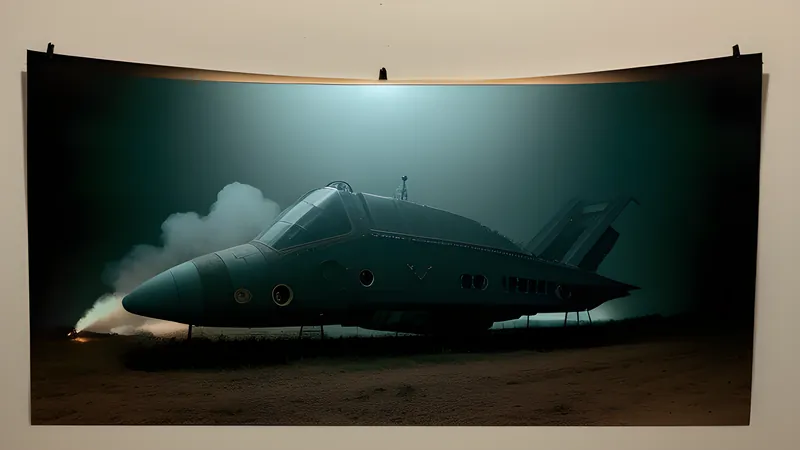
The Thunder Road is a fairground car with a windscreen and a wooden dashboard, wrapped in a sphere. That is the entire ship. Dante and cinematographer John Hora shoot it almost exclusively at night, in close, with the boys’ faces lit by the glow of their own instruments and the town below rendered as a scatter of lights. You never get a clean, wide, daylight look at the craft in flight, and the reason is that a clean wide daylight look would have shown you a fairground car on a wire. The constraint produces the film’s most beautiful idea: the spaceship is only ever seen the way the boys see it, from inside, at night, with the world small underneath.
Jerry Goldsmith’s score is the other half of it. He writes the flight material as a waltz — a rising, wheeling three-four that keeps turning over on itself — and it is the single best cue in a decade of Goldsmith writing very good cues. The music is doing something the effects budget could not: it supplies the sensation of altitude.
The third element is Dante’s own furniture. There is a drive-in on the ground, a monster movie playing in Ben’s bedroom, a Dick Miller cameo, and a running argument about what science fiction has promised these children. Every one of those is a joke and also a thesis statement, and the film is building towards cashing them in.
The ancestor
Explorers looks like Amblin and it is not descended from Amblin. Its parents are the 1950s juvenile invasion pictures that Ben Crandall watches on television, and Dante’s whole point is that Ben has been raised on them and has taken them as instruction. The film he is really rewriting is It Came from Outer Space — the one where the aliens are frightening only until somebody bothers to listen — and the connection is not homage. It is argument. Ben has learned everything he knows about first contact from films, and Dante’s real subject is what happens to a boy raised on that literature when the literature is finally tested.
The other ancestor is Warner Bros animation, which is the key to every Dante picture. He came out of trailers and Corman and a childhood of Chuck Jones, and his instinct is always that a joke and a moment of awe should occupy the same shot. That is why Explorers refuses to be sincere for more than ninety seconds at a stretch, and it is also why the studio did not know how to sell it.
The neighbour to watch it against is The Last Starfighter, released a year earlier with the identical faith that a bright kid from nowhere gets to go to space — and with the wish granted, straight, no complications. Dante grants the wish and then asks what the wish was actually made of. For the adult version of the same suspicion about what the movies taught America, Repo Man got there the year before with a great deal more bile.
The children
Two of the three leads became significant actors and the film is now watched partly as an artefact of that. It survives the scrutiny.
Hawke is already recognisably Hawke — the same slightly stricken sincerity, the same habit of listening harder than the scene requires. Phoenix is the astonishing one. He plays Wolfgang as a boy who is genuinely, unshowily cleverer than everyone in the room and completely unable to convert that into standing, and he does the accent and the fussiness without ever once asking you to find him cute. He was fourteen. There are adults in this film being out-acted by him.
Presson gets the least and does the most with it. Darren is the kid with the difficult home and no interest in physics, and the film never makes a speech about that; it just lets him be the one who is unafraid, because he has less to lose.
The case against
The last act does not work. This is not really arguable and Dante does not argue it. The film builds an hour of exquisite anticipation and then arrives somewhere tonally sideways from everything preceding it — funny, strange, and structurally unfinished, with an ending that stops rather than concludes. Audiences in 1985 came out baffled and the film died in a fortnight.
It is worth being precise about the blame, because “studio interference” is usually a director’s alibi and here it is documented. Dante had a delivery date he could not move. The consequence was not a butchered cut imposed by an executive; it was a film that never got its last stage of work at all. The difference matters, because a butchered film has a better version sitting in a vault somewhere. Explorers does not. There is nothing to restore. The good version was never made.
Even the defence has to concede the damage. A rough cut is a rough cut. The pacing of the final twenty minutes is wrong, the effects are incomplete, and there is a resolution missing that Dante had planned and never shot. What is on screen is a sketch of an idea rather than the idea.
The film also has an odd shape for its audience. It is too knowing for small children, too slight in its plotting for teenagers, and its jokes are aimed squarely at a forty-year-old who grew up on Saturday matinées. Paramount had no idea who to sell it to, and its marketing pitched it as a spaceship adventure for kids, which is precisely the film Dante was declining to make.
Where to watch: it has had disc releases and turns up on rental platforms. Watch the first hour with anyone at all. Watch the last twenty minutes with someone who wants to argue.
Spoilers below
The boys make contact and the aliens are children.
That is the reveal, and it is why the film failed and why it is loved. Wak and Neek — Wak played by Robert Picardo, unrecognisable under prosthetics — are adolescents who have taken their father’s ship out without permission. They have been broadcasting the circuit design into Ben’s dreams because they wanted someone to come and play. And everything they know about humanity, every word, gesture and idea, they have learned from decades of television and film transmissions leaking off the planet.
So Wak talks in fragments of advertisements and monster movies and game-show patter, at volume, delighted, and it is very funny and completely unbearable for Ben, who has spent his short life believing that the sky contained something better than this. The dream was a prank. The wonder was a signal leak. First contact turns out to be a boy from another planet quoting your own worst television back at you because he thinks it is what you are.
Picardo’s performance is a stunt and it is also the whole argument. Dante is saying, in a summer film aimed at children, that the culture we broadcast is the only version of ourselves anyone else will ever receive, and that it is a humiliating one. Ben’s disillusionment in that scene is real and the film does not rescue him from it. When Wak’s father comes home and throws the humans off the ship, the boys go home with nothing — no artefact, no proof, no friendship. Just the knowledge that the aliens are as ordinary and as badly informed as they are.
The scene works as the culmination of everything the first hour set up. It works as a joke. It works as an idea. It does not work as an ending, because it needs a fourth movement that the release schedule ate — Dante has described intentions for what came after, and what exists instead is the boys dreaming and a hint that they will fly again, which is simply where the footage ran out.
Watch it anyway, and watch it knowing the shape of the thing you are missing. There is a film in here about a boy who loved science fiction, built a spaceship out of a fairground ride to go and find the thing it promised him, and discovered that the promise was a rerun. Paramount released two-thirds of it in July and buried the rest. Nearly forty years on, those two-thirds are still better than almost everything that opened alongside them.
Related Content