eXistenZ: Cronenberg's Game That Predicted the Console War
A revisit of the wettest virtual-reality film ever made, and the one that saw the industry coming

Contents
In the spring of 1999 two films about jacking your consciousness into a fabricated world opened within weeks of each other. One of them dressed its heroes in black leather, gave them guns and a messiah, and became the defining blockbuster of its generation. The other grew its game consoles out of amphibian tissue, plugged them into a hole at the base of your spine, and quietly told the truth about where the games industry was heading. The Matrix got the decade. David Cronenberg’s eXistenZ got the future.
The pod, the port, and the umbicord
The setup is pure Cronenberg. Allegra Geller, played by Jennifer Jason Leigh, is the world’s most celebrated game designer, unveiling her new virtual-reality system eXistenZ to a focus group of hand-picked fans. The console is a MetaFlesh game-pod, a pulsing organic mass that breathes in your palm and connects to players through a “bio-port” surgically drilled into the spine, fed by an “umbicord” that looks exactly as unpleasant as it sounds. When an assassin fires a pistol grown from bone and loaded with human teeth, Allegra flees with Ted Pikul, a marketing trainee turned reluctant bodyguard played by a young Jude Law, and the two dive into her game to check whether the master copy survived the attack.
From there the film folds. Layers of game nest inside layers of game, and the flat, slightly stilted performances Cronenberg coaxes from his cast become the tell — everyone plays as though half-aware they might be a non-player character running a script. The supporting bench is deep and strange: Ian Holm as a shady bio-port surgeon, Willem Dafoe as a gas-station mechanic who installs illegal ports, Sarah Polley, Don McKellar and Christopher Eccleston filling out a world where the seams between real and rendered have already dissolved.
Why the flesh matters
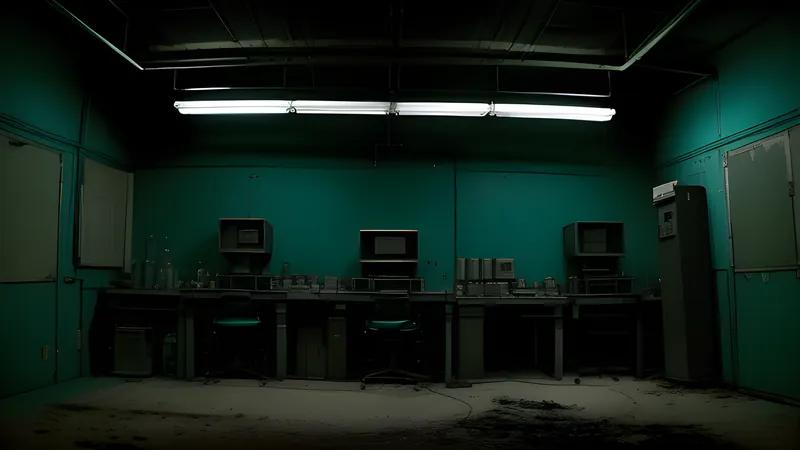
Cronenberg wrote eXistenZ himself, his first fully original screenplay since Videodrome sixteen years earlier, and the two films rhyme deliberately. Where the earlier picture imagined television growing into the body through a vaginal slit in a man’s abdomen, this one imagines the games console doing the same thing from the other end. The craft decision that makes it work is the refusal to render the game as clean digital space. There are no glowing grids or wireframe horizons here. The virtual world looks exactly like the real one, shot on the same overcast Ontario locations, so the audience loses its footing precisely the way the characters do. You can never point at the screen and say “that part is the game”, which is the entire trick.
The special effects, built practically by Jim Isaac and his team, are the film’s argument made physical. A gun that fires teeth cannot pass a metal detector. A console that lives off your body cannot be pirated in the usual way. Cronenberg thinks through the biology of his premise with an engineer’s rigour, and the queasy tactility of it — the pod flinching when it is hurt, the port that can go septic — grounds the metaphysics in something you can feel in your own spine. This is where the film out-thinks its glossier rival: The Matrix treats the interface as a magic phone line, while eXistenZ insists the interface is meat, with all the vulnerability meat carries.
Leigh and Law carry this queasiness in their bodies. Leigh plays Allegra as an addict of her own creation, stroking the pod, wincing when it is wounded, more tender toward the console than toward the man beside her. Law plays Pikul as a man frightened of penetration, flinching from the port until he surrenders to it, and his slow conversion from squeamishness to hunger is the emotional engine of the whole picture. Cronenberg has always understood that technology enters us through desire, and the two leads perform that idea without ever naming it. The camera lingers on hands and orifices, on the instant of connection, until the act of plugging in reads as unmistakably sexual and faintly diseased at once.
The console war, foreseen
Watch it now and the prophecy is almost funny in its accuracy. Allegra’s company, Antenna Research, is locked in commercial war with a rival platform-holder, Cortical Systematics, and the plot turns on corporate espionage, leaked builds and the fanatical loyalty of the player base. There is a “realist” underground waging a literal holy war against game designers, complete with a death sentence pronounced on Allegra — a fatwa, a detail Cronenberg drew from the Rushdie affair, transplanted onto the culture of gaming a good decade before anyone spoke of console loyalists as a tribe.
The film understood that the coming battle would be fought over platforms and immersion, that hardware would become an object of near-religious attachment, and that the deepest fear would be losing the ability to tell the game from your life. It grasped the emotional core of the games industry — the craving to disappear into a built world, and the queasy question of who owns the world once you are inside it — years before the industry could articulate it about itself. As speculative fiction about technology and desire, it belongs on the shelf beside the coldest, most prescient sci-fi of its era. There is a further prophecy in how the film treats authorship. Allegra is a designer whose creation has escaped her control, worshipped by strangers who feel they own it and hunted by others who think it profane. That collision of the maker against the fandom, the personal vision against the mass audience that consumes and mutates it, describes the culture around games, and around every large franchise, far more accurately than anything in its blockbuster contemporary. Cronenberg saw that the coming fight would be about who gets to define an imaginary world once millions of people live inside it, and that the answer would never again be the person who built it.
The verdict, argued
eXistenZ was overshadowed on release and has stayed underseen, and the neglect is a genuine loss. It is the more intellectually daring of the two 1999 VR films, funnier than its reputation, and its ideas have only sharpened with age while its rival’s mythology calcified. The flat performances that put some viewers off are a deliberate design, and once you read them as a feature the film opens up. It is minor Cronenberg only in the sense that it is small and strange; on its own terms it is one of the sharpest things he ever made. It was made cheaply and quickly, and that economy suits it; the drab, functional world of trout farms and roadside garages makes the horror feel domestic and reachable, the way the best speculative fiction always does. Two and a half decades on, its questions have simply gone on ripening while the technology raced to catch up. Watch it, then chase the recommendations below.
Spoilers below
The whole film is a nested trap, and the ending is its punchline.
Throughout, Ted and Allegra descend through games within games — a rural trout farm that turns out to be a bio-port workshop, a Chinese restaurant where Ted assembles the tooth-gun from the “special” on his plate and shoots the waiter, a factory where diseased game-pods are manufactured. Characters glitch, repeat lines when prompted, and freeze when the plot needs them elsewhere, all the tells of software wearing the skin of the world. Cronenberg keeps pulling the rug, and each new floor looks identical to the last.
The final reveal is that everything we have watched was itself a game — a system called transCendenZ, designed by a different company, being play-tested by the very people who appeared as the leads. Allegra and Ted are revealed as players named differently, and the assassin from the opening scene turns out to be a fellow tester who denounces the designer for making a game that “deforms reality”. The two protagonists then draw weapons on that designer, and the film cuts to black on a question asked straight to a bystander and to the audience: are we still in the game?
That closing gesture is the film’s thesis delivered as a joke and a threat at once. Once immersion becomes total, the exit sign itself becomes suspect, and no revealed layer can be trusted as the last. It is a colder, more honest ending than the messianic ascension its 1999 sibling reached for, and it lands because Cronenberg never once let the game look like a game.
For the film that started this obsession of his, go back to Videodrome, where the screen first started growing into the body. And for the clean, leather-clad opposite of everything eXistenZ does with flesh and doubt, revisit The Matrix — the two are the same year, the same question, and utterly different nerves.
Related Content