Even Dwarfs Started Small: Herzog's Revolt of the Small
An island institution rises up, and Herzog films the revolution eating itself
Contents
Werner Herzog was twenty-seven when he made his second feature, and it is the one that people still bring up when they want to argue that he was, for a while, genuinely out of control. Even Dwarfs Started Small was shot in black and white on Lanzarote, in the volcanic dead ground of the Canary Islands, with a cast composed entirely of people with dwarfism, and it depicts the inmates of a remote institution rising against their keepers and then discovering that they have no idea what to do next. It was received with something close to revulsion. Herzog spent decades answering the charge of exploitation. The film has never softened.
I want to deal with that charge first, because it determines whether you can watch the thing at all. The accusation is that Herzog cast people with dwarfism in order to make his revolutionaries look ridiculous — that the film’s whole method is a visual joke at the cast’s expense. Herzog’s answer has always been that the reverse is true: that the institution and its furniture are built to a scale nobody in the film fits, and that scale is the subject. The cast, by every subsequent account, were willing collaborators; Herzog has said he promised them that if they came through the shoot uninjured he would jump into a cactus patch, and when they did, he did, and spent a long time afterwards with a needle. That is not a defence of the film’s ethics. It is evidence about the atmosphere on the set, which is a different thing, and both should sit in the reader’s mind at once.
The premise, kept above the line
An institution on a remote island — reformatory, asylum, school, the film declines to specify and the ambiguity is deliberate. The director has gone. In his absence the inmates have rebelled, and the deputy who remains has barricaded himself in the office with a single inmate, Pepe, as a hostage, waiting for authority to return and negotiating with people who no longer recognise the concept.
Outside, the revolt proceeds. Its leader, more or less, is Hombre, played by Helmut Döring, whose laugh is the film’s most notorious sound. There is no manifesto, no demand, no plan beyond continuing. The rebels break what is available, eat what is available, and improvise escalations, and the film’s central and appalling observation is that they escalate because the momentum has nowhere else to go, with their oppression supplying no further demand.
Herzog stages this in a landscape that does most of the argument for him. Lanzarote’s lava fields have no vegetation, no horizon of interest, no scale references at all, and Thomas Mauch’s camera holds them in a grey, over-exposed monochrome that makes the courtyard look like a place at the end of a planet. The revolt takes place in a container that leads nowhere. Whatever they win, they will still be here.
Why it works: the car
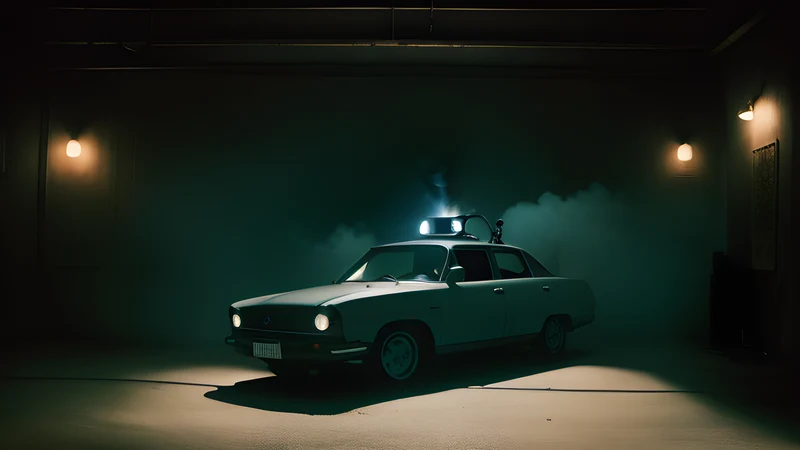
The image everyone carries away is the driverless car. The rebels start a vehicle, lock its wheel, and let it circle the courtyard, round and round, unmanned, at walking pace, for what feels like the remainder of the film. It appears in the background of scenes. It passes. It comes back. Nobody stops it. Nobody can.
This is a piece of staging of the highest order, and it works on about four levels at once. Practically, it gives Herzog a continuous motion to cut against — every static composition acquires an event without a cut. Comically, it is a great sight gag that gets funnier the longer it is not addressed. Structurally, it is the film’s thesis rendered as a physical object: a machine set going by people who thought they were destroying it, which now cannot be switched off, which threatens them, and which will circle until the fuel runs out. And emotionally it is the thing that gets under the skin, because a car going round in circles is the most exact image of a revolution without an object that anyone has ever put on screen.
Herzog does not explain it. He never cuts to a character regarding it thoughtfully. It is simply there, in the background of the frame, going round, while other things happen in front of it, and after twenty minutes you are watching nothing else.
Why it works: cruelty as data
The film’s hardest passages are the ones in which the rebels turn on things smaller and weaker than themselves. Two blind residents with sticks are tormented. A monkey is bound to a pole and carried about in a parody of a procession. Chickens, of which there are many, eat one another; Herzog films it plainly, in close-up, at length.
The purpose of this material is unmistakable once you stop flinching. Herzog is documenting the direction that revolt travels when it has no target it can reach. The deputy is behind a locked door. The institution is a building, and buildings absorb damage without noticing. So the violence flows downhill, to the blind, to the animals, to whatever cannot resist, because that is the only place where the rebels can experience the sensation of power they took the building for. It is the most unsentimental account of an uprising in European cinema, and Herzog made it in 1970, two years after the barricades in Paris and Berlin, by a director who had watched his own generation discover the limits of its enthusiasm.
The chickens are the masterstroke, and Herzog has said as much over the years — he found their pecking at each other more frightening than anything he could stage. He is right, and the reason is that a chicken has no politics. It does what it does. Cutting from the rebels to the birds is an argument that the film never has to voice: this is a mechanism, and you are in it.
The collector’s note
The essential Herzog companion is Fata Morgana, assembled from the same period and the same instinct for filming a landscape as though reporting from another world; the two pictures share a conviction that the camera should be pointed at the terrain until the terrain confesses. Heart of Glass is the later, more infamous instance of the method that underlies all of it — Herzog putting performers into a state and shooting the result — and the two films are the bookends of his most extreme decade. Nosferatu the Vampyre is where the same instincts finally met a budget and a genre.
Outside his own work, the honest ancestor is Freaks, Tod Browning’s 1932 picture, which ended a career for exactly the accusation Herzog would face thirty-eight years later, and which is worth setting beside this one because the two films answer the charge in opposite ways: Browning’s cast are the moral centre and the audience is the freak, while Herzog refuses moral centres altogether. The double bill is a genuine education in what casting can and cannot do.
For the revolt itself, Themroc is the film to put alongside it — Claude Faraldo’s wordless French comedy from 1973, in which an apartment block goes feral and the fantasy is allowed to win. Herzog films the same revolt without any of that licence, and the gap is the difference between a comedy and whatever this is.
The honest case against
The exploitation question does not close. Herzog’s defence is coherent and his cast’s participation is documented, and it remains true that the film’s imagery depends absolutely on their bodies for its effect, that they had no authorship, and that a director with total control over a set is not a neutral witness to how willing everybody was. A viewer who cannot get past that is not being squeamish; they are noticing the load-bearing element.
Separately, the film is punishing in a way that is sometimes just monotony. Once the thesis has landed — around the fortieth minute, when the car has been circling long enough to have made its point — the remaining hour is repetition at increasing volume, and Herzog’s refusal to modulate is as much youthful stubbornness as it is rigour. He would learn, later, that an audience will follow you further if you occasionally let them breathe.
The verdict, above the line
This is the most uncompromising film Herzog ever made and one of the few genuinely dangerous artefacts of the post-1968 European cinema — a work that looks at the revolutionary energy of its moment and reports, without pleasure, that it has nowhere to go and will eat whatever is nearest. It is hard to like and impossible to dismiss, and the car alone justifies the ninety minutes. It circulates in the boutique restorations of the early Herzog and is best met after Fata Morgana, when you have the taste for the landscape.
Everything above this line is safe. The ending goes below.
Spoilers below
The revolt does not fail. That is the first thing to say, because every convention in the genre prepares you for the crackdown, and it does not come. There is no arrival of the authorities, no punishment, no restoration. The deputy stays behind his door, cracking, shouting threats at a courtyard that has stopped listening — and the film simply leaves him there, a man addressing an institution that no longer exists, with his hostage and his rules and no audience for either.
What the rebels get for winning is the island. They have burned the flowerpots, smashed the crockery, tormented everything within reach, and set the car going. And the picture’s final movement is the closest thing to a verdict Herzog allows: it withholds the future entirely. There is no next morning.
Instead there is a dromedary. It kneels, laboriously, in the dust — and then rises, and then kneels again, and cannot seem to decide, and repeats the manoeuvre with the enormous patience of an animal that has all day. Hombre stands watching it and begins to laugh. And the laugh does not stop. It goes on past the point of comedy, past the point of hysteria, into something that is plainly no longer under his control — a wheezing, choking, unending noise, while the camel gets up and gets down and the camera holds and holds, until the film physically runs out and the reel ends mid-laugh.
It is one of the great endings, and it is great because it is structurally identical to the car. Something has been started that cannot be stopped by the person who started it. The laugh is the revolution: an energy released, initially joyful, that outlasts its cause, that consumes the person emitting it, and that terminates only when the material it was printed on gives up. Herzog does not fade out. He runs out.
Ninety minutes earlier the film gave you an institution and an oppressor and every reason to want them destroyed. It grants the wish in the first ten minutes and then spends the rest demonstrating that the wish was the easy part — that a revolt with no idea of what comes after is a courtyard, a circling car, a dying animal act and a man who cannot stop laughing at it. My verdict: a cruel, monotonous, entirely necessary film, and the clearest thing any European director said about 1968 while the paint was still wet. Nobody is coming to stop the car.
Related Content