Eraserhead: Lynch's Industrial Lullaby of Dread
The five-year AFI experiment that invented a new kind of nightmare and a new kind of sound
Contents
Close your eyes during Eraserhead and you have already understood most of it. Before the images resolve into anything you can name, there is the sound: a low, continuous industrial hum, the churn of unseen machinery, a wind that never stops and never comes from anywhere. David Lynch and his sound designer Alan Splet built that drone over years, and it is the true architecture of the film. The pictures are the wallpaper. The dread lives in the air pressure.
Lynch’s feature debut arrived in cinemas in 1977 after roughly five years of stop-start production at the American Film Institute’s Center for Advanced Film Studies, a genteel mansion in Beverly Hills where Lynch and a tiny crew shot in stolen hours whenever the money reappeared. It is the most patient nightmare in the canon, and its patience is legible in every frame. Nothing here was improvised into existence. It was accreted, layer by layer, over a stretch of time long enough that Lynch’s own daughter and marriage changed shape around it — biographical facts he has half-confirmed as the anxious tissue underneath the whole thing.
A plot that behaves like a dream
Henry Spencer (Jack Nance, his hair standing vertically in a fright-wig column that became one of cinema’s great silhouettes) lives in a single room in a nameless industrial city. Pipes hiss. A radiator glows. He learns that his sometime girlfriend Mary X has given birth to something — a swaddled, bandaged, bleating creature that may or may not be a baby — and the couple attempt to keep house with it in Henry’s room. A woman lives inside his radiator and sings on a small stage. There are dreams inside the dream, and the film never signals where one ends and the next begins.
To describe the plot is to falsify it, because Eraserhead does not move by plot. It moves by the logic of the anxiety dream, where a single dreadful fact — you are responsible for a helpless, sickly thing that will not stop crying — metastasises into an entire world. Lynch has always insisted the film “makes sense” to him and refused to explain it, and I take him at his word. The coherence is emotional and total. Every corridor, every meal, every mechanical groan expresses the same feeling: the terror of a young man who has been handed a life he cannot manage.
Why the sound does the work
This is the craft lesson, and it is the one filmmakers still steal from. Lynch and Splet treated sound as the primary carrier of feeling, well ahead of the image. There is very little dialogue. What fills the space is a designed, continuous drone — factory noise, organic squelch, distant hydraulics — mixed low enough that you stop consciously hearing it and start simply enduring it. The body registers the pressure before the mind does. When Lynch wants a jolt, he does not raise the music; he alters the texture of the drone, and the shift lands somewhere below thought.
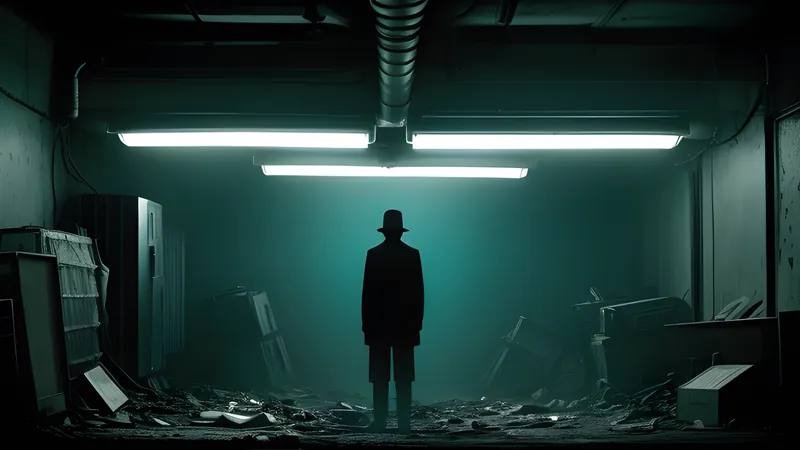
The black-and-white photography, by Herbert Cardwell and later Frederick Elmes, is the visual equivalent: deep, velvety blacks that swallow the edges of every room, so that Henry seems to live inside a pocket of dim light surrounded by void. The compositions are frontal and still, closer to portrait photography than to conventional coverage. Lynch trained as a painter, and the film is arranged like a series of grim canvases that happen to breathe. That painterly stillness is why individual frames of Eraserhead work as prints; it is also why the film feels less like a story unfolding and more like a gallery you are being walked through by a very calm madman.
The other engine is Jack Nance. His Henry is a passive, wide-eyed innocent, perpetually startled, radiating a helplessness that makes the surrounding horror bearable and unbearable at once. Nance holds expressions for an eternity. That stillness — the refusal to react at human speed — is deeply unnerving, and it became a signature Lynch would draw on his whole career.
The baby, and the secret Lynch kept
Every account of Eraserhead eventually reaches the baby, the film’s central creation and its most famous unsolved mystery. Lynch has never revealed how it was built or operated. He has declined to answer the question for nearly fifty years, deflecting every interviewer who tries. Reportedly the crew were sworn to silence, and Lynch preferred to let the creature retain the aura of something found rather than made. I respect the omertà and will not repeat the popular guesses, because guessing spoils the effect. What matters critically is the choice to keep the secret: Lynch understood that a nightmare explained is a nightmare defused. The baby unsettles precisely because it sits outside the vocabulary of special effects you can reverse-engineer. It simply exists, and it suffers, and you cannot look away.
Where it sits in the map
Eraserhead found its audience the way the best oddities did: at midnight. It ran for years on the midnight circuit — the Cinema Village in New York, the Nuart in Los Angeles — where the same crowds were sustaining the other unclassifiable films of the era. That circuit is the natural habitat of everything Lynch’s debut resembles, and it is worth reading it as a scene rather than a one-off. Start with El Topo and the birth of the midnight movie for the origin of the ritual, and use the midnight-movie canon as the viewing list Eraserhead belongs near the top of.
For a collector, the interesting cross-references run in two directions. Backwards, the film’s ancestor is the European surrealist tradition — Buñuel and Dalí’s dream cinema, the Kafka of anxious bureaucratic dread — filtered through American industrial decay. Sideways, its truest cousin is the fever-dream architecture of other films that abandon plot for pure sensory logic; the closest tonal sibling in a completely different key is Hausu and the haunted house as a sugar-rush fever dream, Nobuhiko Obayashi’s manic Japanese phantasmagoria from the same year. Both films trust that a coherent feeling can carry a viewer through incoherent events, and both are right.
Forwards, Eraserhead is a headwater of modern body horror’s more poetic wing. Its obsession with the biological — birth, mutation, the leaking and pulsing of flesh — feeds directly into the Cronenberg lineage, and you can trace the bloodline through Videodrome and the prophecy about the screen, where physical revulsion becomes a vehicle for ideas. The grubbier, funnier end of that same family tree runs through the sibling-monster tenderness of Basket Case and the Times Square body-horror fable. Lynch is the arthouse patriarch of all of it, the man who proved that a bad dream, filmed with total seriousness and total patience, could hold a paying audience for an hour and a half.
The verdict
Eraserhead is a difficult film, and I would be lying to call it a good time. It is slow by design, opaque by conviction, and physically oppressive in a way that leaves some viewers reaching for the exit within twenty minutes. What it is not is empty or pretentious, the two charges lazily thrown at it. Every choice serves the single feeling it exists to transmit, and it transmits that feeling more completely than almost any film I know. Sit inside it, let the drone get under your skin, and it becomes a genuinely great work of atmosphere — the most sustained mood in American cinema.
Its power is that it bypasses interpretation. You can theorise about fatherhood, sexual terror, industrial alienation, and all the readings hold water, because Lynch built the film to hold them. Underneath every reading is the same wordless pressure, the hum in the walls, the sense that something is wrong at a frequency the conscious mind cannot quite tune to. That is the film’s genius and its permanence.
Where to see it: the Criterion restoration, supervised by Lynch himself, presents the image and — crucially — the sound with the fidelity the film demands. Watch it late, watch it loud, and watch it alone. This is one to let get inside you.
Spoilers below
The film’s climax turns on the baby, and it is as upsetting as anything Lynch ever staged. Henry, worn down by the creature’s ceaseless crying and abandoned by Mary, finally takes a pair of scissors and cuts open the bandages that have swaddled the child from birth. What is revealed is that the bandages were not a swaddle at all; they were holding the creature together. Beneath them the organs are exposed, pulsing and alive, and Henry, in horror, punctures them. The room convulses. The lights surge and fail. The baby’s head swells enormously as the world short-circuits around Henry.
The craft of the sequence is entirely in the sound and the light. Lynch does not score the moment with music; he lets the industrial drone rise to a scream of electrical overload, sparks and static swallowing the image, so that the murder of the child registers as the collapse of the entire universe Henry inhabits. It is patricide in reverse, the parent destroying the impossible burden of the offspring, and the film treats it with cosmic finality.
The closing image sends Henry into the arms of the Lady in the Radiator, bathed in white light, in what plays as either death, transcendence, or release from an unbearable life. Lynch offers no key. The famous song the Lady sings earlier — I will describe rather than quote it — promises that in heaven everything is fine, and the ending appears to grant Henry that heaven at the cost of the small monstrous life he could not sustain. Whether that is mercy or damnation, the film leaves entirely, deliberately, permanently open. Fifty years on, no one has closed it, and that is exactly as Lynch wanted.
Related Content