Electra Glide in Blue: The Motorcycle-Cop Tragedy
A record producer with Chicago money hired Conrad Hall, drove into Monument Valley and made the one American film that takes the traffic cop seriously
Contents
The strangest thing about Electra Glide in Blue is who paid for it.
James William Guercio was a record producer. He managed and produced Chicago, he produced Blood, Sweat & Tears, and by the early 1970s he had made the sort of money that the American music industry was briefly handing out to men in their twenties. He took that money and made a film. He directed it himself, having directed nothing. He supervised the music himself. He hired Conrad Hall to shoot it, which is the single decision that turns a rich man’s hobby into a permanent object. Then he went to Arizona and made the only feature he would ever direct.
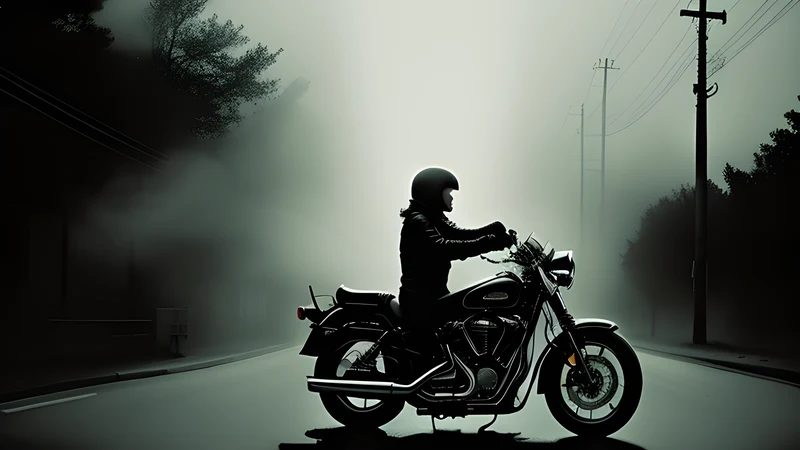
The title is two pieces of hardware. An Electra Glide is a Harley-Davidson — the big touring machine, the one American highway patrols actually rode. “In blue” is the uniform. The film is named after a man’s job and his bike, and that is precisely the correct name for it, because Electra Glide in Blue is about what happens when a person’s entire identity has been issued to him by a department.
The cop as the subject
You have to remember what 1973 thought a motorcycle cop was.
Easy Rider had come out four years earlier and organised a generation’s picture of the American road: the free men on the bikes, the hostile straight world, the shotgun at the end. Every road film in its wake inherited the arrangement, and the uniformed man on the motorcycle in the mirror was scenery — a threat, a punchline, a thing to outrun. Vanishing Point had made him the antagonist of the entire republic.
Guercio’s move was to get off the fugitive’s bike and onto the cop’s, and to discover that the man on it is smaller and sadder than anyone had bothered to check.
John Wintergreen, played by Robert Blake, is an Arizona motorcycle patrolman who writes tickets on a stretch of highway where almost nothing happens. He is scrupulous about the job. He is also profoundly bored by it, and what he wants — the want that drives the whole film — is to make detective. He wants to be moved indoors, into a suit, into work that involves thinking. When a death on his patch gives him a chance to investigate something, he takes it with an eagerness that is close to painful to watch.
That is the premise, and it is a considerable act of nerve. The counterculture film of 1973 was a genre about escaping institutions. Guercio made one about a man desperate to be promoted within one.
Why it works: Conrad Hall puts a small man in a big country
The film’s greatness is photographic, and it is not decoration.
Conrad Hall had shot In Cold Blood and Butch Cassidy and the Sundance Kid, and he came to this with the best eye in American cinema and a director happy to let him use it. Hall and Guercio shot in Monument Valley, and the reference is deliberate to the point of provocation: those buttes are John Ford’s. They are the backdrop of the American Western, the landscape the cavalry rides through, the frame in which the American hero was invented.
Into that frame Guercio puts a traffic cop on a Harley writing a ticket.
The compositions do the argument without a word of dialogue. Hall shoots Wintergreen small and low and wide, a blue speck against geology, and the effect is to invoke the whole apparatus of the heroic Western and then decline to supply the hero. Ford’s men rode through that country making history. This man rides through it making paperwork. There is a running visual joke — a very cold one — in which the most mythologised landscape in the American cinema turns out to be a place where somebody has to do a shift.
Hall’s other register is the interior, and it is where the film’s real cruelty lives. The station houses, the diners, the trailers are all flat and low-ceilinged and shot in a heavy, sallow light, and Wintergreen is too big for none of them — he fits perfectly. That is the point. The monuments are where he works. The mean little rooms are where he belongs, and he knows it.
And Guercio’s casting of scale is exact. Wintergreen is short, Blake was short, and the film says so out loud: there is a much-quoted running preoccupation with Alan Ladd’s height, a leading man of roughly Wintergreen’s stature, held up as proof that a small man can be a large figure. It is the saddest running gag in 1970s cinema, because it is a man citing a movie star as evidence that his own life might be allowed to mean something.
Robert Blake
Blake is the reason this holds together, and his presence in it now is complicated.
He had been a child actor — the Our Gang shorts, the Red Ryder pictures — which is a biography that tends to leave marks. In 1967 he had played Perry Smith in In Cold Blood, shot by Conrad Hall, and the reunion here is not accidental: Hall had already photographed Blake as a small, damaged, dangerous man in a flat American landscape, and Electra Glide in Blue is in some sense the same face six years on, having chosen the uniform instead.
What Blake does with Wintergreen is refuse to make him likeable in the easy way. Wintergreen is vain, pedantic, sexually graceless and quietly ambitious, and he is also decent in a manner the film keeps testing — he is the only person on screen who consistently declines to be cruel when cruelty is available and free. Blake plays the decency as a habit rather than a virtue, which is far more affecting.
Blake’s later life sits on the film now, and there is no honest way to write about it without saying so: he was tried for the 2001 murder of his wife, Bonny Lee Bakley, acquitted in the criminal trial in 2005, and found liable in the subsequent civil suit. He died in 2023. None of that is in the film, and it changes nothing about the performance. It does mean that watching it is a different experience than it was in 1973, and pretending otherwise would be a kind of cowardice.
The supporting bench is deep. Mitchell Ryan is Harve Poole, the homicide detective Wintergreen wants to become, and Ryan plays him as a man who got everything Wintergreen wants and was hollowed out by it. Billy “Green” Bush is Zipper, Wintergreen’s partner, a genuinely frightening portrait of the ordinary bully the uniform attracts. And Elisha Cook Jr. turns up — the great small doomed face of American noir, the man from The Maltese Falcon and The Killing — which tells you exactly which tradition Guercio thought he was working in.
The case against
The film is smug in stretches, and the smugness is Guercio’s.
Its hippies are cartoons. A picture this careful about the interior life of a traffic cop has no curiosity at all about the long-haired people he pulls over, who exist to be obnoxious so that the cop can be interesting by contrast. Members of Chicago appear in small roles, which is either charming or an indication of how much of this was a rich man’s party, depending on the day you watch it.
The pacing sags badly in the middle. The investigation Wintergreen is so desperate to conduct is thin, and the film loses its grip on the procedural while it goes off to be atmospheric. There are twenty minutes here that a director with more experience would have cut, and Guercio, being the money, had nobody to make him.
And it hectors. The film’s opinion of America is delivered rather than discovered, and the final movement in particular arranges its symbolism with a heavy hand. What saves it is that Guercio’s actual sympathies keep escaping his thesis: he set out to make a statement and accidentally made a character study, and the character is better than the statement.
The ancestors
The declared ancestor is John Ford, invoked by geography. The real one is closer to On Dangerous Ground, Nicholas Ray’s film about a policeman whose interior life is a liability to him — the same understanding that the uniform is a container for a person, and that the person is still in there going wrong.
Its siblings are the road films it argues with: Vanishing Point and Two-Lane Blacktop, both of which take the driver’s side and treat the law as weather. Electra Glide in Blue is the reverse angle of those films, and it is worth watching directly after either of them, because it makes the pair of them look slightly adolescent. Girl on a Motorcycle had already established that the machine itself could carry a film’s whole emotional argument.
The descendants are everywhere and mostly unaware of the debt. Every subsequent film about the loneliness of a man in a uniform on an empty road — and every prestige television series about a policeman whose ambition exceeds his jurisdiction — is working ground Guercio broke once and then walked away from.
The verdict
Electra Glide in Blue is a rich amateur’s film with a masterpiece’s photography and a genuinely original idea, and its failures are all failures of a first-time director with no one to say no to him. It sags, it patronises its extras, it announces its meanings. It also contains the only serious portrait in American cinema of the man who writes your speeding ticket: a small, vain, decent, thoroughly institutionalised person who wants very badly to be moved indoors.
Guercio never directed another feature. He went back to records, and the film drifted into the repertory circuit where it has been quietly acquiring admirers for fifty years. Find the best print you can — Hall’s photography is the whole argument and a bad transfer destroys it — and watch it in Monument Valley’s company, thinking about who usually gets to be filmed there.
Spoilers below
The ending is what the film is famous for, and it is worth protecting.
Wintergreen gets his promotion. He is taken off the bike, put into a suit, and assigned to Harve Poole as a detective — the exact thing he has wanted since the first reel. And it is immediately, unbearably clear that he has not been rescued. Poole is a mediocrity with a grudge and a jealous streak, the work is squalid, and Wintergreen’s decency makes him useless at it. The promotion he has organised his whole personality around is the film’s cruellest joke: he gets it, and it is nothing, and there is no version of the job that was ever going to contain the man he is.
So he is sent back to the bike. That is the real devastation, and Guercio plays it quietly — a man returned to his patch of highway having been shown that the ceiling is about four feet above his head.
Then the last shot. Wintergreen stops a van of long-haired travellers, one of whom he has tangled with before, and the encounter goes wrong in a way that is entirely stupid and entirely plausible, and a shotgun comes out of the back of the van. Wintergreen dies on the tarmac. And Guercio holds. The camera pulls back — an extraordinarily long, slow reverse zoom straight down the highway, Wintergreen’s body getting smaller in the centre of the frame, the road going on, the country going on, for what feels like an eternity of running time while the credits do not come and the shot refuses to end.
It is the Easy Rider ending played from the other side. Dennis Hopper and Peter Fonda were shot off their bikes by rednecks in a truck, and the counterculture read it as martyrdom. Guercio’s cop is shot off his bike by the counterculture, and the film declines to score the point. The reverse zoom is the argument: pull back far enough from any of it — the hippies, the cop, the shotgun, Monument Valley, the whole quarrel of 1973 — and it is one small body on an enormous indifferent road, and nobody involved was the hero of anything.
That shot is why the film survived its own director. It is also, characteristically, about ten seconds longer than it needs to be, and Guercio was absolutely right to keep them.
Related Content