El Topo: Jodorowsky and the Birth of the Midnight Movie
The acid Western that invented the after-hours cinema cult
Contents
There is a specific kind of film that only exists because someone decided ordinary screening hours were negotiable. Alejandro Jodorowsky’s El Topo (1970) is the origin point of that idea. Before it, “midnight movie” meant a cheap horror double bill for insomniac teenagers. After it, midnight became a venue — a place where a film could gather a congregation instead of an audience, one week at a time, on word of mouth alone. More than fifty years on, the film that started the ritual remains the strangest thing to have ever done it.
The desert as a religious text
The bones are a Western. A black-clad gunfighter — El Topo, “the Mole,” played by Jodorowsky himself — rides through a Mexican desert with his naked young son behind him on the saddle. The son is played by Brontis Jodorowsky, the director’s actual child, which tells you early that this is a man who does not believe in the line between the film and his own life. They find a massacred village. They take revenge. And then the film does the thing that made it notorious: it abandons its own plot to become a parable.
El Topo takes up with a woman, Mara, and she goads him into a quest to kill the four Master gunfighters of the desert — each one a spiritual teacher disguised as a duel. The film moves through them like the stations of a mystical text, borrowing freely from Zen koans, the Tarot (Jodorowsky’s lifelong obsession), the Old Testament, and whatever Jodorowsky had absorbed from Buñuel and the Panic Movement theatre he ran in Paris and Mexico City with Fernando Arrabal and Roland Topor. Each Master offers a lesson El Topo can only “win” by cheating, and every victory hollows him out further.
Then the film breaks in half. The gunfighter is left for dead, wakes years later underground among a community of deformed and disabled people trapped in a cave, and reinvents himself as a shaven-headed clown-saint trying to dig them a tunnel to freedom. The second movement is gentler, sadder, and building toward one of cinema’s great acts of self-immolation. To describe it as uneven is to miss that the unevenness is structural — Jodorowsky wants you seasick.
Why it works when it should not
On paper El Topo should be an indulgent mess, and plenty of people file it there. What keeps it alive is that Jodorowsky is a genuine image-maker, not merely a provocateur with a budget. He shoots the desert in wide, sun-bleached compositions that owe as much to Sergio Leone as to any avant-garde, then detonates them with something obscene or holy. A field of dead rabbits. A bridge of monks used as a literal walkway. Blood that arcs too far to be real and is all the more disturbing for it. He understood, before Sam Raimi or Takashi Miike made careers of it, that a surreal image lands hardest when it is framed with the sober grammar of a classical genre. The Western form is the straight man; the atrocities are the joke and the prayer.
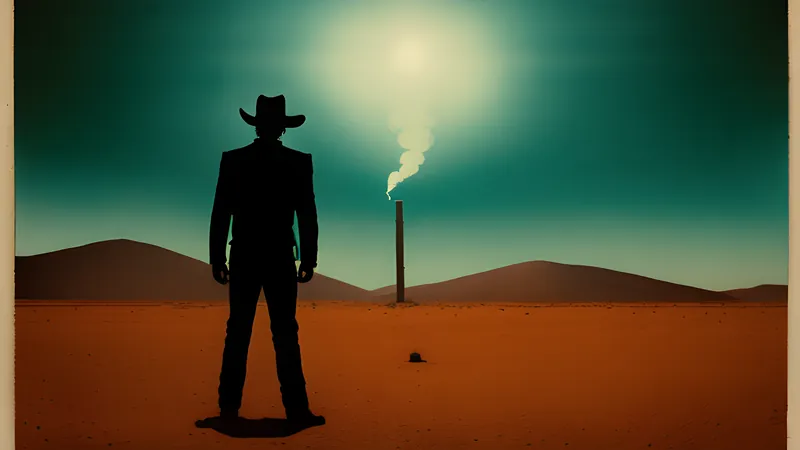
The craft argument for the film lives in its editing rhythm. Jodorowsky cuts on incongruity — a serene wide shot slammed against a close-up of a wound, a moment of tenderness guillotined by cruelty. That whiplash is the whole engine. It refuses to let you settle into either awe or revulsion, and it is why the film feels like a bad dream you can nonetheless follow scene to scene. The colour work matters too: he saturates the earth tones until the desert itself looks feverish, so that when the black-clad Mole crosses it he reads as an ink stain on a burning page.
He is also, it should be said, a limited actor giving a huge performance, and that mismatch works in his favour. El Topo is meant to be a man playing at being a legend, and Jodorowsky’s stiffness in the saddle keeps reminding you that the myth is a costume.
The Elgin, and the accident of a movement
The legend of El Topo is inseparable from a specific building. The film had no American distributor and no obvious audience until Ben Barenholtz, running the Elgin Theatre in New York, began showing it at midnight in late 1970. It ran there for months on the strength of nothing but talk. John Lennon and Yoko Ono saw it and were evangelised; Lennon persuaded Allen Klein’s ABKCO to buy the rights, which is how a Beatles business manager ended up owning an acid Western — and, in a twist that kept the film out of circulation for decades, how a later falling-out between Klein and Jodorowsky buried it. For years El Topo was a rumour you could only satisfy on grey-market VHS, which did more for its mystique than any distributor could have.
That midnight run at the Elgin is the true birth certificate of a form. Everything that followed at the witching hour — Pink Flamingos, The Rocky Horror Picture Show, Eraserhead, Night of the Living Dead on its second life — inherited the model Barenholtz proved with Jodorowsky: that a difficult film could find its people if you gave it a time slot that felt like a secret. The midnight movie is a distribution strategy that became an aesthetic. El Topo is where the two fused.
If you come to it now, come to it as the ancestor. You can draw a straight line from the Mole’s desert to Jodorowsky’s own later work — the film pairs most obviously with The Holy Mountain, his bigger, glossier, ABKCO-funded follow-up, and it rhymes hauntingly with Santa Sangre, the 1989 film where he finally married his imagery to a story with a heartbeat. Watch the three in sequence and you get a complete map of a filmmaker learning what his own images are for.
The theatre under the film
To understand why El Topo moves the way it does, it helps to know where Jodorowsky came from. He came up through the theatre rather than the cinema — a mime who had studied with Marcel Marceau, a puppeteer, and the co-founder with Fernando Arrabal and Roland Topor of the Panic Movement, a Paris-based answer to a Surrealism its founders considered domesticated and toothless. Panic staged marathon “happenings” designed to overwhelm and disturb: live animals, ritual violence, exhaustion as an artistic instrument. El Topo is a Panic happening that happened to be filmed. The endurance-test length of each ordeal, the ceremonial cruelty, the sense that the film is testing your stamina as much as telling you a story — all of it is stagecraft ported to celluloid.
That lineage explains the film’s most divisive quality, which is that it does not care whether you are having a good time. Jodorowsky is running a rite, and rites are supposed to cost the participant something. When people say the film is punishing, they are describing the design working exactly as intended. Whether that design is profound or merely an art-house dare is the argument that has run around the film for half a century, and honestly it can be both in the same viewing.
The verdict
El Topo is not a film I can honestly call good in the way one calls a Carpenter picture good — it does not have that machined efficiency. It is something rarer and more awkward: a film that opened a door and then wandered off through it. Some of its provocations have aged into student-film posturing, and its treatment of its disabled cave community is exactly as troubling as it sounds. But the best twenty minutes of it — the Masters, the tunnel, the ending — remain genuinely unlike anything else, and the film’s historical weight is not in dispute. It taught an entire culture that cinema could be a rite. That is a strange, real achievement, and worth the trip into the desert.
Where to watch: the ABKCO restoration is the version to seek, on the Jodorowsky discs that finally emerged once the rights logjam cleared. See it late, ideally with other people, ideally slightly too tired. That is the frequency it was tuned to.
Spoilers below
The two endings are the whole point. El Topo’s failure with the four Masters is a rigged game — Jodorowsky stages each “victory” so that the Mole only survives through deception or the Master’s own withdrawal from the fight, and the cumulative effect is a man winning his way into damnation. Mara and the second woman in black turn on him and gun him down at the peak of his arrogance, and it plays as the correct verdict on everything he has done.
The resurrection underground is the film’s argument. The Mole who returns is unrecognisable — bald, gentle, comic, a saint who begs for coins to fund the escape tunnel. Jodorowsky is literalising rebirth: the killer has to die and come back as a fool before he is capable of love. When the tunnel finally breaks through and the cave dwellers pour out into the town that penned their families away, they are massacred on sight, and El Topo responds by dousing himself in oil and burning alive in the street. The self-immolation is deliberately staged to echo the protest suicides that were in the global news in the years before the film, and it is the moment the parable stops being decorative and turns into a genuine howl. The child he abandoned in the first half returns to bury him, and the wheel starts again. It is a film about a man who has to become nothing before he can become good, and it is willing to burn its own hero to prove the point.
Related Content