Don't Look Now: Editing as Premonition
Nicolas Roeg made grief and foresight out of the cut itself
Contents
Nicolas Roeg was a cinematographer before he was a director, and Don’t Look Now is the film of a man who thinks in images the way a poet thinks in rhyme. Released in 1973 and adapted from a Daphne du Maurier short story, it follows a married couple to a wintry, decaying Venice after the death of their young daughter, where the husband begins to glimpse a small red-coated figure in the alleys and a blind psychic warns that his life is in danger. On paper it is a supernatural thriller. On screen it is something stranger and greater: a film that uses the mechanics of editing to dramatise grief, foresight, and the terrible idea that time might not run in a straight line.
The cut as a way of seeing
The famous thing about Don’t Look Now is its editing, and the fame is deserved because the editing is the film’s argument. Roeg and editor Graeme Clifford construct the picture from fragments that leap across time and space — a detail in one scene rhymes with a detail in another, an object glimpsed now pays off later, an image flashes for a fraction of a second and lodges in you before you have consciously registered it. The film is forever cutting away from the present to something that has happened or is about to, so that the whole experience is destabilised. You are never quite anchored in now.
This is not style for its own sake, and that is the crucial point. John Baxter, the husband, is established early as a man with a latent psychic gift he refuses to acknowledge — he “sees” things, premonitions he rationalises away. The fractured editing is the film putting you inside that condition. When a shot of red glass bleeds forward into a later catastrophe, when water and blood and stained glass keep answering one another across the runtime, Roeg is building a mind that cannot tell prophecy from memory. The cut becomes a premonition. You, the viewer, are made slightly psychic, always sensing a pattern you cannot yet name.
Venice as a labyrinth of grief
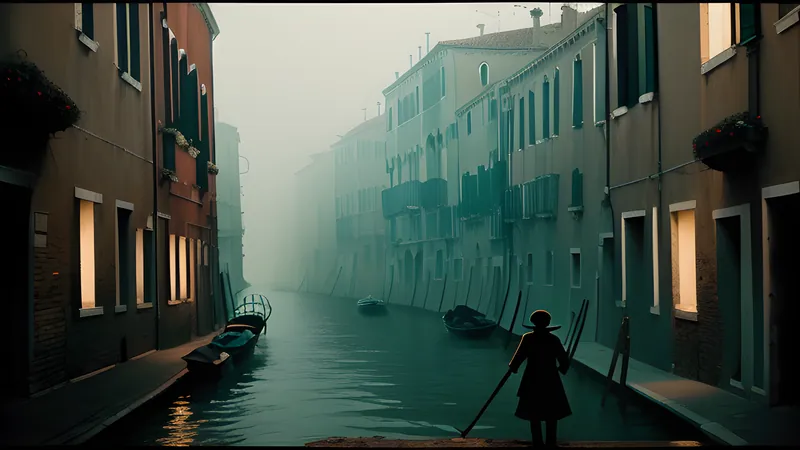
Roeg shoots Venice in winter, drained of tourists and postcard glamour, all peeling plaster and black canals and dead ends. It is one of the great uses of a real city as a psychological landscape. The Baxters are there because John is restoring a church, but the film turns the whole waterlogged maze into an externalisation of their mourning — beautiful, sinking, full of wrong turnings, a place where you are always lost and always near water that has already taken one child. The city’s decay and the couple’s grief are the same substance.
The performances ground all this fracture in something warm and real. Donald Sutherland and Julie Christie play John and Laura as a genuinely married couple — tender, exasperated, physically easy with each other — and that lived-in intimacy is what gives the horror its stakes. Their love scene, intercut with images of the two of them dressing afterwards, became notorious on release, but its real function is structural: it is the one moment of connection and continuity in a film otherwise built from disjunction, and Roeg fractures even that, folding the tenderness of the act into the ordinariness of the aftermath so that intimacy and its passing arrive at once.
Why it works
The mechanics reward slow, repeat viewing, because Don’t Look Now is a film engineered to reveal that it told you the ending in its opening minutes. The pre-title sequence — the drowning of the daughter, in her red coat, by the pond at the English house — is loaded with images and sounds that the rest of the film will detonate. A slide, a spreading stain, breaking glass, water: these are planted as grief and harvested as prophecy. The film’s structure is a closed loop, and the editing is the mechanism that seals it. On a second watch you realise there was never a moment when the outcome was open. The cutting was warning you the whole time.
Compare that to how a conventional thriller withholds. Most films hide the ending to spring it. Roeg does the opposite: he shows you everything, scattered and out of order, and dares you to assemble it in time. That inversion is why the film rewards the collector’s rewatch and why it has been studied by editors ever since as the definitive demonstration that montage can carry meaning no single image holds. The horror lives in the growing sense that whatever happens was always going to.
The film sits at the head of a lineage worth tracing. Its central subject — a parent undone by the death of a child, the grief warping perception until you cannot trust what the parent sees — runs straight into Hereditary, which turns the same wound into an operatic family collapse, and into the quieter, documentary grief of Lake Mungo, where a drowned child and a searching family produce apparitions that may be real or may be manufactured by need. And its foundational ambiguity — is John genuinely seeing the future, or is a broken man reading omens into a hostile city — is the same uncertainty that powers The Innocents. Roeg’s innovation was to locate that ambiguity in the edit rather than the performance.
If the film has a flaw, it is that its deliberate disorientation can read as coldness. The fractured method holds the audience at a slight remove even as the emotions run hot, and viewers who want a thriller to grip rather than to haunt sometimes find it maddening. That distance is inseparable from what the film is doing — you cannot make a film about the unreliability of perception and also offer the comfort of a firm grip — but it does mean Don’t Look Now is admired more often than it is loved. Loved is the wrong verb for it anyway. It gets under you and stays.
The verdict
Don’t Look Now is one of the essential British films of the 1970s and one of the few horror-adjacent pictures that the wider film-critical world has always been happy to call art without flinching. It was a landmark on release and its reputation has only hardened; ask working editors to name the films that taught them the craft and this one comes up again and again. It belongs to that small class of genre films — like The Innocents before it — that expanded what the form could do and were taken seriously for it at the time.
Watch it with your full attention and no distractions, because the film is a machine for rewarding the attentive and punishing the half-present. Then watch it again, and discover that it is a different, sadder, more frightening film the second time, once you know where every planted image is pointing. That double life is the mark of its greatness.
Where to watch: it has been beautifully restored and circulates on the arthouse and classic-film streaming platforms and on premium physical media; the restoration is worth seeking, because the film’s whole method depends on the precise colour of a particular red.
Spoilers below
Stop here if you have not seen it.
The daughter, Christine, drowns in the film’s opening sequence, in a red mackintosh, while John — sensing something wrong before he can know it — rushes too late from the house. That red coat is the film’s detonator. In Venice, John repeatedly glimpses a small red-coated figure darting through the alleys, and grief lets him believe, without ever admitting it, that it might be Christine, that his dead daughter is somehow present in the city. Meanwhile two elderly sisters, one of them a blind psychic, tell Laura that they can see Christine with the couple and that John himself has “the gift” but that he is in danger and must leave Venice.
John refuses the warning, as men who cannot bear to believe always do, even as the omens multiply and a killer stalks the city. The film braids his rationalism against his own suppressed foresight: he keeps seeing the future and keeps explaining it away. The trap is that his gift is real and useless to him, because he will not trust it.
The ending is one of the most brutal reversals in the genre, and it works precisely because the editing prepared it from frame one. John finally corners the little red-coated figure in a dead-end chamber, believing he has found his daughter, or her ghost, or the truth. The figure turns, and it is a small, ancient woman — the serial killer who has been murdering people across the city — who cuts his throat. In his dying moments the film floods with the images it has been withholding and rhyming all along: the funeral he glimpsed, the red, the water, the premonition he had at the very start now revealed as a vision of his own death rather than the daughter’s he assumed it meant. The gliding funeral boat he saw earlier was his own.
This is why the film is a closed loop rather than a linear thriller. John’s psychic flashes were never of the past; they were of this moment, arriving out of order because a man who “sees” experiences time as a single simultaneous field. He mistook a premonition of his own murder for a haunting by his daughter, because grief taught him to read every red omen as her. The horror is total and it is structural: the film told him, and told us, exactly how it would end, in the first five minutes, and neither he nor we could read the warning until it was too late. That is editing as premonition — the cut that knew the future before the character did.
Related Content