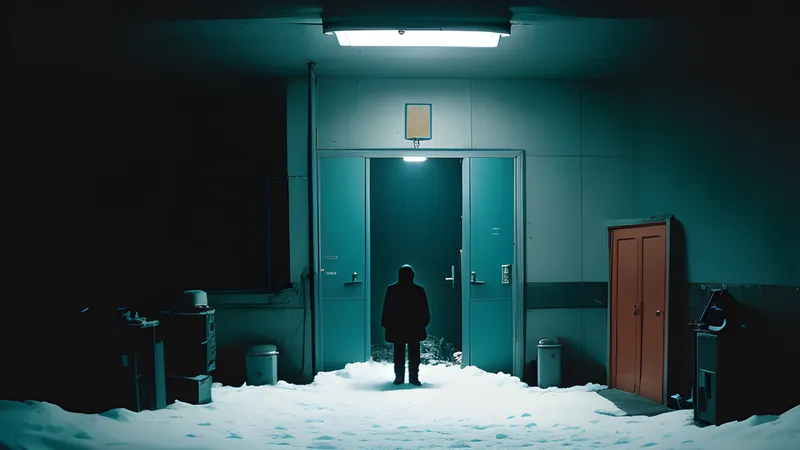
District 9: The Alien Film as Apartheid Allegory
Neill Blomkamp turned a Johannesburg slum into the most pointed science fiction of its decade
Contents
A stranded alien ship hangs motionless over a city for twenty years and nothing happens. That is the joke and the thesis of District 9 (2009), Neill Blomkamp’s feature debut, produced by Peter Jackson after a planned Halo adaptation collapsed. The ship does not attack. It does not open a portal. It sits there, dead in the air over Johannesburg, while a million malnourished aliens are herded off it into a fenced camp, given a racial slur for a name — “prawns” — and slowly turned into a housing problem the authorities would rather bulldoze than solve. The most famous science-fiction image of the decade, the hovering mothership, becomes a piece of municipal bureaucracy.
That inversion is the whole film in one gesture. Blomkamp took the standard first-contact scenario, drained it of wonder, and set it down in the one country whose recent history could supply the rest for free. District 9 was made for around thirty million dollars, grossed over two hundred, and picked up four Oscar nominations including Best Picture — a startling run for a hard-R alien film shot with a largely unknown cast in a real Johannesburg township. It earned every bit of it.
The camp is the point
Blomkamp expanded the film from his own 2005 short Alive in Joburg, and the first act keeps the short’s method: fake news footage, talking-head interviews, CCTV, handheld shakycam, the grammar of a television documentary about a social crisis. We meet Wikus van de Merwe (Sharlto Copley, in a debut performance largely improvised), a mid-level bureaucrat at Multinational United, the private contractor tasked with evicting the aliens from District 9 and relocating them to a tent city further from the humans. Wikus is a small man promoted above his competence, cheerfully serving eviction notices to creatures he barely regards as alive, and Copley plays him as a company drone who genuinely believes he is one of the good ones.
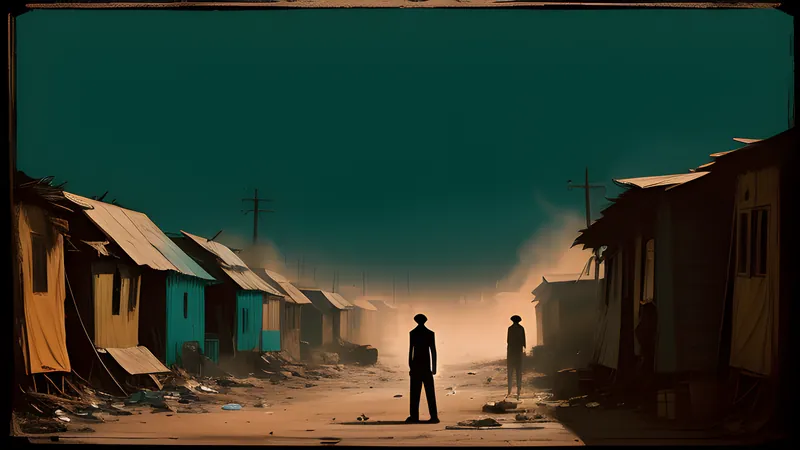
The allegory needs no decoding. District 9 sits where Cape Town’s District 6 once stood in the national memory — the mixed-race neighbourhood whose sixty thousand residents were forcibly removed under apartheid’s Group Areas Act and dumped on the Cape Flats. Blomkamp, who grew up in Johannesburg and left for Canada as a teenager, films the alien camp as a South African informal settlement because that is what he knew and what the story required. The shacks, the checkpoints, the Nigerian gangsters running protection and interspecies prostitution, the casual brutality of the eviction squads: none of it is invented from whole cloth. The film simply asks whether you would treat a suffering underclass any differently if it happened to have an exoskeleton.
Why the documentary shell works
The mockumentary opening is doing precise structural work. By spending its first act pretending to be a news report, District 9 installs Wikus as a public figure being explained to us in retrospect — the interviews use past tense, hinting that something has already gone wrong — and it earns a tonal freedom most science fiction cannot afford. When the film later abandons the fake-doc conceit and slides into conventional third-person action, the shift itself carries meaning: the moment Wikus stops being the state’s smiling face and becomes its target, the camera stops treating him as a subject to be filmed and starts running alongside him. Form tracks his fall from human to hunted.
Copley is the reason it lands. His improvised, motor-mouthed banality in the first act makes Wikus almost unbearable — the petty enthusiasm, the nervous laugh while torching a shack full of alien eggs — and it is exactly that ordinariness that makes his later degradation legible. He is not a hero waiting to be discovered. He is a coward and a functionary, and the film’s cruelty is to make his education involuntary and physical.
The craft under the grime
District 9 is a triumph of resourceful design. The Weta effects work is photoreal and, crucially, unglamorous — the prawns are all wet mandibles and insectoid twitch, kept mostly at a distance until one of them, Christopher Johnson, is allowed enough close-up tenderness to become a character. Blomkamp shoots the alien weaponry, which functions only on alien DNA, as scavenged industrial junk, and the film’s action climax is built almost entirely from practical squibs, dust, and a hulking exosuit rather than weightless digital spectacle. The violence is wet and sudden, and it costs something every time.
The film’s DNA runs back through a specific lineage. The obvious ancestor is Alien Nation (1988), which imagined refugee extraterrestrials assimilating into Los Angeles and used them as a race parable, though it wore the metaphor far more comfortably than Blomkamp does. Behind that sits the whole Cronenberg tradition of the body turned traitor — the physical transformation as the site of horror and meaning, which District 9 borrows wholesale and which reaches its purest form in The Fly (1986). And its documentary-realist instinct, the idea that a monster is scariest when filmed like the evening news on a tight budget, is the same instinct that powered Monsters a year later. Watch the three together and you have a complete argument about how to make an alien feel real without a studio’s money.
Where the film is weakest is its politics of representation, and the criticism is fair: the Nigerian characters are drawn as cannibalistic gangster caricatures, a lazy note in a film otherwise alert to how dehumanisation works. It is a real flaw in a genuinely intelligent film, and worth naming rather than waving away.
The verdict, spoiler-free
District 9 is the rare science-fiction film that uses the genre’s licence to smuggle in something bitter and specific about the actual world, and does it while functioning as a propulsive, gory, genuinely thrilling piece of entertainment. It is angrier than Elysium and more coherent than Chappie, the two Blomkamp films that followed and squandered much of this goodwill. Fifteen years on it looks like the moment a director had exactly one perfect idea and the ferocity to execute it before the sequel machine and the bigger budgets diluted him.
If it lands for you, the natural next steps are Cronenberg for the body horror it inherits, and the low-budget realist tradition of Monsters and Gareth Edwards’s later work. And for the other side of the alien-invasion coin — dread weaponised rather than satirised — there is Aliens, the film that proved you could turn extraterrestrial horror into a war picture without losing the fear.
Spoilers below
The engine of the plot is contamination. Raiding a prawn’s shack, Wikus is sprayed in the face with a black fluid — alien fuel that Christopher Johnson has spent twenty years secretly refining to power the dormant command module and get his people home. The fluid rewrites Wikus’s DNA. His arm transforms into a prawn’s claw, and because that biology is the only thing that can operate the alien weapons MNU has been unable to fire, Wikus overnight becomes the most valuable military asset on Earth.
What follows is the film’s harshest turn. MNU straps him to a table and, in a scene shot with clinical documentary flatness, forces him to fire alien weapons at live prawn captives to prove the guns work, then prepares to vivisect him for parts while his own father-in-law, the MNU executive, signs off on it. The corporation that Wikus served loyally treats his body as raw material the instant it stops being human. He escapes, and the only place that will hide a half-transformed fugitive is District 9 itself — the slum he was cheerfully evicting a day earlier.
The alliance with Christopher is the moral spine. Wikus wants his humanity back; Christopher can restore it, but only by using the recovered fuel to reach the mothership, which means abandoning the escape home he has been building for two decades. Christopher agrees to help the man who has caused him nothing but harm, and asks only that Wikus wait three years for him to return with a cure. In the climactic assault on the MNU labs, Wikus finally does the one selfless thing the film has been withholding: he covers Christopher’s escape to the command module, taking control of an alien exosuit and buying the shuttle time to launch.
The ending is deliberately unresolved and all the stronger for it. Christopher’s ship rises to the mothership and the fleet drifts away over Johannesburg, the aliens relocated once more to a new camp, District 10, the eviction cycle simply renamed. Wikus, abandoned to complete his transformation, is last glimpsed as a fully formed prawn, squatting in the rubbish, fashioning a small flower out of scrap metal — the film has earlier shown Wikus’s wife receiving anonymous metal flowers, and she narrates that she believes they are from him. Whether Christopher will ever come back is left open. The man who began the film as the human face of the machinery ends it as one of the creatures he processed, waiting, with the patience of the powerless, for a promise that may never be kept. Blomkamp closes on the allegory’s cruellest note: to understand what you did to them, you had to become one of them, and by then it was too late to undo any of it.
Related Content