Demons: Bava and Argento's Cinema of the Damned
The 1985 film that turned a Berlin cinema into a slaughterhouse and the audience into the plot
Contents
The credit that everyone gets wrong first: Dario Argento did not direct Dèmoni. He produced it and co-wrote it, alongside Dardano Sacchetti, Franco Ferrini and the man whose name is actually on the film — Lamberto Bava, son of Mario, who had already made Macabre in 1980 and A Blade in the Dark in 1983 and who spent his adolescence on his father’s sets watching a genius do miracles with a plywood flat and a coloured gel.
That misattribution matters, because the two men wanted different things and the film is the argument between them. Argento’s instinct is architecture and dread. Lamberto Bava’s, on the evidence of forty years, is momentum. Demons runs on Bava’s setting, and it is the most purely kinetic thing either family ever put its name to.
The premise is a joke that eats itself
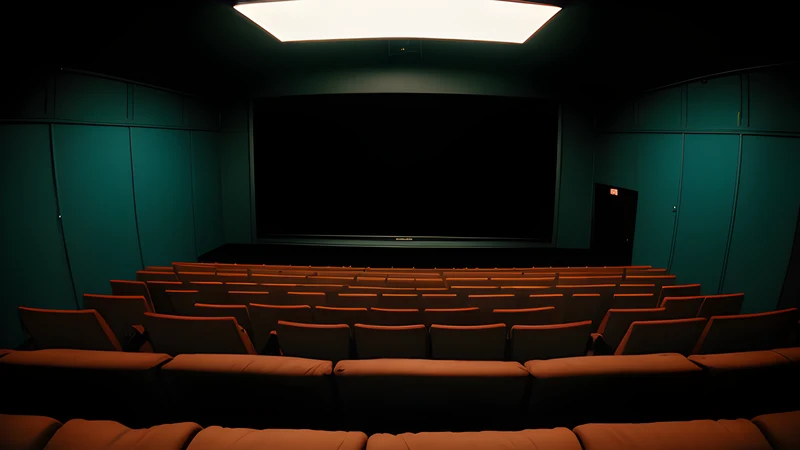
A man in a metal half-mask hands out free tickets to a screening at the Metropol, a cinema in West Berlin that has just reopened. The masked man is Michele Soavi, who was also assistant director here and would go on to make StageFright two years later and The Church after that.
In the lobby there is a display of props: a motorbike, a sword, and a demon mask on a stand. Rosemary — Geretta Geretta, giving the film its best physical performance — tries the mask on for a laugh and scratches her cheek on it. The audience files in. The film they watch is about four youths who open Nostradamus’s tomb and find a mask, and a prophecy, and the warning that whoever wears it becomes a demon. On screen, a character puts on the mask and is scratched. In the auditorium, Rosemary’s cheek begins to weep.
That is the whole idea, and it is a very good one. The film-within-a-film is the instruction manual for the film you are watching, delivered in real time, to an audience that ignores it. The Metropol’s patrons watch a horror movie explain exactly how they are about to die and they keep eating the popcorn. Sitting in a dark room now, watching a film about people sitting in a dark room, you are handed the joke and given no exit from it either.
Why it works: the geography and the meat
Two things hold the picture together, and both are craft decisions before they are ideas.
The first is the floor plan. Bava spends the opening reel walking you through the Metropol — the lobby, the balcony, the aisles, the corridor to the projection booth, the boarded-up exits. It looks like padding on a first watch. It is the load-bearing structure of the entire second half. When the survivors barricade a door or make a run for the balcony stairs, you know precisely where they are and how bad the odds are, because the film taught you the building before it set it on fire. Most siege horror skips this homework and then wonders why the tension leaks. Dawn of the Dead did the same work with its shopping centre seven years earlier, and the mall’s geography is likewise the reason that film’s third act lands.
The second is Sergio Stivaletti. Demons is his breakout, and the transformations are the reason the film survived the decade. They are wet, slow and structural: teeth extruding through gums, nails splitting and pushing outward, green fluid coming up in a rope. Stivaletti makes possession look like an event happening to a body’s architecture. He went straight from here to Argento’s Opera and Soavi’s The Church, and became the most important Italian effects artist of his generation. What he does here would be a render now, and it would be weightless.
Claudio Simonetti, of Goblin, does the score, and the film buys in a small mountain of licensed mid-eighties rock — Billy Idol, Accept, Mötley Crüe, Saxon — which was expensive and which is precisely why the film feels like a hardware store on fire. The needle drops are cut to the violence with total sincerity. There is a sequence built around a motorbike and a sword and an Accept track that is either the stupidest thing in Italian horror or the most joyful, and after forty years I have settled firmly on joyful.
The real ancestor is William Castle
Everyone reaches for Romero here, and the siege structure earns that. Everyone reaches for The Evil Dead, and the scratch-borne possession and the deadite grin earn that too.
The true grandfather is The Tingler, William Castle’s 1959 picture, in which the film appears to break, the screen goes black, Vincent Price’s voice tells the audience to scream, and Castle wired buzzers under the seats of real cinemas to make them jump. Castle’s thesis was that the film and the room are one thing, and that the fourth wall is a marketing opportunity. Demons is that thesis given an Italian gore budget and no sense of restraint. Castle gave you a shock in your chair; Bava sets the chair on fire.
The other line into it runs through Cronenberg, whose Videodrome had argued two years earlier that the screen is a delivery mechanism for physical infection. Bava and Argento take the same premise and refuse to be clever about it. The literalism is the point: the movie makes monsters out of the audience, and the film says so in the first act with a straight face.
What it does badly, and why it survives anyway
The characters are cardboard, and I say that as an admirer. George and Cheryl are two haircuts with dialogue. The blind man and his unfaithful daughter exist to generate a single beat. The pimp Tony — Bobby Rhodes, who is genuinely magnetic and who Argento liked enough to bring back in a different role for Demons 2 — is the only person in the building with a personality, which is why every viewer remembers him.
The film gets away with it because the crowd is the protagonist. Demons has no interest in who lives; it is about what a room full of strangers does when the exits are welded shut. That is a legitimate subject, and it is the reason this thing still detonates in a late-night screening while better-written Italian horror of the same year sits unwatched. The desk’s argument for why that communal charge cannot be replicated on a laptop is in why the midnight movie needs a crowd.
Where to find it: the boutique restorations are excellent, and the film is worth seeking in a print that holds the reds, since Bava lights the auditorium like his father lit a Gothic crypt. Watch the Italian cut with subtitles if you can; the English dub is period-charming and flattens Rhodes' timing.
Spoilers below
The escalation is beautifully judged. Rosemary transforms in the toilets and comes back through the curtain, and from there the infection moves at the speed of a scratch. Each new demon is a former person the film spent ninety seconds establishing, which is exactly enough investment for the purpose.
One genuinely eerie touch survives all the noise. When the survivors finally break into the projection booth to stop the film, there is nobody there. The projector is running by itself. For about fifteen seconds Demons stops being a rock video and becomes something colder, and you glimpse the film Argento might have made with the same script.
Stivaletti’s showpiece arrives in the third act, when a small demon claws its way out of a possessed body’s back — a birth staged as a rupture, and the single image that got Demons onto every video shop shelf in Europe. It has no story function whatsoever. It exists because it is astonishing.
Then a helicopter falls through the roof. There is no build-up and no explanation, and the film treats the sky opening as a plot solution, because the survivors needed a hole and the screenwriters gave them one. George takes the motorbike and the sword from the lobby display — the props planted in reel one, fired in reel five, which is the only piece of classical construction in the entire picture — and rides down the aisle cutting demons apart while Accept plays. It is ridiculous. It is also the most alive thing in eighties Italian horror.
The coda is the part people underrate. George and Cheryl climb out through the roof into a Berlin already overrun, get picked up by a jeep of survivors, and Cheryl turns in the back seat and is shot dead by a stranger with a rifle. George is left alive in a ruined city with people he does not know. The film has spent eighty minutes as a machine for delivering thrills and then ends on abandonment, with the contagion out of the building and into the world. The joke closed the loop: the film got out of the cinema.
For where this sits in the wider European tradition, the desk’s map is the Eurohorror canon; for the father whose lighting Lamberto inherited, start with Mario Bava.
Related Content