Dead Ringers: Cronenberg's Twin Study in Dread
Jeremy Irons plays both halves of a pair of gynaecologist twins, and David Cronenberg builds his coldest, saddest horror around the gap between them.
Contents
There is a moment early in Dead Ringers when you stop trying to tell the twins apart and start dreading the fact that you can’t. That is the film working exactly as designed. David Cronenberg made it in 1988, at the crest of his run of physical horror, and then did something perverse: he made his most disturbing film almost entirely without the prosthetics and mutation that were his signature. The horror here is a matter of identity, dependence and dissolution, and it gets under the skin more thoroughly than any exploding head he ever staged.
The premise sounds like a lurid thriller and, in the wrong hands, would be. Elliot and Beverly Mantle are twin gynaecologists who run a fertility clinic in Toronto, brilliant, celebrated, and so entwined that they share everything, including women, who are passed from the confident brother to the shy one without ever being told there are two of them. Jeremy Irons plays both. When one of the twins falls in love and tries to become a separate person, the shared self begins to come apart, and the unravelling is agonising to watch.
The real case underneath
Cronenberg did not invent the Mantles out of thin air. The film draws on the novel Twins by Bari Wood and Jack Geasland, which was itself inspired by the real deaths of Stewart and Cyril Marcus, identical-twin gynaecologists found dead together in their New York apartment in 1975. The bare facts of that case — two accomplished doctors, deeply interdependent, dead in circumstances that suggested a shared collapse — supplied the film its grim spine.
What Cronenberg brought to it was the reading. He was less interested in the sensational headline than in the question buried inside it: what happens to a self that was never singular to begin with? The Mantles are presented as a single organism split across two bodies, and the film treats the attempt of one half to individuate as a kind of surgery performed without anaesthetic. That is the Cronenberg move — to find, inside a true-crime footnote, the deeper body horror of consciousness itself.
The clinical setting lets him do it in his own language. The Mantles specialise in fertility and the female reproductive body, and Beverly, the fragile twin, eventually commissions a set of gleaming, cruel “instruments for operating on mutant women” from a startled sculptor. Those instruments are the film’s only real prop-horror flourish, and they land like a scream in a library precisely because everything around them is so restrained. They externalise Beverly’s belief that the bodies he treats have become monstrous — that the wrongness he feels in himself has spread to the world.
Two performances, one actor
The technical achievement is easy to praise and easy to underrate. To put Irons on screen opposite himself, Cronenberg and his team built an elaborate motion-control rig that let the camera repeat identical moves so two separately filmed performances could be composited seamlessly, with a body double filling in the physical exchanges. For 1988 the effect is astonishing; you never once catch the seam, and the camera moves freely rather than locking off the way older twin effects demanded.
The seamlessness would be a party trick, though, if Irons were not doing the deeper work. He distinguishes Elliot and Beverly with almost nothing — no different haircut, no scar, no accent. Elliot stands a fraction straighter and speaks a beat faster, comfortable in the world, always slightly performing. Beverly folds inward, softer in voice and posture, watchful. Within twenty minutes you know instantly which brother is on screen, and Cronenberg exploits that certainty by staging scenes where the twins swap places and you feel the wrongness before you can name it.
That Irons went unrecognised by the major awards for this work is one of the more telling oversights of the period; the performance was too unnerving, too devoid of the usual signposts, to read as “acting” in the way voters reward. He does not signal the difference between the brothers with technique you can point at. He simply is two men, and lets the audience do the terrible work of preferring one, worrying for one, and watching helplessly as the boundary between them dissolves. The double role is usually an actor’s showcase, a chance to demonstrate range side by side. Irons uses it for the opposite purpose — to demonstrate how little separates two people who were formed as one, and how catastrophic even that little turns out to be.
It is one of the great performances of double-role cinema, and it belongs in the same conversation as the finest studies of the divided self. The film is a cornerstone of the tradition traced in our piece on the doppelgänger film and the anxiety of the self — the fear that identity is contingent, that there might be another you, that the border of the self is thinner than we pretend. Cronenberg’s twist is that the double here was present from the very beginning, a co-founder of the self, so that separation becomes a mortal wound.
Why it works, and where it belongs
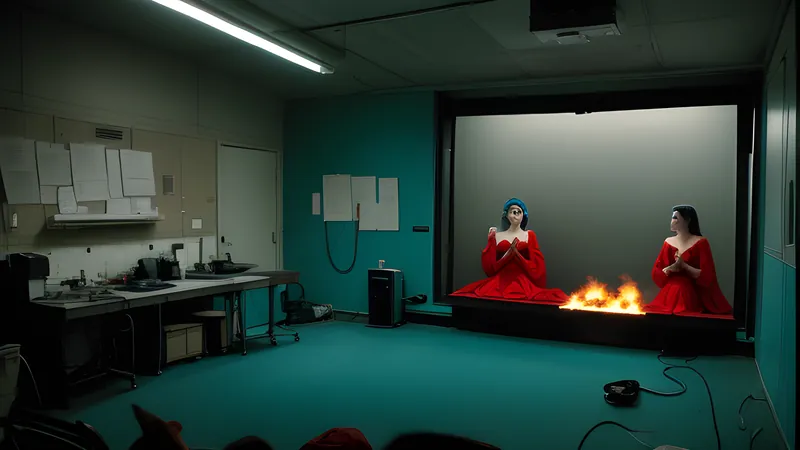
Dead Ringers works because Cronenberg refuses the melodrama the material invites. Howard Shore’s score is mournful and stately, the palette clinical, the surgical gowns a deep ecclesiastical red that turns the operating theatre into a chapel. The film moves at the pace of a slow sedation, and the effect is hypnotic — you feel yourself sinking along with Beverly. The horror is emotional first and physical second, which is the reverse of the usual Cronenberg engine and, in some ways, its most sophisticated expression.
Geneviève Bujold is the third point of the triangle as Claire Niveau, the actress whose affair with Beverly cracks the twinship open. She is written with unusual care for what could have been a plot device — a woman with her own appetites and damage, who becomes the mirror in which Beverly first glimpses the possibility of being a whole, separate person, and the agent, unwittingly, of his undoing.
Cronenberg also understands the grammar of the fertility clinic as a horror space long before the plot demands it. The waiting rooms and consulting suites are shot with a hushed institutional calm that reads, gradually, as menace — the sense of women handing their most intimate biology to two men who cannot themselves tell where one of them ends and the other begins. The film never leers and never lectures. It simply lets the setting accumulate unease, so that by the time Beverly’s belief in “mutant” anatomy surfaces, the ground has been prepared and the leap into delusion feels horribly continuous with everything before it.
Set this beside the rest of Cronenberg’s body-horror decade and its strangeness sharpens. Where The Fly externalises decay in melting flesh and Videodrome turns media itself into a mutating organism, Dead Ringers keeps the transformation entirely interior — the disease is the erosion of a shared identity, and you have to watch faces rather than prosthetics to see it advance. It is the hinge in his filmography, the pivot from the visceral early work toward the cooler, more literary films that followed, a lineage laid out in our career survey of Cronenberg, the flesh and the machine. The very next year he would take on William Burroughs in Naked Lunch, and the through-line is clear: the body as a site of writing, of doubling, of things that will not stay where they belong.
Where to find it: the Criterion restoration is the way in, and it renders the red gowns and the cold Toronto light exactly as intended. The film also turns up on streaming services and repertory calendars, though it deserves the dark of a proper screen and no distractions.
Spoilers below
The genius and the cruelty of Dead Ringers is that it never lets you hope for a clean separation. Beverly’s attempt to become a person independent of Elliot is the thing that kills them both. As his relationship with Claire deepens and then destabilises, Beverly slides into drug addiction, and Elliot — unable to bear the divergence — deliberately synchronises himself to his brother’s decline, taking the same drugs so that they will be “the same” again. The dependency runs both ways. Neither can survive the other’s individuation.
The ending is one of the quietest and most harrowing in Cronenberg’s work. Beverly uses his own surgical instruments — the tools built to operate on “mutant women” — to perform a separation on Elliot, killing him, in a scene the film shoots with terrible tenderness rather than gore. Having severed the twin he could not live with or without, Beverly briefly walks out into the world alone, tries to reach Claire, and cannot. He returns to the clinic and to Elliot’s body, and lies down beside him to die. The final image of the two brothers entwined echoes the real Marcus case and closes the loop the film opened.
What makes it devastating rather than merely morbid is the logic. Cronenberg has spent the whole film convincing you that the Mantles were one being, so the “murder” reads as an amputation and the death as the only possible end for a self that has been cut in half. There is no monster here except the fact of being two people who were always meant to be one. That is the coldest, saddest horror Cronenberg ever filmed, and it does not need a single drop of transformed flesh to leave you hollow.
Related Content