Dead & Buried: The Seaside Town of the Undead
Gary Sherman's Potters Bluff, where the welcome party takes photographs
Contents
The first four minutes of Dead & Buried are among the most efficient in eighties horror. A photographer works a fog-bound beach. A young woman wanders into frame, friendly, then flirtatious, then posing for him. He is delighted. Then there are other people on the beach, and there are a great many of them, and they tie him to a post and set him alight — and as he burns, they photograph him. Flash after flash out of the fog. The town has turned out for this the way a town turns out for a fête.
That’s the film’s whole thesis delivered before the title card: in Potters Bluff, murder is a community activity with a documented record. Everything after it is Sheriff Dan Gillis (James Farentino) doing detective work in a place where every single person he interviews was holding a camera.
The pedigree, and the fight over it
The screenplay is credited to Ronald Shusett and Dan O’Bannon, from a story by Jeff Millar and Alex Stern. Two years earlier that pair had written Alien. This is the kind of credit that sells a film in a repertory listing and it comes with an asterisk: O’Bannon spent years telling anyone who asked that the finished picture bore little relation to what he wrote, and that his contribution had been rewritten past recognition. He was a reliably combative man about credit, so weigh it accordingly. What survives regardless is a structural instinct the two of them shared — put an ordinary competent professional inside a closed system and let him discover the system’s actual purpose slowly, from the inside, with no exit.
Gary Sherman directed. His first feature was Death Line in 1972, the British film about a cannibal living in the disused tunnels under Russell Square, which is one of the few horror pictures of that decade with genuine pity in it. Sherman brings the same quality here. He shoots Potters Bluff with real affection — the clapboard, the harbour, the northern Californian coast dressed convincingly as New England — and the affection is the trap. You want to live there for about forty minutes.
Jack Albertson’s last performance
William G. Dobbs, the town mortician, is played by Jack Albertson, and it is the reason to watch the film even if you know every turn.
Albertson had won an Academy Award for The Subject Was Roses in 1968 and had spent a long career being warm at people. He plays Dobbs as a craftsman in love with his craft: big-band 78s on the gramophone in the embalming room, a proprietary pride in reconstruction work, an old man’s pleasure in being good at a difficult thing nobody else wants to do. He explains his methods to Gillis the way a joiner explains a dovetail. The performance is generous, funny and completely without menace, and that is what makes it monstrous — Albertson never plays the subtext, so the audience has to assemble it themselves out of nothing but enthusiasm.
He died in November 1981, six months after the film opened. It’s his last screen role and it’s a better sign-off than most careers manage.
The rest of the town is cast with the same cunning. Melody Anderson — fresh from playing Dale Arden in Flash Gordon the previous year — gives Janet Gillis an unforced small-town brightness that the film spends ninety minutes weaponising. And there is Robert Englund, three years before the glove, doing a few minutes as one of the locals with nothing to play but availability. Sherman fills the frame with faces that read as helpful. Nobody in Potters Bluff is furtive. That’s the design: a conspiracy of the visibly pleasant, where the only suspicious behaviour on offer is being new.
Stan Winston, before the fame
The makeup effects are early Stan Winston, a year before The Thing and three before The Terminator. The showcase is the burn work: the photographer survives the beach, arrives in hospital as a mass of charred tissue, and the film holds on him considerably longer than comfort allows. Then a nurse leans over him with a syringe.
That syringe put the film on the wrong side of the British authorities for the better part of two decades. It became one of the flashpoint images of the video nasties panic, and generations of UK viewers met Dead & Buried only in a version with a hole in it. The irony is that the scene works because of Winston’s restraint elsewhere — the sequence is short, clinically lit, and shot from the patient’s helplessness rather than the nurse’s cruelty. It’s the practical-effects craft of the period used to make you flinch on behalf of a body rather than gawp at it.
What it’s really descended from
The obvious lineage is the closed-community picture. Potters Bluff is The Wicker Man’s Summerisle with a highway running through it, and the townsfolk-as-single-organism idea comes straight down from Invasion of the Body Snatchers. Sherman gets the Santa Mira paranoia right: the horror of the face you recognise doing something the face should not be capable of.
The truer ancestor is Carnival of Souls. Herk Harvey’s 1962 film runs on a question the protagonist is constitutionally unable to ask about herself, and the audience’s dread comes from being one step ahead and unable to shout. Dead & Buried is built on identical foundations. Gillis is a good investigator conducting a competent enquiry, and the film’s cruelty is that his competence is the problem — every fact he establishes moves him closer to a conclusion the audience has already reached about him. Harvey’s film gave the genre its great structural gift, which is a mystery where the detective is the evidence.
There’s a third strand worth naming: the film is unusually interested in documentation as a horror device. The murders are photographed and filmed. Evidence is abundant. Gillis has more material than any fictional sheriff in the genre, and none of it helps, because the archive belongs to the archivists. Long before found footage made a format of it, Sherman worked out that a recording is only as truthful as the person who keeps it, and he built a whole town on that principle.
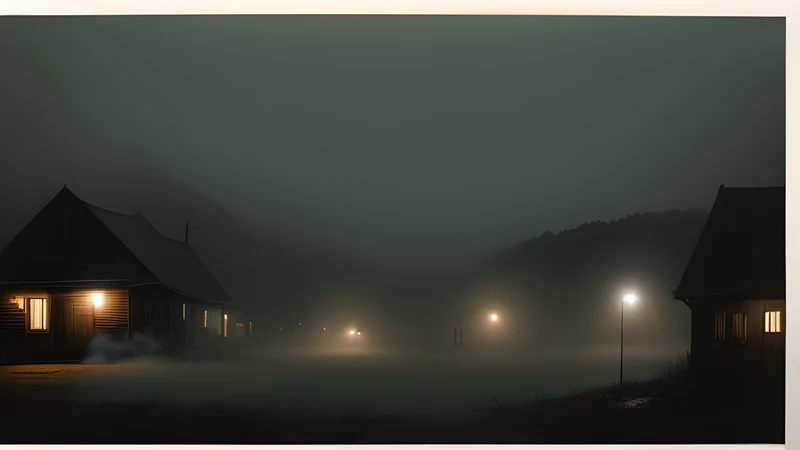
Sherman also understands the coastal fog as an editing tool rather than atmosphere. Steven Poster’s photography keeps the depth of field shallow and the background populated, so figures resolve out of grey at the wrong moment and dissolve back before you can count them. The town is always slightly more crowded than the shot admits.
The verdict, argued
Dead & Buried has real problems. Farentino is stolid where the part wanted someone fraying, the middle hour repeats its investigative beats, and Joe Renzetti’s score occasionally telegraphs a reveal the images were handling perfectly well alone. It is a film with one enormous idea and a slightly mechanical delivery system attached to it.
The idea is enormous enough. Very few horror films locate their monster in municipal enthusiasm — in the pleasure of a community doing something together, well, with good turnout. The photographs are the masterstroke, because photography is what a town does at a wedding. Sherman found the exact place where civic warmth and atrocity share a gesture, and he opens the film on it rather than saving it.
It’s in print in restored, uncut form now, which is not something the 1980s would have predicted. Watch it as the third point of a triangle with Carnival of Souls and The Wicker Man, and the shape of an entire subgenre becomes visible.
Spoilers below
Gillis is dead. He has been dead since before the film started, killed and reconstructed and returned to his post with his memory intact and his status withheld, which means the entire investigation has been a dead man tracking down his own murderers on behalf of the people who committed the murder. His wife Janet is in on it. Dobbs is the architect — the reconstruction work isn’t a hobby, it’s the town’s manufacturing process, and every citizen of Potters Bluff is one of his pieces.
The reveal reorganises Albertson’s performance completely. All that craftsman’s pride in the embalming room was literal boasting about the population; he has been showing the sheriff his own file. And Janet’s role turns the marriage into the film’s most genuinely disturbing element, because she isn’t coerced and she isn’t a pod-person — she chose this, twice, and she is happier now.
The last beat is the one that earns the film its cult. Dobbs demonstrates his work, and the horror arrives as pure vocational satisfaction: a man delighted to explain how the trick is done, to the trick. Gillis’s discovery buys him nothing. He cannot leave, cannot die again, and cannot un-know it. Sherman ends on the mortician’s contentment, and it is the most frightening thing in the film — a monster who is, on the evidence, a very happy man in a job he loves.
Related Content