Dark Water (2002): Nakata's Damp, Patient Terror
The Ringu director trades the videotape for a leaking ceiling and a mother's exhaustion
Contents
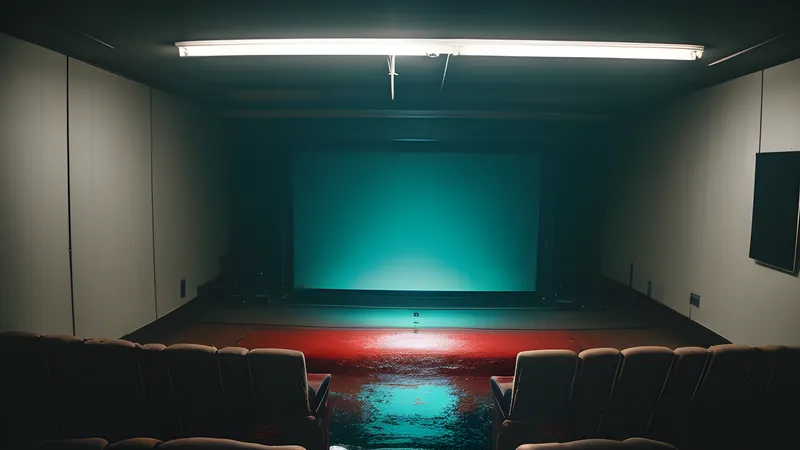
The scariest object in Dark Water is a stain on a ceiling. It starts small, a dark bloom in the corner of a rented flat, and it grows — spreading, darkening, dripping — across a film that understands damp the way other horror understands blood. Hideo Nakata, four years after he changed the genre with Ringu, made a ghost story out of water, exhaustion, and the particular terror of a mother who cannot afford to fall apart, and the result is one of the most emotionally devastating horror films ever made under the label of J-horror.
A mother, a daughter, and a leak
Yoshimi Matsubara (Hitomi Kuroki) is in the middle of a bruising divorce and a custody fight over her small daughter, Ikuko. To prove she can provide a stable home, she rents a cheap flat in a grim, rain-streaked apartment block — the kind of concrete 1970s housing that seems to have been designed to hold weather inside it. Almost at once, the ceiling begins to leak. A patch of damp appears above, water pools on the floor, and the drip becomes the metronome of the whole film. The building is failing, the marriage has failed, and Yoshimi is being watched by lawyers and a mediator for any sign that she is failing too.
Nakata roots the horror in that pressure. Yoshimi has a history — a fragile mental state, a fear that her own mother’s neglect is repeating in her — and the custody process weaponises it. Every strange thing that happens in the flat is also a thing that could be read, by the people judging her, as instability. The leak might be the building. The child’s red bag that keeps reappearing might be a coincidence. The little girl she glimpses might be Ikuko’s imaginary friend. The film keeps the supernatural and the psychological pressed together so tightly that Yoshimi cannot afford to believe her own eyes, because believing them would mean she is unwell, and being unwell would mean losing her daughter.
Water as the whole language
The craft here is a masterclass in using a single element as an entire visual and emotional vocabulary. Water leaks, pools, drips, floods, rises; it stains the ceiling, warps the walls, fills a rooftop tank, brims from an elevator. Nakata and his team make the apartment block feel permanently saturated, so that the dread is ambient and constant — you are never dry, and neither is the film. The colour palette is drained to greys, greens, and rust; the light is the flat, sunless grey of a rainy afternoon that never ends. By the time water becomes an active threat, it has already soaked every frame, so the horror feels less like an arrival than a saturation reaching its limit.
That is the opposite of a jump-scare approach, and it is why the film endures. Nakata builds dread through patience and accumulation, the same slow method that made Ringu so unnerving — a curse that seeps rather than strikes. Dark Water shares more than a director with that film: both come from the same author, Koji Suzuki, whose short story is the source here, and both are obsessed with drowned children, wells, and water as the medium the dead travel through. Watching them as a pair reveals a whole private mythology, a sense that for Suzuki and Nakata the border between the living and the dead is always wet.
Why it works: the horror is the love
The move that lifts Dark Water above the wave it belongs to is that its supernatural threat and its emotional core are the same thing. The ghost, when you understand it, wants exactly what Yoshimi has and can least afford to give — a mother’s attention, a mother’s love, a mother who won’t leave. Every horror beat is also a beat about parenthood, abandonment, and the terrible arithmetic of a woman forced to choose. That fusion puts it beside the Korean grief-ghosts of A Tale of Two Sisters and Spain’s The Orphanage, films where the haunting is a wound in a family rather than a monster from outside.
It also stands apart from its J-horror siblings in tone. Where Ju-on is cold and structural, a curse-machine indifferent to its victims, Dark Water is warm and grieving, and its scares hurt because you love the woman they happen to. Hitomi Kuroki’s performance is the reason: exhausted, frightened, fierce about her daughter, she plays Yoshimi as a woman held together by will alone, and the film’s real suspense is whether the will can outlast the water. Kiyoshi Kurosawa’s empty, dread-soaked cities work a nearby register of alienation; Nakata aims it all at one flat and one mother, and the concentration is what makes it unbearable.
Nakata’s staging is quieter than his reputation suggests. The film’s most famous sustained sequence takes place around a lift — Yoshimi watching the floor numbers, the doors, the small figure that should not be there — and it works entirely on dread of anticipation, on the audience’s certainty that something is coming before it arrives. He trusts the held shot and the ambient drip to do what a lesser film would hire a music sting for. Even the ghost’s biggest reveals are underlit and brief, glimpsed through water or hair, so that your imagination finishes the image and implicates itself. That restraint is a deliberate inheritance from Japan’s older ghost tradition, the painted, patient theatre of Kwaidan, where a spectre’s power came from stillness and suggestion rather than from motion and shock.
The remake and where it sits
Hollywood, mid-J-horror gold rush, remade this one too — Walter Salles’s 2005 Dark Water, with Jennifer Connelly relocating the story to a bleak apartment on New York’s Roosevelt Island. It is one of the more respectable remakes of the cycle, well-acted and genuinely melancholy, and it still loses something in the translation: the specific texture of the Japanese housing block, the cultural weight of the custody stigma, the patience. The pattern of what these crossings sacrifice is traced in the J-horror remake essay, and Dark Water is a gentler case than most — a remake that respects its source and still can’t quite hold the same water.
Where to watch: the 2002 Japanese Dark Water has circulated on physical media and streaming internationally; watch the original with subtitles, ideally on a grey wet afternoon, and let it take its time. If it moves you, the Suzuki-Nakata pairing with Ringu and the grief-ghost films linked above are its closest kin.
Spoilers below
The final act turns the leak into a face. The reappearing child is Mitsuko Kawai, a little girl who lived in the building and drowned in the rooftop water tank after being abandoned — left waiting for a mother who never came, her small red bag the only trace of her. The overflowing tank on the roof is the source of the water that has been staining Yoshimi’s ceiling all along; the building has been weeping the dead girl down through its floors, and the damp that reads as neglect and poverty is also a corpse’s slow signal.
Mitsuko’s ghost is not vengeful in the ordinary sense. She is a child who wants a mother, and she has settled on Yoshimi and, more dangerously, on Ikuko — because a living daughter is a rival for the mother Mitsuko craves. The climax forces Yoshimi into the choice the entire custody plot has been rehearsing: to save her own child, she gives herself to the ghost, agreeing to become Mitsuko’s mother so that the dead girl will let Ikuko go. She steps into the flooding, chooses the drowned child, and vanishes into the building’s water.
The coda, years later, is what makes the film devastating rather than merely sad. A grown Ikuko returns to the old building and briefly senses her mother’s presence — protective, loving, and utterly unreachable, dissolved into the water and the walls. Yoshimi’s final act of love is also her erasure: she saved her daughter by disappearing into the thing that threatened her, becoming a ghost’s mother to remain, in some drowned way, her own daughter’s guardian. It is the same trade The Orphanage makes — a parent choosing the dead to protect the living — and few horror films have ever made that sacrifice ache the way this quiet, leaking one does.
Related Content