Daisies: Chytilová's Anarchic Feminist Provocation
Two girls named Marie decide the world is spoiled, so they will be spoiled too
Contents
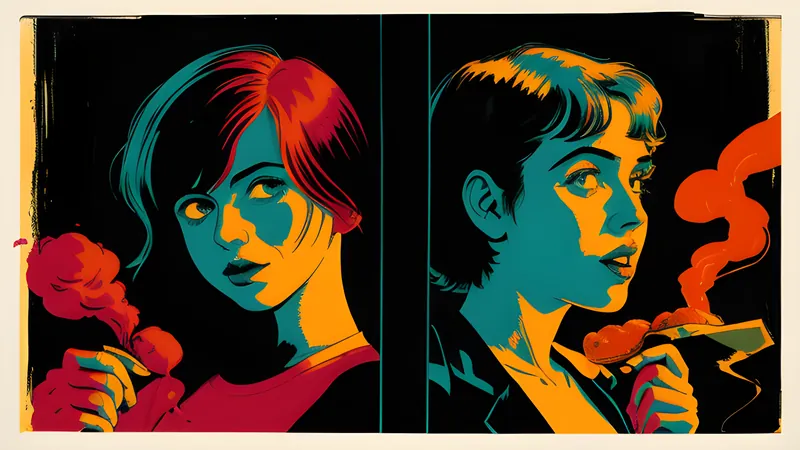
There is a moment early in Věra Chytilová’s Daisies — Sedmikrásky, 1966 — when the two heroines, both named Marie, sit in a field and conclude that since the world is spoiled, they will be spoiled too. From that childish logic the film launches into seventy-four minutes of pure, gleeful destruction: gorging on stolen food, conning elderly men out of expensive lunches, snipping images and each other into paper collage, and finally demolishing a banquet in the most joyously anarchic food-fight ever committed to celluloid. It is one of the great provocations of the 1960s and one of the foundational works of feminist cinema, and it remains genuinely, dangerously funny.
I love this film without reservation, and I want to explain why its chaos is so precisely engineered. Daisies looks like an explosion. It is in fact one of the most controlled avant-garde features ever made, every act of vandalism placed with the timing of a demolition expert. The disorder is the argument, and the argument is aimed straight at a society that wanted its women decorative, obedient and quiet.
Two Maries against the world
The setup barely qualifies as a plot. Two young women, Marie I (Jitka Cerhová) and Marie II (Ivana Karbanová), move through a series of loosely connected episodes with no goal beyond appetite and mischief. They take sugar daddies to restaurants and eat ravenously while feigning innocence, then pack the men off on trains alone. They set fire to streamers, roll around in their flat cutting up food and photographs, and generally treat every rule of feminine propriety as a thing to be mocked and broken.
Chytilová made the film with two crucial collaborators. Ester Krumbachová co-wrote the screenplay and designed the extraordinary costumes; her sensibility — witty, sensual, subversive — is woven through every frame. The cinematographer was Jaroslav Kučera, Chytilová’s husband, whose restless invention with colour, tinting and exposure gives the film its handmade, ever-mutating surface. This was a genuine collaboration among artists pushing each other toward maximum audacity, and the credit belongs across all three.
The two Maries are not characters in any conventional sense. They have no backstory, no psychology, no arc of growth. They are principles let loose — the id of a repressed society given two bodies and a licence to wreck. That refusal of interiority scandalised some viewers then and puzzles some now, but it is deliberate. Chytilová is not asking you to identify with the girls. She is asking you to watch what happens when women stop performing the roles assigned to them and simply take.
Banned for wasting food
The reception is inseparable from the film. Daisies was condemned by the Czechoslovak authorities and effectively banned, and the official objection has become legendary for its own absurdity: the film was denounced, in part, for depicting the wanton destruction of food — the banquet demolished in the finale — at a time when the state prized thrift and productive labour. Members of the National Assembly reportedly raised the food waste as a scandal. Chytilová was barred from filmmaking for years afterward.
That the censors fixated on the food is the richest joke the film never intended. They looked at a savage satire of consumption, conformity and the emptiness of a society that reduces women to ornaments, and they saw ruined pastries. The literal-mindedness of the objection proves the target was real. Daisies is about appetite as rebellion — women consuming the world greedily instead of being consumed by it — and a regime that could only see the wasted cake was exactly the machinery Chytilová was mocking.
She was working at the crest of the Czech New Wave, in the same Prague ferment that produced the oneiric gothic of Valerie and Her Week of Wonders and, a few years later, the paper-cut allegory of Fantastic Planet. Where those films turned constraint into dream, Chytilová turned it into slapstick — and the slapstick got her silenced, which tells you how sharp it was.
Why the chaos is engineered
Here is the craft that separates Daisies from mere provocation. Chytilová and Kučera treat the medium itself as one more rule to break. The film shifts constantly between black-and-white, tinted monochrome and saturated colour, sometimes within a single scene, the palette changing to match the girls’ moods or simply to keep the viewer from settling. Sequences are cut into rhythmic collage; the frame is chopped, mirrored, and — in the film’s most famous flourish — the girls literally take scissors to the image, appearing to slice their own bodies and the screen into fragments that keep moving.
This is not randomness. Every disruption of film form mirrors the girls’ disruption of social form. When they refuse to behave, the film refuses to behave; when they cut up their food and their world, the edit cuts up the image. The style and the story enact the same rebellion at once, which is why Daisies feels so unified despite its apparent anarchy. A conventional visual grammar would have implied a stable world the girls were merely misbehaving in. By breaking the grammar, Chytilová insists the whole order is up for demolition, form and content together.
The influence radiates outward. You can trace this collage-riot sensibility — destruction as ecstatic feminine revolt — forward into decades of avant-garde and music-video language, and sideways into the transgressive European cinema of the same moment. The deliberate assault on the audience’s comfort connects it to the confrontational satire Dušan Makavejev would push even further in Sweet Movie a few years later, another Central European provocation designed to make complicity impossible.
Where it sits, and where to find it
Daisies is short, fast and inexhaustible; it rewards repeat viewing precisely because so much is happening on the surface at once. It has become a feminist landmark and a staple of avant-garde canons, cited by generations of filmmakers and artists, and unlike a lot of sixties provocation it has not aged into a museum piece. The girls’ greed still reads as liberation, the food fight still reads as joy, and the film’s contempt for the roles it was mocking has, if anything, sharpened.
There is a technical audacity here that repeated viewings keep uncovering. The soundtrack is as fragmented as the image — snatches of march music, birdsong, mechanical clatter and abrupt silence, edited into a percussive collage that refuses to soothe. Sound and picture pull against each other constantly, so that even the film’s calmest passages carry an undertow of disruption. Chytilová never lets the viewer relax into a stable register, and that restlessness is why the film still feels contemporary: it anticipates the jump-cut, channel-surfing sensibility that mainstream culture would not catch up to for another twenty years. What looked in 1966 like avant-garde difficulty now reads as prophecy.
It has been restored and released through the Criterion Collection and screens often in repertory. Meet it there, loud and in colour, and let it be as rude as it wants to be. It is the rare experimental film that is also an unqualified good time — a demolition that leaves you grinning.
Spoilers below
The banquet finale is where Daisies delivers its thesis. The two Maries stumble into an enormous formal feast laid out for absent dignitaries, an obscene spread of food and wine, and they demolish it — swinging from a chandelier, walking across the table, stuffing themselves, hurling delicacies, reducing the entire display of institutional plenty to wreckage. It is ecstatic and total, and it is the image the censors could not forgive. The girls’ private appetite becomes public sabotage, and the excess of the state’s own banquet is turned against it.
Then comes the ending, and it is a masterstroke of ironic ambiguity. Chastened — or pretending to be — the girls try to atone by “repairing” the ruined banquet, clumsily reassembling smashed plates and spoiled food onto the table while solemnly declaring that they will be good, that they will be useful, that they will work hard. They lie down on the reconstructed table in newspaper dresses, and the film seems to grant the reform the authorities would have demanded. A chandelier then falls. A closing title dedicates the film, with heavy sarcasm, to those whose only outrage is a trampled trifle.
The irony is total and it is the film’s final act of defiance. The “reform” is a sham, a rickety patch-up of something already destroyed, offered with a straight face to a system that wanted its women repentant and productive. Chytilová gives the censors the ending they might have wanted and poisons it, so that submission itself becomes the last and sharpest joke. The girls perform obedience the way they performed everything else — as mockery. Nothing has been repaired. The world is still spoiled, and so are they, and the film ends knowing the authorities would miss the point once more.
Related Content