Cure (1997): Kiyoshi Kurosawa's Hypnotist and the Empty Detective
The serial-killer film that removed the killer and left only the suggestion
Contents
A series of murders in Tokyo. Each victim has the same wound, a large X cut into the throat and chest. Each killer is a different, ordinary person — a policeman, a doctor, a schoolteacher — caught at the scene, fully confessing, utterly unable to say why they did it. That is the engine of Cure, Kiyoshi Kurosawa’s 1997 breakthrough, and it is worth stating up front that the film has no interest in the thing every other serial-killer picture is built to deliver: the reveal, the profile, the click of a motive locking into place. Kurosawa withholds all of it, and the withholding is the horror.
A procedural with the middle removed
The detective is Takabe, played by Koji Yakusho with a stiffness that reads at first as competence and later as strain. He has a wife with a deteriorating mental condition, a home life he manages the way you manage a leak, and a caseload of murders that share a signature but no perpetrator. The films Cure superficially resembles — The Silence of the Lambs, Se7en, the whole prestige-procedural boom of the mid-nineties — all run on the same promise: that intelligence applied hard enough will produce an answer, that the pattern means something a clever person can decode. Kurosawa takes the shape of that film and quietly disconnects the wiring.
Because the man behind the killings, a drifting amnesiac named Mamiya, does not command anyone to kill. He asks questions. He meets a stranger, produces a flame from a cigarette lighter or draws their attention to running water, and asks them, patiently, who they are — and keeps asking until the person he is speaking to comes loose from themselves. He is a hypnotist with no agenda you could prosecute. He plants nothing; he removes the lid. What crawls out was, the film suggests, always there. The X on each throat is the mark of a social self peeled back to expose the resentment underneath.
Kurosawa — no relation to Akira, a coincidence that has followed him his whole career — came up through the low-budget pink-film and direct-to-video trenches of the Japanese industry, and Cure was the film that lifted him out of them in 1997. You can feel that apprenticeship in the economy of the thing: a man who learned to make images fast and cheap discovers that constraint is a style, that a room shot flatly and held too long is more frightening than any amount of coverage. He would spend the following decade refining the same grammar across ghost stories and end-of-the-world pictures, but the template was set here, in a crime film that treats the crime as almost incidental to the mood it generates.
This is why Cure frightens people who are not easily frightened. Most crime cinema reassures us that violence is exceptional, the property of monsters. Kurosawa’s proposition is that the murderous impulse is ordinary and near the surface in everyone, and that all it takes to release it is the right question asked by someone with no stake in the answer.
Why the emptiness works on screen
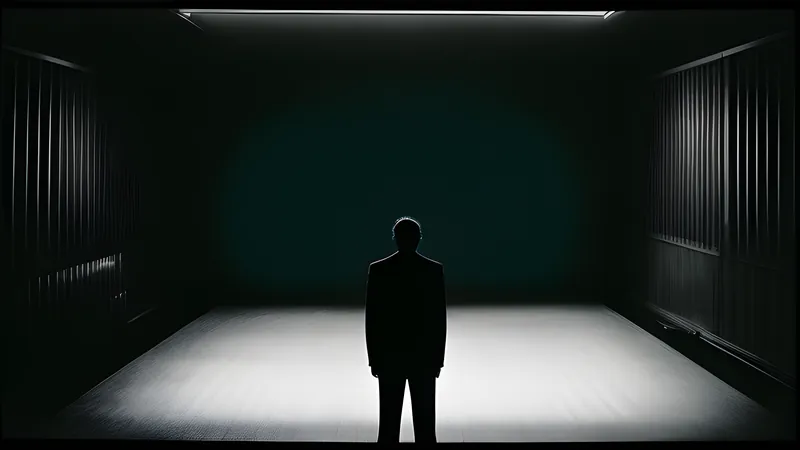
The craft here is a study in subtraction, and it is the reason the film has aged into a classic while flashier thrillers of its year have dated. Kurosawa shoots in long, static wide shots, the camera set back far enough that human figures sit small inside grey rooms and derelict industrial spaces. He starves the frame of close-ups, so that when a face finally fills the screen it lands like a shock. The palette is drained to concrete and rust. There is almost no score in the conventional sense; instead the soundtrack is a low industrial hum, the drone of a washing machine, wind in an abandoned building, a wash of noise that never resolves into music and never lets you settle.
That formal coldness does specific work. By keeping the camera at a distance and refusing to cut in for reaction shots, Kurosawa denies you the guidance a thriller normally provides — the editing that tells you where to look and how to feel. You are left scanning the wide frame yourself, and the act of looking becomes uneasy, because you are doing the detective’s job and getting the detective’s non-answers. The film’s most notorious device is the hypnotic trigger: flame, water, the repeated soft question. Kurosawa stages these inductions so slowly and so plainly that the viewer begins to feel the pull of the rhythm, which is a genuinely daring thing to do to an audience and the source of the film’s lingering dread.
The ancestor Kurosawa is really working from is less the American serial-killer film than the cinema of possession and mesmerism — the old idea, running back through folklore and silent film, that a person can be hollowed out and driven. What he adds is a modern, secular frame: no demon, only suggestion and the emptiness a certain kind of person carries around waiting to be filled. It puts Cure in strange, close conversation with the wave of Japanese horror that broke a year or two later, films that located their terror in transmission and contagion rather than in a knife. If you came to Kurosawa through that door, the film to set beside this one is Takashi Miike’s Audition, another patient, quiet Japanese picture that lulls you for an hour before it shows its teeth.
The empty detective
The genius stroke is that Cure is finally about Takabe more than about Mamiya. The hunter, not the hunted, is the film’s real subject. Yakusho plays a man holding himself together through routine and duty, and Kurosawa spends the running time showing us the cracks: the impatience with his ill wife, the flashes of a temper he keeps clamped, the fatigue that has worn his defences down to the veneer. A procedural usually keeps its detective stable so that the world can be unstable around him. Kurosawa makes the detective the least stable element in the frame and dares you to notice before he does.
This is the cross-reference that matters most. Cure belongs on the same shelf as the great procedurals about investigators consumed by the case — David Fincher’s Zodiac, where the pursuit hollows out the men who undertake it, and Bong Joon-ho’s Memories of Murder, where a real unsolved killing curdles into national and personal shame. All three understand that the danger of staring into a void is that the void has your attention too. Kurosawa simply takes the idea to its most literal conclusion.
Spoilers below
Everything from here assumes you have seen the film.
Takabe does eventually corner Mamiya, and the confrontation delivers no catharsis. Mamiya turns his method on the detective — the same soft interrogation, the same erosion of the self — and although Takabe seems to resist, seems even to kill Mamiya and close the case, Kurosawa refuses to let the resolution hold. The final stretch strongly implies that the contagion has not ended. It has changed hosts. Takabe, the man who spent the film absorbing Mamiya’s questions in order to defeat them, has taken up the role.
The closing scene is one of the great quiet horrors in nineties cinema. Takabe sits in a restaurant, apparently calm, apparently free. A waitress clears his plate and walks toward the kitchen, and the camera follows her as she takes up a large knife and moves, unhurried, back into the room. Kurosawa cuts away before anything happens, and the cut is the point: the cure has spread, the emptiness has found a new carrier, and the mechanism will simply continue, indifferent to which body carries it forward. There is no scene of a killer being profiled and understood, because there was never a killer in the sense the genre means. There was a question, and it is still being asked.
What makes this ending durable, rather than merely bleak, is how completely it reframes everything before it. On a second viewing you watch Takabe’s fraying with dread from the first reel, knowing the case was working on him the whole time. Cure is a film that turns the detective into the crime scene, and it does so with such control that the horror feels less like a twist than an inevitability you simply failed to see coming.
Where to watch: Cure has had a proper restoration and a good disc release; find that rather than an old fansub, because the film’s power lives in the depth of its greys and the precision of its sound design, both of which a bad transfer flattens into nothing. Watch it late, alone, with the lights off, and give it the patience it demands; the film rewards attention the way it punishes the characters who pay it.
Related Content