Cube: The Trap Film That Launched a Genre
Vincenzo Natali built a whole subgenre out of one room, six strangers and a budget of nothing
Contents
A man wakes in a cube-shaped room with a hatch in every wall — six doors leading to six identical rooms, each with six more doors, a lattice of cells stretching in every direction with no visible edge and no explanation. He climbs through one. It kills him: a grid of wires slices him into neat falling cubes before he has finished stepping across the threshold. The title card appears. Cube (1997), Vincenzo Natali’s debut feature, has spent ninety seconds establishing its entire universe, its lethal logic, and the impossibility of escape, and it has not yet introduced a single character who will survive to the credits.
That opening is a masterclass in economy, and economy was not optional. Cube was a Canadian production made for roughly a third of a million dollars, financed partly through a low-budget development programme, and its poverty is invisible on screen because Natali turned the constraint into the concept. The film needed only one set. So the film is about being trapped in a place made of identical copies of one set. The whole apparatus of the story — the maze, the paranoia, the mathematics of survival — grows directly out of a filmmaker looking at what he could actually afford to build and writing the script that made a virtue of it.
One room, endless rooms
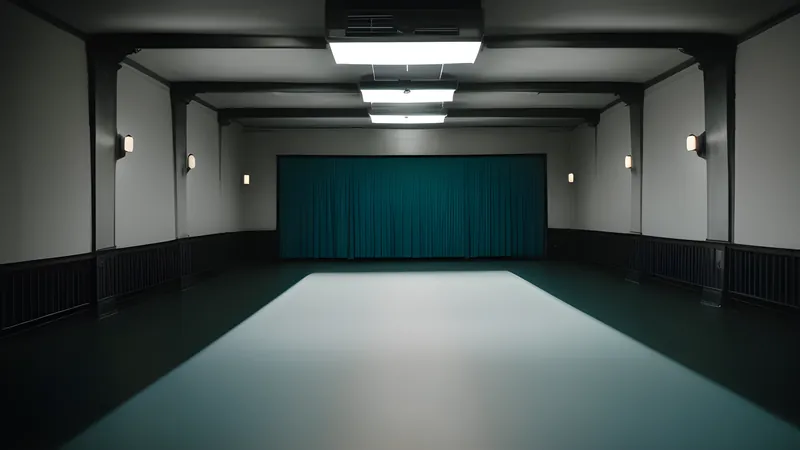
Natali and his team constructed a single cubic set, about fourteen feet on each side, with a hatch in every wall, and then changed the coloured gel lighting between scenes — red, blue, green, white — so that a handful of dressings could stand in for hundreds of distinct rooms. Editing and the actors’ performances do the rest: when the group crawls from a blue room into a red one, we accept that they have moved through the maze, because the film has trained us to read colour as location. It is a conjuring trick performed in plain sight, and it holds because Natali never cheats the geometry. The rooms genuinely connect the way the film says they do.
Into this trap he drops seven strangers who wake with no memory of how they arrived and no idea why they were chosen. There is Quentin (Maurice Dean Wint), a police officer whose authority curdles into something dangerous as the ordeal grinds on; Worth (David Hewlett), a cynical office drone hiding what he knows; Leaven (Nicole de Boer), a maths student whose skill becomes the group’s only navigational tool; Holloway (Nicky Guadagni), a conspiracy-minded doctor; Rennes (Wayne Robson), a celebrated prison escapist; and Kazan (Andrew Miller), an autistic man the others initially dismiss as dead weight. None of them knows the others. None knows why these particular people were assembled. The absence of explanation is the film’s engine, and Natali has the discipline never to fill it in.
Why the maths matters
The trap has a system, and cracking it is the closest the film comes to hope. The rooms are marked with sets of three-digit numbers, and Leaven eventually deduces that the numbers encode which rooms are booby-trapped — a room is safe unless one of its number sequences is prime. The moment the audience understands the rule, Cube becomes unbearably tense, because now we can see the trap coming and can do nothing about the human failures that will spring it anyway. Later the calculation grows more monstrous still, involving permutations and factorisation beyond what any of the survivors can do in their heads, and the film quietly makes its bleakest point: the maze is solvable in theory and lethal in practice, because knowledge is useless without the one person who can actually run the numbers.
This is science fiction of a very particular, very cold kind — closer to a logic puzzle with a body count than to spectacle. Natali stages the horror not through gore, though the deaths are grisly and sudden, but through the slow revelation of the system’s indifference. Nobody built the Cube to punish these people specifically. There is no villain in the maze, no voice on a speaker, no game master enjoying the show. The horror is bureaucratic and unauthored, a machine that exists and kills because it exists, and the film’s most chilling suggestion is that no one may be in charge of it at all.
The genre it launched
Cube is the ancestor everyone forgets to credit. Seven years later Saw (2004) took the premise — strangers trapped in a deadly game with rules to decode, low budget, single-location ingenuity — and added a villain and a moral framework, and became a franchise that has grossed over a billion dollars. Behind Saw sits Cube, and behind the entire escape-room-as-cinema boom that followed: Exam (2009), Circle (2015), The Platform (2019), the Escape Room films, the Spanish Fermat’s Room (2007) which owes Cube an especially obvious debt. Natali built the chassis, and an industry has been rebadging it for thirty years.
Its own ancestry runs back to the anthology-television tradition of the cruel unexplained scenario — The Twilight Zone and its bottle episodes, the science-fiction short story that poses a situation and refuses to soften it. And its sensibility, a group of strangers reduced to their worst selves under a pressure they cannot escape, connects it to the chamber-piece paranoia of films like Coherence, where the trap is metaphysical rather than physical but the human breakdown runs identically. It shares, too, the mathematics-as-madness fixation of Pi, released the following year, where the search for a governing pattern again becomes a death sentence. The two films are a matched pair from the same brief moment, both convinced that numbers are where the real horror lives.
The verdict, spoiler-free
Cube is not slick. The acting is uneven, some of the dialogue clanks, and the mid-budget sequels it spawned — Cube 2: Hypercube (2002) and Cube Zero (2004), plus a 2021 Japanese remake — mostly proved how hard the original’s balance was to repeat. But the core is close to perfect: a genuinely original premise executed with total commitment, a set of ideas about systems and helplessness that has aged into relevance, and a refusal to explain that most modern films in its lineage lack the nerve to attempt. It is the rare debut whose limitations and virtues are the same thing.
Watch it, and then watch how much the trap film gave up when it started explaining itself — Saw’s Jigsaw is a great villain, and he is also the thing Cube was wise enough to leave out. For the same cold logic turned inward, Pi is the companion piece; for the same strangers-in-a-collapsing-reality dread on an even smaller budget, Coherence is the one to seek out next.
Spoilers below
The group’s disintegration is the real trap, and it is far deadlier than the wires. Rennes, the master escapist and the person most likely to lead them out, dies early and almost casually, sprayed with acid the instant he trusts a room he has tested — the film’s way of announcing that expertise guarantees nothing here. Quentin, the cop, curdles from reluctant leader into a violent authoritarian as the days without food or water wear on, and it becomes clear that the maze does not need to kill everyone itself. It only needs to keep the people inside it long enough for the strongest to turn on the weakest.
Kazan, dismissed by everyone as a liability, turns out to be the key. The final calculation required to navigate the last stretch of the maze — the factorisation of enormous numbers to predict the moving rooms — is beyond Leaven’s ability to do by hand, and it is Kazan, the autistic man Quentin nearly abandoned, who can perform the arithmetic instantly in his head. The group’s survival depends entirely on the person they were ready to leave behind, and the film’s cruellest irony is that Quentin’s contempt for Kazan is the thing that dooms the rest of them. As the maze shifts toward its exit, Quentin’s violence peaks; he kills or fatally wounds the others in a final paranoid rage, and is himself crushed between two shifting rooms as he lunges for a last victim.
The ending is pure Natali. Only Kazan reaches the edge of the Cube, where a final room opens onto blinding white light — the boundary of the structure, the way out, or possibly just another kind of oblivion; the film declines to say what lies beyond it. Kazan walks into the light alone, the one survivor, the “useless” man, carried through the maze by the very quality the others could not see past. There is no reveal of who built the Cube, no captured architect, no motive. The machine remains unauthored and unexplained, having consumed six people for no stated reason, and Natali cuts to white with the central mystery deliberately, permanently intact. That withheld answer is the film’s masterstroke and the exact thing every imitator since has been unable to resist filling in.
Related Content