Croupier: Clive Owen and the Casino Cold Streak
Mike Hodges came back after thirty years with a film about a writer who refuses to gamble
Contents
The first rule of Croupier is stated early and obeyed absolutely: the croupier does not gamble. Jack Manfred stands behind the table for a wage, watching people destroy themselves at a rate he can predict, and his entire professional identity rests on never once wanting what they want. The film is about a man who has organised his life around the refusal to have a stake in anything, and it is far funnier and colder about that than a synopsis suggests.
Mike Hodges made it in 1998, twenty-seven years after Get Carter, in a career that had spent the intervening decades being sabotaged by studios, recuts and bad luck. Britain gave the film essentially no theatrical release; it went out on television with a shrug. Then an American distributor picked it up in 2000, put it into arthouse cinemas, and it became a genuine hit — critics discovered it, audiences turned up for months, and the film was subsequently re-released in the country that had already thrown it away. Hodges got his career’s last act. Clive Owen got a career.
Twenty-seven years in the wilderness
The backstory matters because it is legible in the film. Hodges made Get Carter at thirty-eight and was, briefly, the most promising director in Britain. What followed was a career of interference: Damien: Omen II, which he left; Flash Gordon, an enjoyable film that was not the one he set out to make; Morons from Outer Space; and Black Rainbow, a genuinely good picture that went almost straight to television. By the mid-1990s he was a director whose reputation rested entirely on something he had done a quarter of a century earlier.
Croupier was shot cheaply and quickly, in a British film culture that had no idea what to do with a spare, unglamorous, adult picture with no geezers in it. That indifference is why the film feels the way it does. There is nobody in it asking to be liked.
Jack, and Jake
Jack Manfred (Owen) is a writer without a book. He has a novel he cannot begin, a girlfriend, Marion (Gina McKee), who is a store detective and therefore also professionally engaged in watching people cheat, and a father with a talent for arranging things Jack should decline. The father arranges a job in a London casino. Jack has done this before, in South Africa, and he is very good at it.
The formal device is the reason the film exists. Jack narrates in the third person — describing himself as the protagonist of the book he is finally, secretly writing, watching his own life as material. The voice-over calls him by a name that is not quite his own, and Hodges lets the two identities slide against each other for ninety minutes without ever tidying up the relationship. It is a device that should be unbearable and instead is the sharpest thing in the picture, because Paul Mayersberg’s screenplay understands what it is actually describing: a man who has discovered that if you narrate your life you never have to live in it.
Mayersberg wrote The Man Who Fell to Earth, which is the useful clue. He is drawn to protagonists who are present at their own existence as observers, and he gives Jack a worldview of pure, glacial detachment. Jack likes watching gamblers lose. He says so. The casino is not a temptation to him; it is a theatre with good seats.
Owen’s stillness
This performance made Clive Owen and it is worth being precise about why, because it consists almost entirely of withholding. Owen plays Jack with a flat, watchful courtesy that never breaks — no tics, no charm offensive, no vulnerability offered to the audience as a bribe. He is beautiful and empty and slightly amused, and the camera finds him fascinating for exactly the reason the film’s women do: there is obviously something in there, and he will not produce it.
The risk of the approach is that a spectator hero can turn the film into a waiting room. Hodges avoids that by making everyone around Jack extremely alive. Alex Kingston’s Jani de Villiers, a South African gambler with a problem and a proposition, plays every scene as though she has already read the last page. Gina McKee’s Marion is the film’s moral instrument, a woman who wants Jack to be a decent man and is slowly realising she has been dating a narrator. Kate Hardie’s Bella, a fellow dealer, supplies the casino’s actual human temperature.
The craft: work, filmed as work
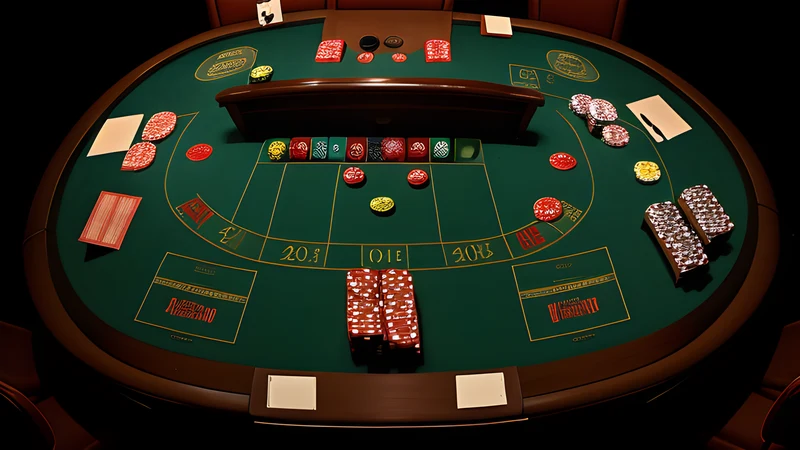
The best sustained thing in Croupier is its proceduralism. Hodges shot the casino as a workplace with rules, hierarchies, petty rivalries and a staff canteen. We learn how a table is run, how the house watches the dealers, how the dealers watch each other, how a cheat is spotted, what happens on a shift change. Mike Garfath’s camera goes overhead for the tables — a flattened, surveillance-adjacent geometry that turns the baize into a diagram — and the film’s visual argument follows from it: from above, gambling stops being drama and becomes a machine converting hope into revenue at a fixed rate.
Simon Fisher-Turner’s score is spare to the point of austerity. There are no montages of glamour. Hodges, who spent his early career in television current affairs, films a casino the way a documentarian would film a factory, and the effect is to strip the location of every romantic association the genre has ever loaded onto it. Croupier is one of the few gambling films with no interest whatsoever in the thrill of gambling.
The film also has a real theory of its subject, delivered without a lecture: the house does not need to cheat, the odds are the cheat, and everyone at the table knows this and plays anyway. Jack’s contempt for gamblers is the contempt of a man who has read the terms and conditions.
The real ancestor
Hodges is on record about the debt and it is visible in every frame: Jean-Pierre Melville’s Bob le flambeur, the 1956 film that established the gambler as a figure of style, fatalism and professional self-knowledge, and that treats a casino as a place where a man goes to find out who he already was. Melville’s Bob has warmth; Jack has none, which is the modern update. Both films know that the interesting question about gambling is temperament rather than money.
The other ancestor is Kubrick’s The Killing, for its conviction that a crime is best filmed as a work process observed at a slight chill. And the essential companion is Hodges’s own Get Carter — the same director, the same refusal of consolation, the same interest in a man who is exceptionally good at something appalling. Carter’s coldness comes from rage. Jack’s comes from having nothing at all underneath, which is the more disturbing account. Against the argument that neo-noir too often mistakes style for substance, Croupier is the rebuttal: the style here is a diagnosis of the character.
A verdict, argued
Croupier has real problems and its admirers do it no favours by pretending otherwise. The plot machinery in the last third is creaky, and it arrives on schedule with a proposition that a viewer will see coming from a long way off. Some of the dialogue in Jack’s private life is stiff. The film’s budget is on the screen.
None of that matters much, because the film is not really running on plot. It is running on a voice and an atmosphere and one very good idea, sustained: that the man telling you this story is the least trustworthy person in it, and that his coldness is a craft he has practised. Hodges gets the ending exactly right, which is to say he trusts that idea rather than the resolution the genre expects of him, and the film’s final argument about temperament is waiting below the line.
It is one of the last genuinely great British neo-noirs and the best possible evidence that Hodges was never a one-film director. It streams and has had a decent disc release. Watch it with the sound up; the voice-over is the picture.
Spoilers below
Stop here if you have not seen it — the last movement depends on two things the film keeps in its sleeve.
Jani’s proposition is a casino robbery, and Jack, having spent the film insisting he does not gamble, takes the bet. His role is passive by design — he is to be distracted at the right moment and let the thing happen at his table, which allows him to tell himself he has not participated. The self-deception is exquisite and entirely in character: Jack refuses to gamble and consents instead to be gambled with, because that way the story still belongs to someone else.
The robbery goes wrong in the specific way that reveals Jack was never a player at all. He was the mark. The proposition was constructed around him, he was recruited to be exactly where he was, and the man who prided himself on watching everyone else lose spent the whole film being watched. Hodges plays the reveal with almost no relish, which is what makes it sting; there is no triumphant explanation, just a slow understanding that the observer was the object of observation.
What Jack gets out of it is the book. The novel he could not write becomes writable the moment he has been comprehensively used, and it is published anonymously and succeeds. This is the film’s real cruelty and its best joke. Jack does not learn anything. He does not become warm, or wise, or punished. He converts his own humiliation into product and goes back behind the table, and Hodges’s final image insists that this is a man in his natural condition. Marion, who wanted him to be better, is the only person in the film who pays a real price for Jack’s detachment — and the film is honest enough to make her absence the thing he narrates his way past.
Related Content