Cosmic Dread: Adapting the Unadaptable Lovecraft
Why the best Lovecraft films throw away the plot and keep the vertigo
Contents
The received wisdom is that H. P. Lovecraft is unfilmable, and the received wisdom is half right. His horror is built on the sentence “there are things man was not meant to see,” which is a fatal premise for a medium whose entire job is to show you things. A monster described as indescribable becomes, the moment a special-effects crew renders it, merely a monster — a squid, a pile of tentacles, a costume. The gap between the dread on the page and the rubber on the screen is the oldest problem in this corner of the genre. And yet a handful of films have crossed it, and every one of them crossed it the same way: they stopped trying to adapt the plots and started adapting the vertigo.
The problem is the tentacle
Begin with the failure mode, because it is instructive. Lovecraft’s prose works by withholding. He piles up adjectives of negation — non-Euclidean, unnameable, blasphemous — precisely so the reader’s imagination does the conjuring, and the reader’s imagination will always out-horrify a model shop. A literal adaptation walks straight into this trap. Show Cthulhu and the audience measures him, files him next to Godzilla and the Kraken, and the cosmic collapses into the merely large.
The films that understand this treat the monster as a delivery problem to be solved by indirection. Stuart Gordon’s From Beyond (1986) is a fascinating half-success here, because Gordon and his collaborators grasped that Lovecraft’s real subject is perception itself. The story’s premise — a machine that stimulates the pineal gland and lets us see the creatures that share our space unseen — becomes, on screen, an argument that the horror is in the seeing, in the widening of the senses past what a body can survive. I have written about that sensory nightmare in my full piece; the reason it half-works and half-tips into camp is the reason this whole essay exists. The moment the creatures become fully visible, latex and all, the dread has to be replaced by something else, and Gordon replaces it with delirium and body-horror excess. It is a legitimate substitution, and it is not the same thing as cosmic fear.
Carpenter’s solution: adapt the apostasy, not the octopus
The single most successful translation of Lovecraft to film contains almost no Lovecraft plot at all. John Carpenter’s In the Mouth of Madness (1994) borrows no specific story; instead it adapts the idea that reality is a thin membrane and that reading the wrong words can dissolve it. Carpenter builds his horror out of an insurance investigator’s certainty that the world is solid, and then he spends ninety minutes taking that certainty apart, until the man’s sanity and the film’s own reality come loose together. The genius is structural. The audience’s sense of a stable, filmable world is the thing being destroyed, so the horror lands where Lovecraft always aimed it — at the viewer’s confidence that the universe is knowable. I have argued this is Carpenter’s Lovecraft endgame in its own piece, and it pairs with his earlier Prince of Darkness (1987), which smuggles cosmic dread in through the language of quantum physics — the ancient evil recast as a problem in particle theory, which I take up here.
What Carpenter proved is that the way to film the unfilmable is to make the loss of certainty the special effect. You cannot show a non-Euclidean angle, but you can show a man discovering that the corridor he just walked down no longer leads back where it came from. Vertigo is photographable. The tentacle is a distraction.
The splatter route and the honest one
There is a second, entirely valid tradition that gives up on cosmic dread and mines Lovecraft for something else — his morbid glee, his mad scientists, his sheer physical wrongness. Stuart Gordon’s Re-Animator (1985) is the masterpiece of this school, and it earns its place by being unashamed about the trade. It takes Lovecraft’s “Herbert West — Reanimator,” a story the author himself dashed off for money and rather despised, and turns it into a splatter comedy of pitch-black precision. It is barely cosmic at all. What it keeps is the transgression — the scientist who will cross any line, the corpse that will not stay dead — and it plays the horror for laughs and gouts of glow-green fluid. I have made the case for it in my review, and the reason it belongs in this argument is that it never pretends to be doing the impossible. It adapts the parts of Lovecraft that are filmable and leaves the ineffable on the shelf.
The most interesting recent development is a third way that costs almost nothing. Justin Benson and Aaron Moorhead’s The Endless (2017) delivers genuine cosmic dread on a mumblecore budget by refusing to build the monster at all. The film’s horror is a repeating time loop and a vast indifferent presence in the sky that the camera barely shows — a few impossible photographs, a moon that will not behave, a sense of a mind too large to perceive us as anything but weather. Because the film has no money, it is forced into the withholding that a bigger production would have spent its way out of, and the withholding is exactly what Lovecraft’s prose does. Poverty pushed the filmmakers into the right aesthetic. I have written about that inversion in my piece on the film, and it is the cleanest proof of this essay’s thesis: the less you show, the more cosmic you get.
The sound of the wrong angle
There is a purely technical toolkit for the cosmic that the successful films share, and it is worth naming because it is teachable. Cosmic dread is largely a matter of sound and scale of image working against the audience’s sense of a stable frame. Carpenter, a composer as well as a director, scores his apocalypses with low, droning synthesiser figures that never resolve, so the ear is denied the release a normal cue provides; the music sits under the scene like pressure under a floor. Prince of Darkness uses this relentlessly, a hum of dread that refuses to become a melody, and the refusal is the point — the universe of the film will not resolve into sense, so neither will its score.
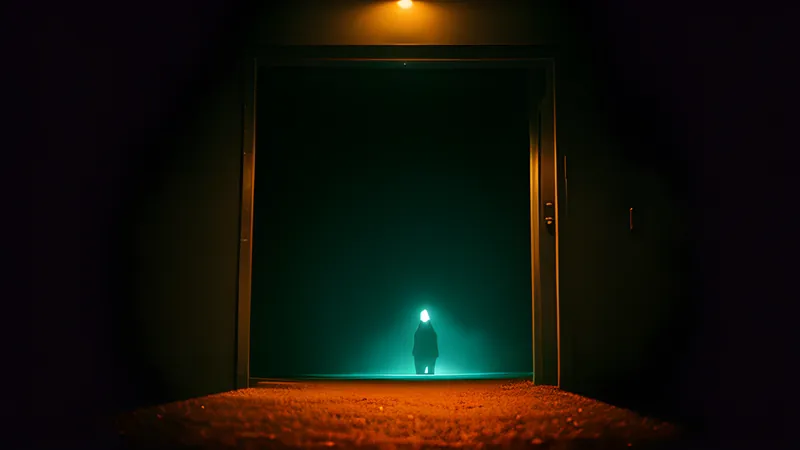
The image does the same work from the other direction. A cosmic-horror film wants compositions that imply an off-screen vastness the frame cannot contain: a figure dwarfed at the bottom of a tall shot, a horizon that reads as wrong, a corridor that should not connect to the room it opens onto. The Endless gets extraordinary mileage from a handful of these — a photograph that shows something impossible in the sky, a moon that behaves against physics — precisely because it never cuts to the full reveal. The audience’s eye keeps trying to complete the geometry and cannot, and that failure to complete is the vertigo Lovecraft’s adjectives were always chasing. The craft lesson is that you frighten cosmically by starving the senses of resolution, in the score and in the frame alike, until the mind fills the gap with something worse than any model could supply.
What “adapting the dread” actually means
Assemble these films and a working method emerges, one that any future Lovecraft adaptation should paste to the camera. Photograph the investigator, never the god. Make the destruction of certainty the set piece and let the creature stay a rumour at the edge of the frame. Treat scale as a feeling the characters cannot cope with rather than a shot the effects team has to nail. And when you cannot do any of that — when the budget or the studio demands a visible monster — pivot honestly to body horror or black comedy the way Gordon did, and stop claiming to deliver the cosmic.
The failure of most Lovecraft films is a failure of nerve dressed up as a triumph of effects. They show the thing because showing is what films do, and in showing it they annihilate the fear. The successes all share a discipline that runs against the medium’s instincts, the same discipline I traced through the ghost story in my essay on the architecture of fear: the confidence to let the audience’s own mind build the horror in the empty space the film leaves open. If you want the wider map, I have gathered the films that get it right — including several that owe Lovecraft everything while adapting none of him directly — in the cosmic-horror canon. Watch them together and the paradox resolves: Lovecraft was never unfilmable. He was only unshowable, and the two are not the same.
Related Content