Color Out of Space: Cage, Alpacas, and Lovecraft's Malignant Hue
Richard Stanley returns after twenty-three years to film the unfilmable monster
Contents
Richard Stanley made two features in the early nineties — Hardware in 1990 and Dust Devil in 1992 — and then was fired from The Island of Dr. Moreau after three days in 1996, an event that became one of the great Hollywood horror stories and cost him twenty-three years of narrative filmmaking. He came back in 2019, at TIFF’s Midnight Madness, with an adaptation of a Lovecraft story about a colour, starring Nicolas Cage as an alpaca farmer.
It is very good. That sentence needed twenty-three years to become possible and it is worth pausing on.
The problem the film exists to solve
“The Colour Out of Space” was published in 1927 and is generally reckoned Lovecraft’s best story, partly because he built a monster that cannot be drawn. A meteorite falls on a New England farm. Something comes out of it. That something is a colour — a hue outside the visible spectrum, which Lovecraft describes only by insisting it has no analogue and cannot be named. It gets into the water. It gets into the crops. It gets into the family, and it does to them what it did to the vegetables.
This is an unfilmable premise for the obvious reason: cinema is made of visible light. You cannot photograph a colour that does not exist, and every previous attempt — and there have been several, going back to Daniel Haller’s Die, Monster, Die! in 1965 — has solved the problem by replacing the colour with a monster, which is a confession of defeat.
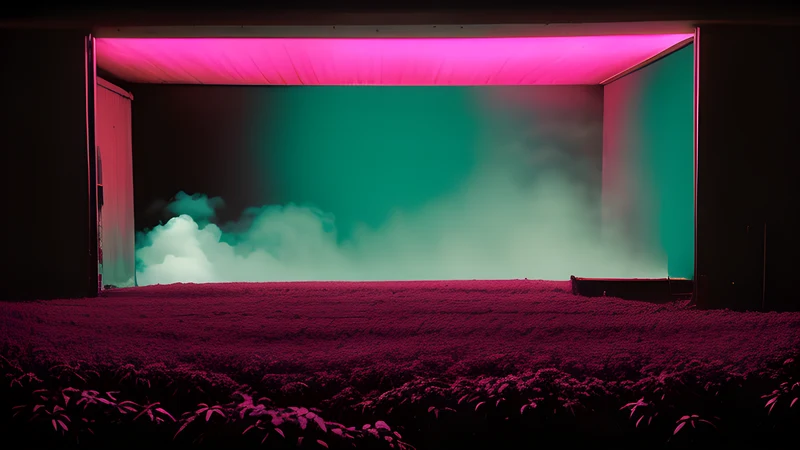
Stanley’s answer is magenta. He picked a hue that sits at the awkward edge of what film stock and digital sensors handle gracefully, a colour that human vision constructs rather than receives — magenta has no wavelength; your brain manufactures it when the red and blue cones fire without the green — and he floods the film with it. It is a genuinely clever cheat. The colour on screen is not Lovecraft’s colour. But it is a colour your visual system invents, which is closer to the story’s idea than anything anyone had tried.
The craft: colour timing as the special effect
Steve Annis shoots the Gardner farm conventionally at first — New England naturalism, warm domestic interiors, the standard grammar of a family drama, all filmed in Portugal standing in for the Miskatonic Valley. Then the meteorite arrives and the palette begins to fail.
The technique is worth watching closely because Stanley does it by degrees. The magenta does not simply switch on. It creeps into the highlights first, then the shadows, then the skin, and each stage is calibrated so the previous one has become normal by the time the next arrives. By the third act the film’s colour space has been comprehensively poisoned, and the reason it registers as horror rather than as style is that Stanley spent an hour establishing what “correct” looked like in this house.
Colin Stetson’s score runs the same programme in sound. Stetson is a saxophonist who plays bass and contrabass instruments using circular breathing, close-miked so you hear the mechanics — keys, breath, the body of the horn — and the result is music that sounds organic and wrong at once. He had done Hereditary the year before. Here he is doing something harder: scoring an entity that has no form, using an instrument recorded so intimately that you cannot tell where the player stops and the machine starts. That is the film’s subject, rendered as timbre.
The practical effects in the last act are the third leg. Stanley and his team built the fusions physically, and the difference between a merged body you can light and a merged body you can render is the difference between revulsion and admiration. This is the argument What Latex Knows That Pixels Don’t makes at length, and Color Out of Space is exhibit A for the modern era.
The real ancestor is Italian
Everyone says The Thing, because of the fusions, and the debt is obvious and acknowledged. Fine.
But the real ancestor of this film is Suspiria. Lovecraft’s problem — a monster made of colour — has exactly one prior solution in cinema, and it is Italian. Argento, working with Luciano Tovoli and the last available stock of Technicolor’s imbibition process, built a film in 1977 where the colour is the antagonist: the reds and greens and blues in Suspiria are not lighting a horror film, they are perpetrating it. Mario Bava got there first in Blood and Black Lace and the colour-timing tradition runs from him forward.
Stanley is a European filmmaker who grew up on this material, and Color Out of Space is a Lovecraft adaptation made by someone who understood that the Italians had already solved his central problem forty years earlier. The film’s colour is not atmosphere. It is the character.
The second ancestor is Mandy, released the year before by the same production company. SpectreVision had already established that a Cage-led horror film could be bathed in impossible light and taken seriously, and Color Out of Space is the follow-through.
Twenty-three years of context
You cannot separate this film from its production history, and it would be dishonest to try.
Stanley’s Hardware was made for almost nothing in 1990 and looks like it cost twenty times what it did — a cyberpunk siege picture assembled out of scrap, exactly the kind of thing a young director makes to prove he can. Dust Devil followed in 1992, shot in Namibia, and was cut to pieces by its financiers. Then came Moreau: a passion project he had developed for years, a major studio, Marlon Brando, and a firing three days into principal photography that has since been documented at feature length. Stanley did not direct another narrative feature until this one. He made documentaries. He lived in France. The industry closed.
That history is legible in Color Out of Space in a way that is neither sentimental nor an excuse. This is a film made by somebody who knows the budget is finite and has planned for it — the effects are practical because practical is controllable, the location is one farm because one farm can be lit, the escalation is built into the colour grade because grading is the cheapest weapon in the box. It is the work of a director who learned, expensively, that the only things you own are the ones you can execute in the room.
It is also, plainly, made by someone with something to prove, which is where the third act’s excess comes from. The restraint in the first eighty minutes is discipline. The last twenty are twenty-three years of being told no.
Cage, honestly assessed
The Cage question dominates the discourse around this film and it is worth being precise about.
Nathan Gardner is a man who has moved his family out of the city to a farm he inherited, taken up alpaca husbandry, and is failing at it while performing contentment. Cage plays the first hour of this straight, and it is good, careful work — a father overcompensating, slightly too enthusiastic about his own choices, visibly tired.
Then the colour gets into him, and Cage begins to escalate. What is often missed is that the escalation has a shape. Nathan does not simply go mad; he progressively becomes his own father, whom the film has established he despised — the voice changes, the register changes, a specific paternal cruelty surfaces. Cage has said in interviews that he was playing a possession as an inherited one, and it tracks on screen. The performance style people mock as Vampire’s Kiss mode is here being used to portray something specific: a man being overwritten by a template he already had installed.
That said: it is also very funny, and Stanley knows it, and the film’s tonal control wobbles whenever Cage is asked to shout about alpacas.
The case against
The screenplay carries too much. Ward Phillips (Elliot Knight), the hydrologist surveying the valley, exists to narrate and to be the outsider Lovecraft’s story needs, and he is thin. The teenage-witchcraft thread for Lavinia (Madeleine Arthur) is a good idea underdeveloped. Tommy Chong’s hermit is a bit.
And the last twenty minutes lose the discipline that made the first eighty work. Stanley, having spent an hour poisoning his colour space by increments, ends by turning everything up at once — a decision that trades the film’s best weapon for spectacle. There is a version that stays quiet and is more frightening.
The counter is that Lovecraft’s story ends with a blast and a blighted heath, and a film that whispered its ending would be lying about its source.
Where it sits
Color Out of Space is the best Lovecraft adaptation since In the Mouth of Madness, and it is better than that film at the specific job of rendering cosmic indifference. It streams widely and is worth the disc, because a film built on colour timing is precisely the kind of film streaming compression destroys — the magenta gradients band horribly at low bitrates.
Watch it in a dark room with the colour settings on your screen left alone. If it works on you, Cosmic Dread: Adapting the Unadaptable Lovecraft covers why almost nobody else manages it.
Spoilers below
Everything from here assumes you have seen it.
The film’s cruellest sequence is Theresa (Joely Richardson) and Jack in the kitchen, and it is cruel because of what precedes it. Stanley establishes Theresa early as the family’s competent one — a financial adviser working remotely, the person holding the household’s economics together, recovering from illness. The film then takes her hands.
What follows is the film’s clearest statement of the story’s actual horror. The colour does not kill the Gardners. It merges them. Theresa and Jack become one organism, and Stanley films the result with practical effects and enough light to see it properly, and the thing on screen is recognisably two people who love each other and are now permanently the same body. The Thing’s fusions are paranoid — you cannot tell who is infected. Stanley’s are the opposite: you can tell exactly who they are, and that is the problem.
Nathan’s arc completes when he starts speaking in his father’s voice about his father’s farm. The colour does not invent anything in him. It amplifies what the Gardners already carried, which is the film’s most Lovecraftian instinct — the entity is indifferent, and the specific shape of each family member’s ruin is supplied by the family.
The alpacas, which everyone treats as a joke, are the film’s straight face. Lovecraft’s story turns on livestock and vegetables being altered — the horror is agricultural, a farm’s output going wrong. Stanley picked an animal that is faintly absurd to a Western audience and then used it to deliver the story’s most unbearable image, and the absurdity is what makes it land. You are not braced for it.
The ending — Ward drinking from the reservoir that will supply the region, the blighted acreage flooded and forgotten — is Lovecraft’s, and Stanley plays it without a flourish. The colour is not defeated. It is scheduled.
Related Content