Cold in July: The Texas Noir That Keeps Swerving
Jim Mickle's adaptation of Joe R. Lansdale changes genre twice, and gets away with it because the synths never stop
Contents
Most thrillers pick a shape in the first ten minutes and keep it. You learn early whether you are in a revenge film or a siege film or a procedural, and the pleasure on offer is the pleasure of a form executed well. Jim Mickle’s Cold in July, from 2014, picks a shape, executes it beautifully for half an hour, and then abandons it. Then it does the same thing again. By the final act it is a different film with the same actors, and the strangest thing about it is that this feels like design rather than damage.
The source is a 1989 novel by Joe R. Lansdale, the East Texas writer whose whole career has been an argument that crime, horror, comedy and the western are the same municipality. Mickle and his regular co-writer Nick Damici kept the novel’s period, its geography and — critically — its willingness to change the reader’s mind about what kind of story they are in. What they added was a synthesiser.
The premise, and only the premise
Richard Dane (Michael C. Hall) is a picture framer in a small East Texas town in 1989. He has a wife, a small son, a mullet he did not choose ironically, and a handgun in a box that he has clearly never thought hard about. One night he hears someone in the house. He shoots a man dead in his own living room.
The town treats him as a hero, which he finds unbearable. The dead man’s father, Ben Russell (Sam Shepard), gets out of prison and arrives in town. Ben has been to prison. Ben knows how this works. Ben starts appearing at the edges of Dane’s life, and the film locks into a rhythm as old as the genre: a soft man, a hard man, and a child in a bedroom at the end of a hallway.
That is where the film’s first thirty minutes live, and they are exemplary. And that is also the last point at which I can describe the plot honestly, because everything after it depends on a reversal I am not going to sit on top of.
Michael C. Hall, cast entirely against his own famous face
Hall arrived here off eight years of Dexter, a series whose entire premise is that the mild man is secretly the most dangerous person in the room. Mickle uses that expectation as a trapdoor. Dane is not secretly capable. Dane is a man who shot someone by accident, in the dark, and has been quietly disintegrating since — he cannot sleep, he cannot look at his wife, he scrubs at a stain on the wall like it owes him something.
Hall plays the whole first act as a man doing a very poor impression of a person who is fine. His body is wrong: he holds his shoulders like he is expecting to be hit, and his voice has a slight upward tilt at the end of sentences, asking for permission. Against Sam Shepard — who could convey a completed prison sentence just by standing in a doorway — this is a genuine mismatch, and the film knows it.
Shepard, meanwhile, is doing something quietly remarkable. Ben Russell is menacing without a single raised voice, and Shepard’s method is stillness plus information: this man has already thought about the thing you are about to say. There is a moment early on, in a police station, where Shepard does almost nothing and the entire power balance of the film reverses. He was a playwright first, and he acts like someone who knows exactly how much a pause is worth.
Then Don Johnson turns up, and the film changes again.
The craft: Jeff Grace’s score is the whole argument
Cold in July has one production decision that carries everything: Jeff Grace’s score is a pulsing analogue synthesiser piece, arpeggiated, cold, and unmistakably in the tradition of John Carpenter. It should not work. The film is a 1989-set Texas crime story with a horror score, and the mismatch ought to read as pastiche.
Instead the score does the film’s structural labour. Because the synths never change register, they hold the tone steady while the genre underneath them slides. When the film is a home-invasion thriller, the score reads as dread. When it becomes a mystery, the same music reads as paranoia. When it becomes something else entirely in the last act, the same music reads as fatalism. Grace and Mickle found the one element that could stay constant across three different films, and the constant is the reason the swerves feel like a road rather than a crash.
There is a second, cheaper reason the score works: 1989 is exactly the right year for it. The film is set at the tail end of the era when a synth score was simply what a thriller sounded like. Mickle is not applying a retro filter; he is scoring the film the way the film’s own year would have scored it. The mullets, the VHS tapes, the beige interiors and the music are all one continuous act of period observation, and none of it is winking.
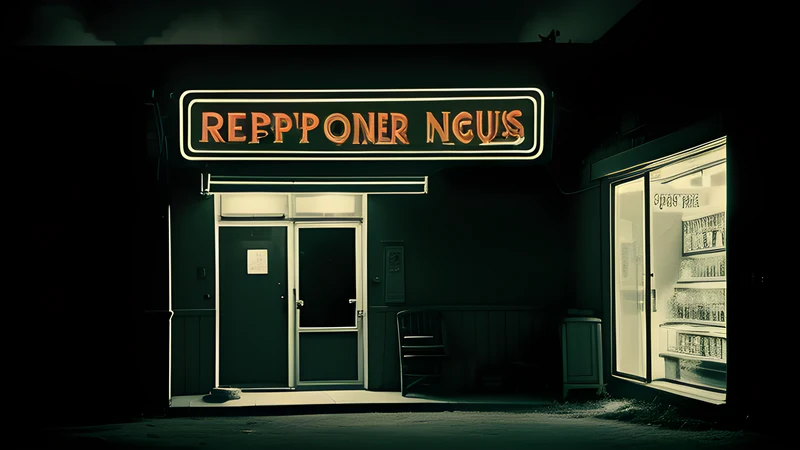
Ryan Samul’s cinematography completes it. He shoots the East Texas night in deep blacks with hard, coloured practicals — the neon of a bar sign, the red of a dashboard, a porch light making a small island. It is a film that understands darkness as a place where things are, rather than an absence of exposure.
The real ancestor is a Texas debut
The obvious cross-reference is Blood Simple, and it is the right one, but for a more specific reason than the shared state. The Coens built their debut around characters acting decisively on wrong information; Cold in July is built around a man who is told a thing by an authority and believes it, and whose entire ordeal follows from the fact that the telling was convenient. Both films are about the lethal gap between what happened and what people were told happened. Both are also very funny in places, in a way that is nearly impossible to describe without sounding like you have misread the film.
The other ancestor is the one everyone skips: this is a Lansdale adaptation, and Lansdale’s real inheritance runs back through the paperback originals of the fifties and sixties — the Gold Medal school, where a novel could open as a domestic drama and end as an atrocity because nobody was policing the genre boundary. If you want the cinematic version of that unpoliced quality, look at how No Country for Old Men removes the thriller’s promised confrontation and dares you to complain. Cold in July is doing the mirror trick: it keeps promising a smaller film and delivering a larger, uglier one.
And Don Johnson’s performance — a Houston private investigator who raises pigs, drives a red convertible and is delighted by absolutely everything — is a direct descendant of the wisecracking noir sidekick, played by a man who spent the eighties being the coolest person on American television and is here enjoying himself so much it is nearly a different film.
The case against
The swerves cost the film its women. Dane’s wife Ann (Vinessa Shaw) is set up as a person with a view, and then the last hour is three men in a car and she is a phone call. The novel has the same problem, and the adaptation does not fix it. Once the film commits to its final register, it becomes a story about fathers, sons and what men owe each other, and everyone else evaporates.
There is also a tonal seam in the third act that some viewers will find unbridgeable. The film travels from a small, credible domestic nightmare to something genuinely lurid, and it asks you to travel with characters who have been established as ordinary. Mickle’s bet is that Shepard, Hall and Johnson can carry you across on charisma. He is mostly right, and there are ten minutes where he is not.
The film is also, plainly, three thirds. The first is the best. If you want a perfect film, this is not it. If you want a film that is willing to risk itself, there is not much competition.
Where it leaves you
Cold in July premiered at Sundance in 2014 and has quietly become one of those titles that gets pressed into people’s hands. It is on the usual services and has a disc release worth owning for the score alone. Mickle’s earlier films — Stake Land, We Are What We Are — are worth the detour if you want to see a director learning to shoot night exteriors on no money.
And read the Lansdale. The novel does something the film cannot: it lets you hear Dane’s internal narration curdle in real time.
Spoilers below
The first swerve is the good one. Dane, hounded by Ben Russell and terrified for his family, sees a wanted poster and realises the man he shot was not Freddy Russell. The police knew. Ray Price, the local officer, knew — the sheriff’s department had a corpse to dispose of and a convenient dead-man’s identity to hang on it, and Dane’s living room was where it landed. So the film’s entire first act, the guilt and the siege and the terror of a father’s revenge, was built on a lie told for administrative convenience. That is a genuinely brilliant hinge, because it works retroactively: Dane is converted from a killer into a dupe, and Ben from an avenger into another dupe. The two men who have spent thirty minutes circling each other are now the only two people in town who have been told the truth.
The second swerve is the risk. Freddy Russell is alive, in witness protection, and involved in the production of snuff films. Dane, Ben and Jim Bob Luke — Don Johnson’s pig-farming investigator, an old Korean War comrade of Ben’s — go looking, find a VHS tape, and watch it. Mickle shoots the tape’s discovery with the camera on the men’s faces rather than the screen, which is the single most disciplined decision in the film: we never see what is on it, and Shepard’s face is worse than any footage would be.
From there the film becomes a straight-up vigilante western. Three armed men assault a house. Ben, having spent the entire film as a threat, is now the one who has to kill his own son, and Shepard plays the sequence with a terrible flatness — a man completing a task he has already accepted. He takes a fatal wound and does it anyway. Dane, the framer with the mullet, does the actual shooting, and Hall’s performance in that final gunfight is the payoff for everything: he does not become competent. He becomes willing, which is worse and lasts longer.
The final image is Dane driving home in the daylight with blood on him, and Jeff Grace’s synth still pulsing underneath. Nothing has been resolved for anyone. The town still thinks he is a hero for the wrong killing, and he now is one for a killing nobody will ever know about. The film’s actual subject arrives only in that last minute: it is about a man who was handed a false story about himself by the state, and who had to commit a real atrocity to make the story true.
Related Content