Coherence: A Dinner Party and a Fracturing Universe
James Ward Byrkit shot a quantum nightmare in his own living room, and it works
Contents
There is a whole tradition of science fiction built on a single, terrifying idea and almost no money, and Coherence belongs near the top of it. James Ward Byrkit’s 2013 debut was shot over five nights in his own house, on a domestic camera, with a cast of eight actors who were never given a full script. It cost a rumoured fifty thousand dollars, most of which is invisible on screen because the film is set entirely at a dinner party. What Byrkit spends instead is dread, doled out with the patience of a man who knows exactly how little he needs to show you.
Eight friends, one comet
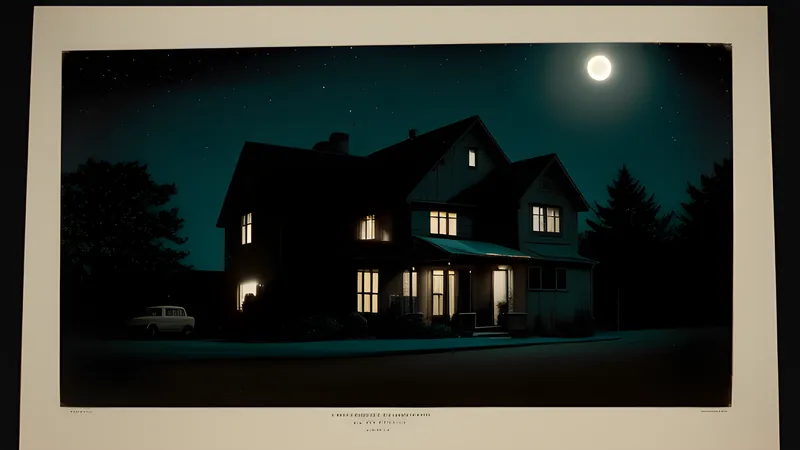
The premise is almost aggressively ordinary. Eight friends gather for dinner at Em and Kevin’s house on the night a comet — Miller’s Comet, invented for the film — is due to pass close to Earth. Wine is poured, old tensions surface, someone mentions a story about a previous comet that supposedly drove people to strange behaviour. Then the phones crack, a screen shatters for no reason, and the power goes out across the whole street except for one house two blocks down, where a single light burns. The friends begin to suspect that the comet has done something to the fabric of the night around them, and that the lit house down the road may not be another house at all.
To say much more about the mechanism would spoil the pleasure of watching intelligent people reason their way toward a horrifying conclusion in real time. The film’s engine is quantum: the loose, dinner-table version of Schrödinger’s cat and the many-worlds interpretation, in which every possibility spawns its own branch of reality. Byrkit takes that idea out of the textbook and drops it into a suburban cul-de-sac, then asks what would actually happen if the walls between those branches went thin for one night.
The improvisation is the special effect
Here is the craft decision that makes Coherence far better than its budget. Byrkit did not hand his cast a screenplay. Each actor received, on each of the five nights, a set of index cards describing only their own character’s knowledge, motivation and secrets for that evening — no dialogue, no sense of where the plot was heading. The scenes were then improvised, with the actors genuinely uncertain what the others knew or would do. Byrkit and his co-writer Alex Manugian (who also plays one of the guests) engineered the situation and let real confusion do the acting.
You can feel it working. The overlapping, interrupting, slightly abrasive rhythm of the dinner-party talk has a texture that written dialogue almost never achieves, because it is real people actually failing to hear each other, actually misjudging the room. When the paranoia arrives, it does not need to be performed; the actors are already off balance, already unsure whom to trust, and the film simply tightens the screw. Byrkit has said he wanted the actors to feel genuine social vertigo, and it shows in every hesitation. This is the same principle that powers the best found-footage horror — take away the actor’s map and the fear stops being a performance and starts being a condition. Byrkit’s masterstroke was realising that a quantum thriller, of all things, benefits most from a cast that does not know which reality it is in.
The look supports the method. The camera is handheld and restless, drifting around the table, catching reactions in the corners of frames, occasionally losing focus the way a home movie does. Byrkit shot with available and practical light, and when the power fails and the guests venture out into the dark street with glowsticks, the film’s visual grammar collapses into pools of coloured light and encroaching black. It feels less like a movie set than a real night that has gone quietly, catastrophically wrong.
Byrkit paces the escalation with real discipline. The first act is almost entirely social — grievances, an ex who has been invited without warning, the small cruelties of a group that knows one another too well — and none of it feels like set-up while you are in it. When the strangeness begins it arrives in increments a rational person could explain away: a dropped call, a cracked screen, a blackout. Each guest talks themselves out of alarm a little longer than the last, and the film lets that denial run exactly long enough to be recognisable before it snaps. By the time anyone accepts what is happening, the audience has been softened by an hour of ordinary friction, so the swerve into cosmic horror lands on people we already understand rather than on strangers in a premise.
The collector’s note
Coherence sits in the small, potent genre of the one-idea sci-fi puzzle box, and its nearest relatives are worth chasing. The most obvious is Timecrimes, another film that gets enormous mileage from a tiny cast, a single location and a mind-bending rule rigorously applied. The deeper kinship is with Primer, which shares the conviction that the audience should be made to work, and that a coherent underlying logic matters even when the film declines to hand it over. Where Primer is austere and technical, Coherence is warm and social, which makes its horror more intimate. The threat here wears the faces of the people you came to dinner with, and that domesticity is what gets under the skin. Casting Nicholas Brendon, best known from a certain long-running vampire show, as a washed-up actor haunted by his old series is a sly private joke about branching identities that the film never over-eggs.
The verdict
Coherence is one of the most efficient science-fiction films of its decade, and efficiency is exactly the right virtue to praise it for. It has no spectacle, no stars, no set-pieces, and it does not need them, because Byrkit understood that the scariest thing you can show an audience is intelligent people slowly working out something they would rather not know. The improvised method gives it a jittery authenticity that a polished production would have sanded away, and the quantum conceit, so easy to fumble, is handled with a light enough touch that you feel it in your stomach before you have fully diagrammed it in your head. It is proof that the genre’s most powerful resource was never money. It was a good idea, followed all the way to its cruellest conclusion. If it has a flaw, it is that the final ten minutes lean harder on plot mechanics than on the human dread that made the first hour so unbearable — a small price for a film this bold on this little.
Watch it cold, ideally, knowing as little as possible, and do not read past this line if you have not seen it.
Spoilers below
The horror of Coherence is that the branching does not produce one alternate house. It produces countless ones. Every time a character makes a decision, or ventures out into the dark, reality splits again, and the friends slowly realise that the versions of themselves in the other houses are doing exactly what they are doing — reasoning it out, growing frightened, deciding to investigate. There is no single “real” group. They are all real, and they are all interchangeable, which is the idea the film turns from a physics lecture into a source of genuine terror.
Em, the film’s centre, gradually understands this faster than the others. When the group tries to mark themselves as distinct — a glowstick colour, a numbered note, a small identifying object — the plan fails, because the other versions are marking themselves too, and the objects get shuffled between houses as people cross back and forth in the dark. Identity, the thing everyone assumed was fixed, turns out to be the one thing the night dissolves.
The ending is where the film commits fully to its own cruelty. Em, unable to bear the thought of returning to a version of her life she is unhappy with, goes house-hopping deliberately, searching the branches for the “best” version of her evening — the version where she made the braver choices. She finds one, and decides to stay in it, attacking and displacing the version of herself who belongs there. When morning comes and the comet has passed and the walls between worlds have sealed, she believes she has escaped into a better life. Then, over breakfast, a phone rings. Kevin is calling — and answers a call from Em, the other Em, the one still stranded out in the dark, meaning this new life she has stolen is already contaminated by the woman she displaced. Her face, in the final shot, is the face of someone realising there is no clean branch to run to, and never was. She did not escape the fracture. She became one more crack in it.
Related Content